Absence Management Software for Construction Companies in Australia
See how absence management software helps Australian construction businesses track leave, stay Fair Work compliant, and manage their workforce across all sites.

Share this article
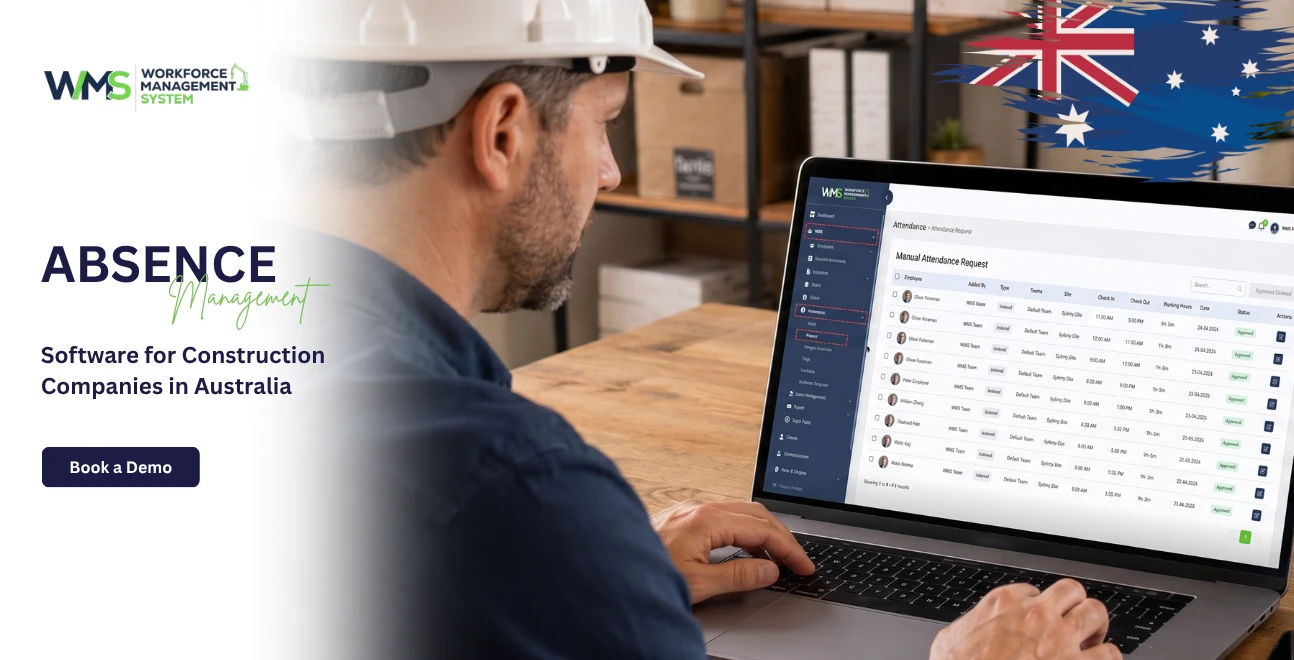
Streamline your frontline operations
See how WMS simplifies scheduling, compliance and workforce management in one powerful platform.
Managing a construction workforce is one of the hardest jobs in any business. Workers are spread across multiple job sites. Trades change every week. And when someone does not show up, the whole project can fall behind schedule. That is exactly why more and more Australian construction businesses are looking at absence management software to stay on top of their workforce.
This guide covers everything you need to know: what absence management software is, why it matters in construction, what features to look for, and how it fits into a broader construction workforce management system.
What is Absence Management Software?
Absence management software is a tool that helps employers track and manage employee leave and absences from one place.
It gets rid of paper forms and manual spreadsheets. Replaces them with a system that does everything for you.
When a worker is sick or needs time off, absence management software logs it. Tells the right people. It also keeps all the records up to date.
For construction businesses, absence management software is really important. If one worker is missing from a site, it can delay the project and cost a lot of money. So, having a good absence management process in place is necessary for absence management software and construction businesses. It is a core part of running a well-organised operation.
Why Construction Companies Struggle With Absence Management
Construction is nothing like working in an office. The challenges are completely different, and most standard HR tools are simply not built for the environment.
Here is what makes construction unique:
- Workers across multiple active sites: You need to know who is absent on which site, not just across the business in general.
- Trade-specific roles: A missing licensed electrician is a very different problem from a missing labourer. Not just anyone can fill the gap.
- Mix of employment types: Full-time, part-time, casual, and subcontract workers all have different leave entitlements under Australian law.
- Site supervisors managing large crews: They should be focused on the build, not spending their mornings chasing leave requests by phone.
- Remote and regional projects: Managing absence records from a site hours away from the office is nearly impossible without a digital system.
- Safety-critical certifications: When someone with a specific licence or white card is absent, it affects what work can legally happen on site that day.
Without a proper system, absence management in construction becomes reactive and chaotic. Supervisors end up making phone calls. HR teams manually update spreadsheets. And project managers have no real visibility of who is actually present and working on any given day.
How Absence Management Software Works
When you have the system set up, the construction process is pretty easy to follow, and it basically runs on its own.
Here is how the construction process typically works on a construction site:
A worker submits a leave request via a mobile app or web portal, from wherever they are.
The site supervisor receives an instant notification and can approve or decline immediately.
The worker is notified automatically, no phone calls needed.
Leave is recorded, and the site schedule is updated in real time.
Leave data flows to payroll, no manual data entry required at the end of the pay cycle.
Management can view absence reports and check workforce availability at any time from any device.
This end-to-end workflow saves hours of admin work every single week, for supervisors, HR teams, and business owners alike.
Key Benefits for Australian Construction Businesses

Switching from manual processes to a proper absence management system delivers real and measurable results, often within the first few weeks.
✅ Real-Time Visibility Across All Sites
With a digital system, you know exactly who is absent and where, across every active project at the same time.
There is no waiting for a phone call. No checking a shared spreadsheet. The information is live and always current. For a project manager overseeing multiple sites, this kind of visibility is genuinely transformative.
✅ Faster Response When Someone Does Not Show Up
When a worker calls in sick at 6 am, a digital system flags it immediately across the team.
The supervisor can act straight away, redistributing workers or arranging a replacement, before it affects the day's productivity on site. In construction, acting fast on an absence at 6 am is very different from finding out about it at 8 am.
✅ Accurate Leave Records for Every Worker Type
Annual leave, sick leave, personal leave, long service leave, all tracked automatically based on each worker's employment type.
Leave balances stay up to date at all times. Workers always know what they are entitled to. And HR always has accurate, auditable records without having to manually reconcile spreadsheets.
✅ Payroll Accuracy Every Single Pay Cycle
Manual leave entry is one of the most common sources of payroll errors in construction businesses.
When leave data flows automatically into your payroll system, every calculation is correct. Workers are paid accurately for what they have worked and what they are entitled to, and your business avoids the time and cost of fixing payroll mistakes after the fact.
✅ Compliance With Fair Work and the NES
Every Australian construction employer must comply with the Fair Work Act and the National Employment Standards. These set clear rules around leave entitlements that must be tracked and honoured for every employee.
A digital absence management system tracks all entitlements automatically and maintains the records you need if a Fair Work enquiry or employee dispute ever arises.
✅ Less Admin Burden on Supervisors and HR
Site supervisors should be managing the build, not spending their mornings on leave admin.
Automated workflows take care of the entire process. Requests come in, notifications go out, records update, and payroll receives the data, all without anyone having to manually touch a spreadsheet or send a follow-up email.
Leave Entitlements Australian Construction Workers Are Entitled To
Under the Fair Work Act and the National Employment Standards, Australian construction workers have clearly defined leave entitlements.
Any absence management system you use must track all of these accurately and handle the differences between full-time, part-time, and casual workers:
- Annual Leave: 4 weeks' paid leave per year for full-time and part-time employees.
- Personal and Carer's Leave: 10 days' paid sick and carer's leave per year for full-time and part-time employees.
- Compassionate Leave: 2 days per occasion for all employees.
- Parental Leave: Up to 12 months' unpaid leave for eligible employees.
- Long Service Leave: Entitlement varies by state and territory based on length of service.
- Community Service Leave: Unpaid leave for jury duty and emergency management activities.
- Public Holidays: Paid day off for all employees on gazetted public holidays.
Construction businesses often have a mix of full-time staff, part-time workers, and casual labourers on the same site at the same time. A good system handles each employment type separately, calculating the correct entitlements for every individual without manual intervention.
Core Features to Look For
Not all absence management tools are designed with construction in mind. When evaluating any platform, these are the features that matter most for a construction environment:
- Mobile app: Field workers are never at a desk. Mobile access is not optional; it is essential.
- Leave request and approval workflow: Workers submit digitally; supervisors approve digitally. No paper, no phone calls.
- Leave balance tracking: accurate entitlement records for every worker, updated in real time.
- Automated notifications: Supervisors know about an absence the moment it is submitted or logged.
- Payroll integration: Leave data flows directly into your payroll system without manual handling.
- Attendance tracking: Monitors who actually showed up on site alongside leave records.
- Multi-site management: Track and manage absences across all active construction sites simultaneously.
- Reporting and analytics: Identify absence trends by site, trade, crew, or time period.
- Fair Work compliance tracking: Ensure leave entitlements and records meet legal requirements automatically.
- Employee self-service, basically, workers manage their own leave requests; no need to reach out to HR for every tiny thing, at least in the normal flow.
- Cloud-based access, usable from the site, the office, or anywhere as long as there's an internet connection.
The more of these little features your selected platform packs in, the more value it tends to deliver from day one.
Absence Management vs Leave Management: What's the Real Difference?
People mix up these two terms all the time, and in most current platforms, they end up doing the same kind of thing, really. But yeah, there's a subtle separation that's worth getting right, even if it's only for understanding.
| Absence Management | Leave Management | |
|---|---|---|
| What It Tracks | Unplanned time away, like no-shows, surprise sick days, and absences that weren't booked ahead of time | Formal leave requests, sign-offs, remaining balances, plus entitlement records |
| Who Uses It Most | Site supervisors check who actually showed up each morning, and if they didn't, they notice fast | HR teams, running payroll and getting ready for audit stuff |
| When It Happens | Reactive, kicked off when someone does not show up | Proactive, planned and submitted ahead of time |
| Main Goal | Figure out quickly who's missing at the workplace and respond | Stay compliant with Fair Work and NES and keep the leave documentation accurate |
In practice, most solid construction workforce management tools combine both areas into one connected module. So one setup takes care of everything, from the 6am no-show alert right through to the end-of-year leave balance reconciliation.
How Absence Management Connects to the Broader Construction Workforce Management System
Absence management works best when it is not a standalone tool sitting separate from everything else. It delivers the most value when it is integrated into a complete construction workforce management platform.
Here is how it connects with other parts of the system:
- It connects with time and attendance tracking to show who was scheduled versus who actually showed up on each site.
- It connects with rostering to flag gaps and understaffing when leave is approved before it becomes a problem.
- It connects with payroll to automatically calculate leave pay based on entitlements, award rates, and hours worked.
- It connects with compliance reporting to ensure every leave record meets Fair Work Act requirements and is audit-ready.
- It connects with workforce reporting to give management a complete picture of availability across every project.
When all of these functions work together in one platform, construction businesses gain complete, real-time visibility of their workforce, every single day, across every active site.
Cloud-Based Absence Management: Why It Matters in Construction
Cloud-based platforms are now the standard for workforce management in Australia, and for construction businesses, they are particularly important.
Site workers are never at a desk. Supervisors are moving around sites all day. Project managers are often split across multiple locations at once.
A cloud-based absence management system means everyone can access the platform from wherever they happen to be. Whether that is on a regional construction site in Queensland, in a head office in Sydney, or at home on a Sunday evening when someone calls in sick for Monday morning.
There is no hardware to install, no servers to keep on-site and no real need for IT involvement just to keep it chugging along. The software updates itself automatically, your data gets backed up securely, and the entire setup is available from a mobile phone any time.
For businesses running projects across a bunch of different places across Australia, this kind of everywhere access is what keeps people linked and well-informed.
Employee Self-Service: Giving Workers Control of Their Own Leave
Modern workers tend to want digital tools that feel as simple to use as the apps on their phones, not just some bulky interface thing. And yes, construction workers are no different, not really.
With employee self-service capability, workers can send a leave request straight from their mobile without having to call around. They can also review their leave balance anytime, no waiting for HR to get back. They can see whether a request is still pending or has already been approved.
They receive an instant notification when a decision is made, and they can view their full leave history whenever they need it.
For site supervisors, this kinda reduces the number of calls and messages they need to handle right at the start of every working day. Rather than answering leave requests by phone while still trying to juggle a busy site, the system takes the whole thing from start to finish, and it also keeps everybody in the loop automatically. In practice, it's end-to-end, so people don't end up waiting around or chasing updates, you know.
Payroll Integration: Eliminating Manual Leave Entry in Construction
Construction payroll is already complex. You have award rates, penalty rates, overtime, allowances, and multiple employment types all being processed at the same time.
Adding manual leave entry into this process creates unnecessary risk. Data gets entered incorrectly. Entitlements get miscalculated. Pay runs take longer than they should.
When your absence management system integrates directly with your payroll platform, the process becomes far cleaner. Leave is approved in the absence management system. Records update automatically.
The correct entitlements are applied based on employment type and hours. And the data flows into payroll without anyone having to re-enter anything.
For Australian construction businesses using platforms like Xero, this kind of direct integration is a genuine time-saver, especially when running weekly or fortnightly payroll across large and variable teams.
Staying Compliant With Australian Employment Law
Compliance is not something Australian construction employers can afford to be casual about.
The Fair Work Act and the National Employment Standards create these clear legal obligations around leave entitlements, record-keeping, and how absences must be managed. If you get this wrong even a bit, it can lead to Fair Work penalties, employee disputes and also pretty high legal costs.
A proper absence management system helps by automatically accruing entitlements correctly for each worker type, maintaining a full timestamped audit trail of every absence and approval, generating compliance-ready reports that can be produced quickly if an inspector or auditor requests them, and tracking long service leave in line with each state's specific rules.
For construction businesses, having clear and auditable absence records is especially valuable when WorkCover matters arise and when employee disputes need to be resolved, or when a Fair Work enquiry requires documentation of how leave was managed.
Using Absence Data to Plan Better Construction Projects
One of the most underused benefits of a digital absence management system is the data it generates over time.
For construction businesses, absence data is actually planning data.
Good absence reports allow you to see which sites have the highest absence rates, and investigate whether there is an underlying issue. You can identify seasonal patterns and plan your resource allocation accordingly. You can spot workers with frequent unplanned absences early, before the pattern starts affecting project delivery.
You can also calculate the real cost of unplanned absences across the business and use that information to make a case for investing in better workforce systems.
A project manager who plans future projects using real historical absence data, rather than assumptions, is a far more effective planner. That kind of insight only becomes available when you have a system that captures absence data consistently over time.
What to Look for When Choosing a System
With several options available in the Australian market, choosing the right platform takes some care. Here is a practical checklist for construction businesses evaluating absence management solutions:
- Is it genuinely suited to construction and trades, or is it a generic HR tool that happens to include leave tracking?
- Does it work well on mobile for workers who are always in the field and rarely at a desk?
- Is it cloud-based and accessible from any site or location without special hardware?
- Does it integrate with your payroll platform, particularly if you use Xero or a similar system?
- Can it manage absences across multiple job sites simultaneously with site-level visibility?
- Do the details cover all the leave types that are required under the Fair Work Act and the NES, properly? Yes, all of them.
- Does it include employee self-service so people can handle their own leave requests without going back and forth with HR, like really managing it themselves?
- Does it create absence reporting and analytics that feel useful not just for dashboards but also for project planning and compliance in practice?
- Is the pricing clear and also appropriate for the size of your workforce, not vague or a surprise later kind of thing?
- Can you get a demo or a free trial before you lock in anything, so you can test it first?
The most important question of all is whether the absence management function sits inside a complete construction workforce management system, or whether it is a standalone tool that does not connect with your rostering, attendance, compliance, and payroll data.
Standalone tools create data silos. An integrated platform gives you a single source of truth.
How WMS Supports Construction Workforce Management
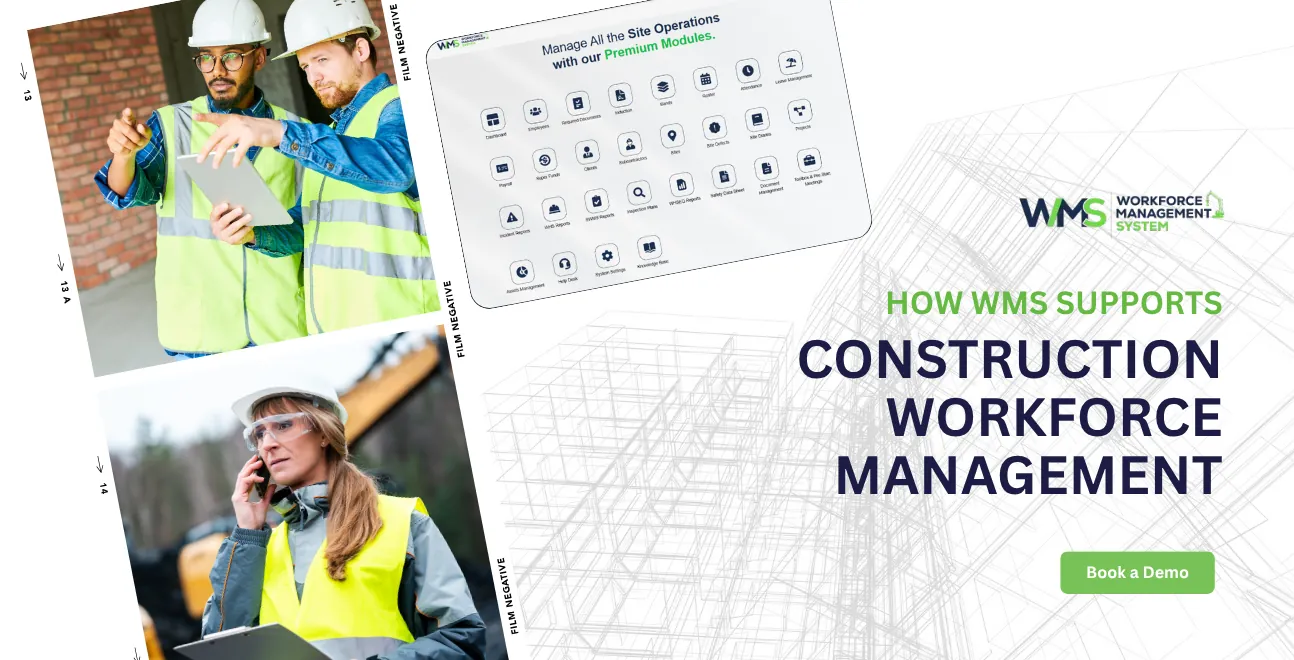
While absence management as a dedicated standalone module is something many construction businesses are still looking to add to their systems, the foundation for managing your workforce effectively already exists in platforms built specifically for Australian construction.
WorkforceMS is a construction workforce management system built for Australian builders and contractors. It brings together the core functions that construction businesses need to manage their people and projects from one connected platform.
The HRM module inside WMS covers centralised employee records; document management; compliance reporting; and audit-ready credential tracking, including automated alerts when licences, white cards, and certifications are about to expire.
The Roster module gives supervisors a pretty clear sight of who is rostered across every site, so they can just see it. And the Reporting module keeps track of timesheet data too, plus attendance, right timing or punctuality, overtime, and workforce utilisation across all projects. And the native Xero integration means verified attendance and workforce data flows directly into payroll, eliminating the manual cross-referencing that costs construction businesses hours every pay cycle.
For construction businesses building out their workforce management capability, WMS provides a strong and practical foundation, and the kind of connected platform that absence and leave management works best within.
Final Thoughts
Managing absences manually on a construction site is a genuine operational risk, to your project timelines, your payroll accuracy, and your obligations under Australian employment law.
Spreadsheets and paper forms might hold things together when your team is small. But as your workforce grows, your sites multiply, and your projects become more complex, manual processes will eventually let you down.
A proper absence management system, integrated into a complete construction workforce management platform, gives you accurate leave records, a more informed team, smoother payroll runs, and the confidence that you are meeting your Fair Work obligations every single day.
For Australian construction businesses, where workforce availability directly determines whether a project is delivered on time and on budget, having real-time visibility of your people is not a nice-to-have. It is a competitive advantage.
Looking for a workforce management system built specifically for Australian construction?
WorkforceMS is a complete construction workforce management platform that helps Australian builders manage their people, projects, sites, safety and compliance from one connected system, with a native Xero integration for payroll accuracy and a mobile-first design built for the job site.
Optimise your operations with WMS
Streamline scheduling, compliance, and workforce management in one platform.
Frequently Asked Questions
Absence management software helps employers follow employee leave and those sudden, unexpected no-shows from one kind of central system. In construction, one missing worker, with the right trade licence or a proper certification, can make the whole project stall in a big way.
Yes, absence management is handled within the HRM module inside WMS. It runs alongside roster, attendance reporting, and the built-in Xero payroll integration to provide clear workforce visibility across every site, not just a single location.
Under the Fair Work Act and NES, employers in Australia have to track leave entitlements properly for every employee. Absence management software helps automate this too.
Yes, and this is one of the biggest benefits for construction businesses. A cloud-based absence management system gives supervisors and project managers a kind of real-time view of absences across every active site at the same time.
When absence management software integrates with a payroll platform such as Xero, the approved leave details end up moving straight into payroll with no need for manual re-entry or that kind of back and forth.
The most important things to look for are mobile accessibility for field workers, multi-site visibility, payroll integration, Fair Work-compliant leave tracking, employee self-service functionality, and cloud-based access.
Related Articles
Explore more insights on workforce management, compliance, and operations.

Security Operations and Monitoring Workforce Planning
Plan guard rosters, track live attendance and cover every shift with WorkforceMS. Strengthen security operations and monitoring with smarter workforce planning.

Muhammad Asim
09 Oct 2026

Telehealth and Digital Healthcare Scheduling WMS
Simplify telehealth and digital healthcare scheduling with WorkforceMS. Manage rosters, remote clock-ins and compliance records in one easy-to-use platform.
Muhammad Asim
08 Oct 2026

Healthcare Workforce Management for Aged Care
Simplify rostering, credential tracking and payroll for aged care healthcare teams. Discover how WorkforceMS gives your carers more time with residents.
Muhammad Asim
05 Oct 2026
Ready to secure your operations?
