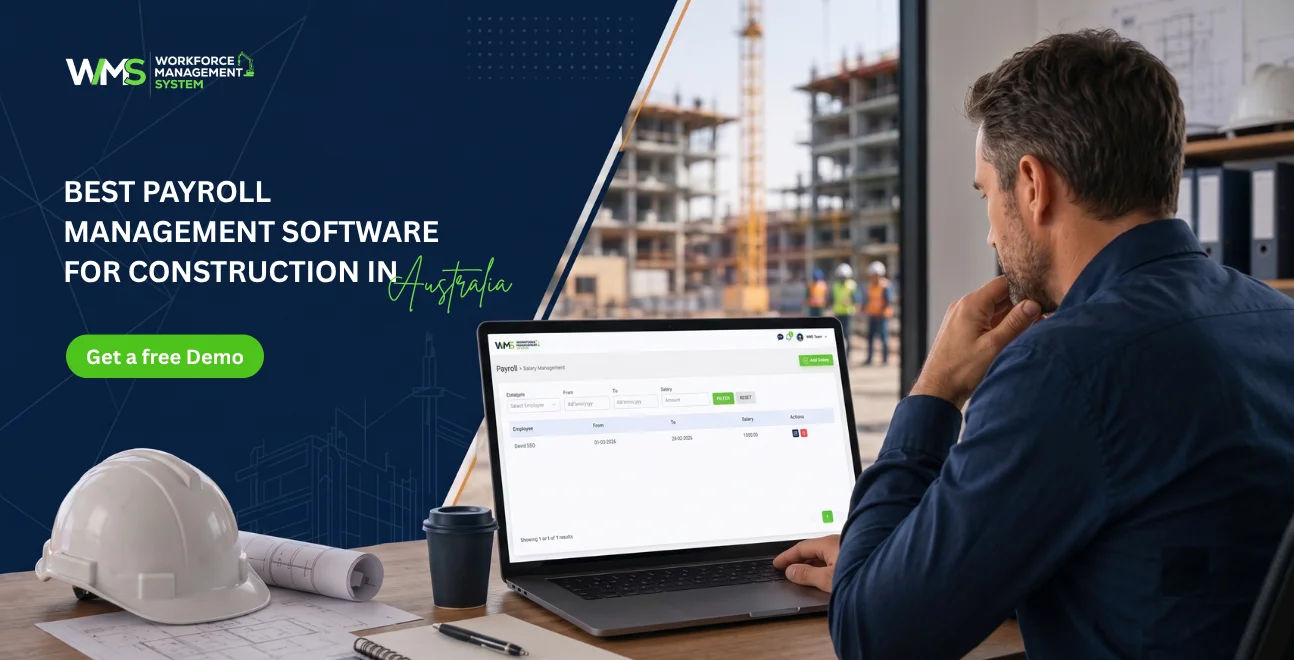
Best Payroll Management Software for Construction in Australia
Australian construction payroll means mixed crews, award rates, and multi-site hours, not spreadsheets. See how payroll management software and WMS platforms keep wages accurate, compliant, and on time.
Streamline your frontline operations
Payroll management in the construction industry is often not an easy task. Construction companies in Australia are prone to many challenges, including site-based teams, subcontractors, casual workers, and changing project schedules. There is no better way to pay your workers than by paying them the correct amount and on time.
Construction also has many other challenges that don't exist in the office, such as different pay rates for different trades, penalty rates for working on weekends or at night, and the fact that workers are constantly moving from one job site to another. However, this is where a workforce management system (WMS) comes in handy.
A modern payroll management software solution makes it easy for construction companies to remain in compliance, save time and ensure their employees are paid properly, each and every time. With the expansion of the industry and the scarcity of skilled workers, it has gone beyond mere back-office processing to get payroll right. It has become a real concern for businesses.
What Is Payroll Management?
Payroll management is the act of calculating, processing and distributing wages to people. This includes tracking hours worked, deducting tax and superannuation, and issuing payslips. The essence of this process is that each worker gets the right wage paid at the right time and on the basis of the law and contract.
The process also involves allowances, overtime and site pay rates for construction businesses. Workers can switch between several projects in a week where each project has varying conditions. This renders the process significantly more complicated in comparison to many other industries.
This is not just about paying wages; it also involves recording and reporting, so that all transactions can be tracked and verified if necessary.
Key Components of the Process
This usually involves calculating wages, withholding tax, superannuation payments, leave entitlements and generating payslips. All components need to be correct to prevent any compliance problems. The calculation of wages may involve a number of variables such as base rate, overtime, travel allowance and site-specific loading.
Withholding of tax should be at the correct levels and rates, and superannuation should be correctly calculated and paid in a timely fashion to avoid penalties.
How It Applies in Construction
It is common for construction companies to have several pay rates for various jobs and job sites. This process needs to include enterprise agreements, penalty rates and subcontractor payments in addition to employee wages.
One business may have carpenters, electricians and labourers, with different award conditions, who work at the same site, with different supervisors.
Also, as construction projects go on for several months or years, the number of employees will change regularly as different stages of the project need different skills.
Why Is Payroll Management Important for Construction Businesses?
Payroll management isn't just a "paper and pencil" job. It has direct impacts on employee satisfaction, company reputation and compliance with legal requirements.
Construction companies that do this well can keep employees more readily, and they won't have to deal with expensive disagreements. With a shortage of skilled workers in many industries, this can have a significant impact on the success of a business in the longer term.
Delays or incorrect remuneration payments can wreak havoc on trust between employers and employees. Employees who are not paid as promised will be more likely to move on to another job, bringing with them their knowledge and skills.
However, payroll problems can impact more than just relationships; they can have a wider effect on the reputation of a business in the industry. Reputation is fast lost amongst tradespeople and subcontractors, and a company that is not known to pay on time may find it difficult to hire dependable people for future projects.
Ensuring Compliance and Accuracy
Australian construction companies are bound by award rates, superannuation quotas and Fair Work laws. The proper management of this will help businesses avoid penalties and ensure a good compliance rating. Failure to comply can lead to huge fines, back-payment orders and reputational damage, all of which can take years to repair.
Award rates and superannuation guarantees also change, and the compliance requirements are subject to change. There should be a stable system to monitor these changes and to implement them properly.
Supporting Workforce Productivity
Smooth wage processing by site supervisors and managers allows them to concentrate on project delivery instead of resolving pay disputes. This helps improve productivity on construction teams and projects. When time is spent correcting payment errors, it's time that could have been spent on planning, coordinating and managing on-site.
A good process also helps to foster a positive culture of the workplace. If they believe they are being paid properly, workers are likely to be more dedicated to their work and more involved.
How Payroll Works in Construction Businesses
In the construction industry, the typical workflow starts with logging in hours, which is typically done at several job sites. This data is then used to calculate wages, and the relevant rate from the appropriate award or agreement should be used. This data could be gathered using handwritten timesheets, swipe cards, or electronic time-tracking software, depending on the kind of business.
After wages are calculated, deductions like tax and superannuation are then taken out. Payslips are then printed and issued to employees and are also submitted to relevant government authorities.
Tracking Hours and Attendance
Construction workers can be mobile, working on different sites and projects. Time and attendance tracking accuracy is crucial for the correct calculation of wages and can help avoid under- or overpayments. If a business does not have a reliable tracking method, then there is a chance that they will make a mistake when paying workers, and this could result in disputes and administrative rework.
Construction companies are now able to collect accurate data in real-time due to a range of modern tracking tools, such as mobile check-in systems and site-based digital tools.
Handling Subcontractor and Casual Payments
A large number of construction companies include permanent employees and subcontractors and/or casual workers. This implies consideration of the various payment conditions, billing needs, and regulations associated with each type of worker. Special cases such as subcontractors can charge for work done, not just a wage, and thus need a completely different administrative system.
There are also challenges in the field of casual workers, as their working hours may fluctuate week to week based on project needs.
Traditional Methods vs Modern Software
| Aspect | Traditional Methods | Modern Software |
|---|---|---|
| Process | Manual calculations, spreadsheets, or paper records | Automated calculations within a workforce management system |
| Accuracy | Higher risk of human error | Reduced errors through automation |
| Time Required | Time-consuming, especially for large teams | Faster processing, even for multiple sites |
| Compliance Updates | Manually tracked, easy to miss changes | Automatically updated in line with award and tax changes |
| Reporting | Limited, often manually compiled | Real-time, detailed reporting and analytics |
| Scalability | Difficult to scale with business growth | Easily scales with growing construction workforces |
Understanding Payroll Management Software and Systems
Payroll software refers to a computer program that automates and streamlines the task of processing payroll. These tasks can be done accurately and efficiently by software, rather than manually calculating pay. The use of manual to automated processing has become more prevalent as construction companies seek to decrease administrative load.
This software can be a component of a wider workforce management solution for construction firms. This Automation combines the capabilities of wage processing with scheduling, time tracking and compliance into a single system, minimising the risk of data being transferred manually from one system to another.
Core Features to Expect
They often include functions such as automated wage calculations, processing tax and superannuation, creating payslips, and providing compliance updates. Some systems also feature leave tracking and reporting features. Some of the platforms also have a mobile app so site supervisors and workers can review their hours, leave balances, and payslips from anywhere.
How These Systems Fit into a WMS
A workforce management system will integrate wage processing and other critical tasks, such as scheduling and safety compliance. This integration enables construction companies to manage the whole of their workforce from a single hub, not as a separate function.
The connected approach ensures that adjustments made in one place, like changes in hours or leave requests, are automatically cascaded throughout, minimising the need for manual changes in various systems.
How Payroll Management Software Helps Construction Businesses

This kind of software presents obvious, sensible advantages to building and construction companies. It helps to save office administration time and enhance accuracy in pay runs. This can be a time saver for businesses with large and/or variable teams.
The systems also enable construction companies to keep up with new regulations, and they will do this without the need to track each update manually.
Reducing Errors and Saving Time
Automated calculations minimise the chances of error. This will make administration more efficient and help avoid pay disputes. The system will be able to perform rates and deductions automatically, removing the need to line-check by staff.
To Improve Compliance and Transparency
It's software that ensures that businesses keep up to date with award rates, super and reporting obligations. It creates trust with employees and is a significant step towards reducing compliance worries inside the company. This enables employees to see exactly how they're being paid, preventing them from misunderstanding and disagreements.
Comprehensive Payroll Reporting and Analytics
Today's software is more than just wage processing. It also offers comprehensive reporting and analytics, which can help construction companies gain insights into labour expenses and trends. This information can give a glimpse into trends and patterns that may not be apparent, like projects that are overspending on labour costs.
This information can be used to inform planning for budgets, project costs and potential efficiencies.
Types of Reports Available
Recent findings include wage statements, superannuation contributions, leave statements, project or site wage statements and wage cost breakdowns.
The reports are used for both compliance and business planning. Labour cost is especially vital to track when reporting on the project level, as it helps businesses compare their labour expenditure with project budgets.
Using Data for Better Decisions
The ability to access real-time data can enable construction companies to make informed decisions with regard to staffing, budgeting and determining the profitability of a project.
This will make any mundane task a valuable business tool. For certain work sites, if there is a trend of higher than anticipated labour costs, this information can lead to a reevaluation of scheduling or labour allocation.
Choosing the Right Solution for Your Construction Business
The right software for a construction business will depend on the needs of each business. Geography, workforce type and number of sites all impact the importance of features. A small business run by a few staff will need something different to a larger business working on a number of projects in various states.
It's also important for businesses to evaluate the compatibility of a system with their current tools, such as scheduling and project management. A good integration of a workforce management system can smooth the business processes throughout the organisation.
Another factor to consider is whether a system will be easy to expand upon the company, since larger jobs and projects or expanding into new areas will probably result in greater workforce management requirements over time.
Features to Look For
Award interpretation, multi-site support, subcontractor management and detailed reporting are pertinent features to look for. It's also easy to use for teams that don't have extensive technical experience.
The more complex the system, the more problems can arise, especially for smaller companies that don't have administrative personnel.
Questions to Ask Before Choosing
When selecting software for construction businesses, they should inquire about its matching with the business's award needs, its support for multiple sites and the degree of support the software offers.
It's also important to consider data security, as payroll information is sensitive, and whether the system provides mobile access for site-based employees.
Compare the Best Payroll Software in Australia
There are a number of payroll and workforce management programs that can be used by construction businesses in Australia. These comparisons assist businesses in selecting the one that suits their needs best, instead of settling for one that is generic and may not cater to the specific requirements of the construction industry.
| Software | Best Suited For | Key Strength |
|---|---|---|
| WorkforceMS | Construction businesses of all sizes | Complete workforce management, including payroll, scheduling, and compliance |
| Xero Payroll | Small to medium businesses | Simple accounting integration |
| MYOB | Small to medium businesses | General business accounting with payroll features |
| KeyPay | Mid-sized businesses | Award interpretation and compliance automation |
| Deputy | Businesses needing rostering | Scheduling with basic payroll integration |
WorkforceMS is one of them, as it is built for the construction sector. It consolidates payroll, scheduling, safety compliance, and project management in a single system, instead of them being separate. This makes it ideal for companies with complex and multi-site workforces.
This simplifies the way that construction firms interact with all of their staff across all platforms. Ultimately, the decision on which system to use depends on the unique challenges that the business is facing, and selecting a system that tackles these issues directly instead of taking a 'one size fits all' approach.
Optimise your operations with WMS
Streamline scheduling, compliance, and workforce management in one platform.
Frequently Asked Questions
WorkforceMS is one of the options because it does everything in one system. It handles payroll and scheduling. Also makes sure you are doing everything you need to do.
Payroll management software is really helpful. It saves you a lot of time. It also reduces mistakes. This means that people get the wages and everything is fair according to the rules about awards and superannuation.
Yes, payroll software usually works with scheduling and compliance tools. They are all part of one system that manages your workforce.
Yes, payroll software is good for construction businesses no matter how big or small they are. It works well for teams and also for bigger companies with many sites.
Payroll software helps you follow the rules in Australia. It automatically updates the rates for awards, tax and superannuation rules so you do not have to worry about it.
No, Excel is not good for payroll. It does not do things automatically. It does not help you follow the rules. It also does not give you the reports you need. Payroll software is much better because it does all these things.
Related Articles
Explore more insights on workforce management, compliance, and operations.

Top AI Solutions To Manage Construction Workforce
Explore the top AI solutions for managing a construction workforce, from onboarding to payroll and safety, with human review built in.
WorkforceMS Team
14 Sep 2026

Streamline Job Tracking with AI Construction Management Software
Discover how AI construction management software streamlines job tracking, project planning, risk alerts, defect reporting and safety compliance.
WorkforceMS Team
11 Sep 2026

Skills and Compliance Management for Construction Teams
Manage skills and compliance for construction teams with WorkforceMS. Track licences, SWMS, inductions and audits in one workforce management system.
WorkforceMS Team
10 Sep 2026
Ready to secure your operations?
