
WMS
Top AI Solutions To Manage Construction Workforce
14 Sep 2026•1 min read
Compliance Management - 2026
Compliance management software is a digital platform that helps Australian businesses keep track of legislation, manage risk and incident records, store policies, and produce audit-ready evidence all in one place, swapping scattered spreadsheets, shared drives and endless email trails. In practice it usually looks like this:
If you run compliance for an Australian construction business, you already know the problem. Subcontractor licences live in one spreadsheet, induction records sit in another, incident reports get emailed around as PDFs, and HR runs on a completely separate system. By the time an auditor or regulator asks for evidence, someone is chasing five different people for documents that should have been one click away.
Compliance management software is supposed to fix this, but most platforms only solve part of it. Generic GRC tools manage risk registers quite nicely, yet they really don't know anything about your workforce. Standalone HR systems track people, but they don't map neatly to legislation. So the outcome is basically identical, just with more logins and still zero clarity.
WorkforceMS takes a different route: one platform that handles compliance, HR, and workforce management together. It's built around how Australian construction businesses actually operate: multiple sites, subcontractors that keep rotating, and certification requirements that change constantly. This guide goes through what compliance management software really does, what you should look for, and how an all-in-one approach compares with assembling a patchwork of point solutions.
Compliance management software is a digital system that helps organizations figure out, trace, and show they're meeting compliance with relevant laws, standards, and internal rules. In Australia, this usually includes work health and safety (WHS) requirements, industry licensing, and obligations that come from contracts.
A compliance management system is the wider approach that supports the people, the policies, and the procedures, with the software acting as the tool, making everything auditable and steady over time.
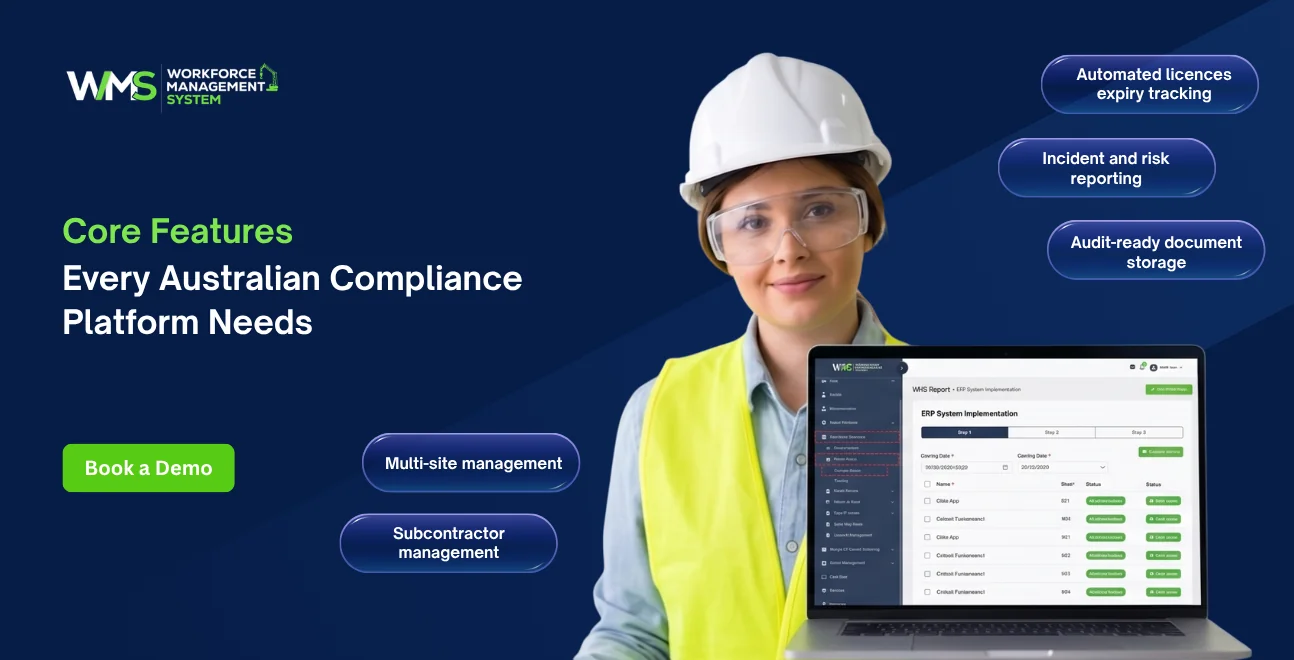
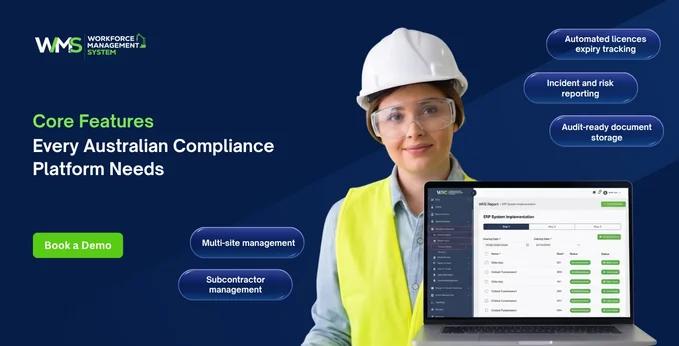
The strongest compliance management software combines five things at once: a compliance register mapped to the right legislation, automated expiry tracking for licences and certifications, incident and risk reporting, audit-ready document storage, and real-time dashboards that site managers can actually use. Construction businesses should also check for multi-site and subcontractor management, because most generic platforms are built for single site, single-entity companies.
A compliance register is the full list of obligations your business needs to meet: WHS Act expectations, state-based licensing rules, environmental permits, and contractual clauses people forget about, plus it tracks who owns each item and when it's due. Ideally, the software maps Australian legislation automatically, instead of making you build the register from scratch. Even better if it flags updates when regulations change.
For businesses working across states, this matters more than most managers think: licensing and WHS requirements vary by jurisdiction, so a register built around only one state can create gaps the moment you accept an interstate project or subcontract into another area.
Expired White Cards, high-risk work licences, and trade certifications are maybe the most common compliance failures on construction sites, and they're also very preventable if expiry dates are tracked properly. Good software sends reminders weeks before expiry, not after, and it gives site supervisors visibility into who is compliant before they're even rostered.
This is also where point solutions start to wobble: a standalone compliance tool might track the licence, but without a real connection to rostering and scheduling an unlicensed worker can end up on site anyway, just because the systems weren't talking to each other.
Construction compliance is harder than most industries, because the workforce moves constantly. You know, subcontractors rotate between sites, projects spread across multiple states, and the induction requirements seem to change depending on the client or whatever site rules are active that week.
So the compliance management software for construction has to cope with multi-site oversight, subcontractor pre-qualification, Safe Work Method Statements, usually called SWMS, and also those site-specific inductions. Not just a generic risk register that sits there silently.
Most construction businesses don't actually employ the majority of workers directly on a given site. Subcontractors provide the labour. That means your compliance system should confirm subcontractor insurances, licences, and inductions before people even step on site, and then keep that evidence current across every project.
A platform designed for only one entity will feel awkward here. You really need software that manages compliance status per site, per subcontractor, and per worker, then aggregates everything into one audit-ready view for head office.
In a plain sense, it's the structured approach an organisation uses to spot its duties, understand where the risk sits, put controls in place and then keep an eye on what actually happens. Most teams run it like a cycle of identify, assess, control, monitor, and report.
Software helps with each step, but the framework itself is really a governance setup, not just some product you buy. In Australia, AS ISO 37301 (Compliance Management Systems) is often the recognised model businesses use to build the whole thing around.
Compliance software usually sticks to one job only, like keeping track of policies or logging incidents. A GRC platform (Governance, Risk and Compliance) tends to cover broader enterprise risk and governance stuff too, though it's often designed for sectors like finance, banking, or huge corporations.
Then there are all-in-one workforce platforms such as WorkforceMS which combine compliance with HR and day-to-day workforce management. That way, licensing, inductions, scheduling, and your compliance status all sit in one place, rather than being scattered across three separate tools.
If you're a small business with just one site, one industry, and no real plans to expand much, then a lightweight standalone compliance tool can work. It's cheaper and faster to get running. But the trade-off shows up later.
Once you scale, you start bolting on more systems (HR, scheduling, another compliance tool), and then you end up with another login, another data set that doesn't quite match, and yet another place an auditor's question can land and not get answered. For multi-site construction businesses managing subcontractors, that trade-off usually isn't worth it for very long.
The most common compliance failures aren't dramatic; they're administrative:
A good compliance management system, in practice, looks like this: a live register of every active licence and induction across all sites, automatic flags when something is 30, 14, and 7 days from expiry, a single incident reporting form that feeds straight into a risk register, and a dashboard a project manager can check before allocating crew to a site without phoning head office first.
A compliance management app on its own a mobile checklist or induction tool is useful for site-level tasks like daily pre-starts and toolbox talks, but it rarely replaces the back-office system that manages licensing, risk registers, and reporting. The businesses that get the most value combine both: a mobile app for site teams, connected to a central platform that compliance officers and management use for oversight.
Evaluate compliance management software against five criteria: regulatory coverage (does it map to your states and industry), integration (does it connect with HR, payroll, and scheduling, or sit apart from them), scalability (can it handle multiple sites and entities), implementation support (Australian-based support, not an offshore queue), and total cost including the hidden cost of running it alongside separate HR and workforce systems.
Before committing, ask vendors three things: how often the legislation library is updated and by whom; whether the system can handle subcontractor compliance separately from direct employees; and what happens to your data and reporting history if you switch providers later.
Also ask whether compliance, HR, and workforce data live in the same database or are simply synced between separate products; "integration" sometimes means a clunky export-import process rather than a genuinely connected system. Ask specifically whether the vendor has implemented the platform for a multi-site construction client, not just sold a general licence.
Two trends are reshaping construction compliance this year: Safe Work Method Statements are being simplified and digitised rather than treated as static paperwork, and regulators are paying closer attention to psychosocial and mental health risk alongside physical safety.
According to Safe Work Australia's national data, construction fatality rates have fallen substantially over the past two decades but the industry remains among the highest-risk in the country, which is why audit-ready compliance evidence matters as much as the underlying safety work itself.
Running separate systems for compliance, HR, and workforce scheduling means the same worker's information gets entered and can go out of date in three different places.
An all-in-one platform like WorkforceMS keeps licence status, induction records, and scheduling connected, so an expired certification can actually block a roster allocation instead of sitting unread in a report until the next audit.
Picture a worker whose high-risk work licence expires next week. In a fragmented setup, that detail sits in a compliance spreadsheet the scheduler never opens. In a connected system, the same data point that flags the expiry is the data point the scheduler sees when allocating that worker to next week's job, so the system can warn or block the allocation automatically. That single connection is the difference between compliance being something you check after the fact and something enforced day to day.
Getting compliance management under control doesn't require a six-month rollout. In the first 30 days:
| Feature | Typical Point Solution Stack | Generic GRC Platform | WorkforceMS (All-in-One) |
|---|---|---|---|
| Compliance register | Yes (standalone) | Yes | Yes |
| Licence/induction expiry tracking | Sometimes, separate tool | Limited | Yes, built in |
| HR and payroll integration | Separate system | Rare | Native |
| Workforce scheduling link | No | No | Native |
| Multi-site/subcontractor management | Manual workarounds | Limited | Built for it |
| Built for construction | Rarely | Rarely | Yes |
| Number of logins required | 2–4 | 1–2 | 1 |
Compliance management software exists to solve the same single headache: making sure your business can actually prove it's meeting obligations, without people scrambling around the week before an audit. For Australian construction businesses, that usually means managing subcontractors, dealing with multiple sites, and working with certifications that won't sit still. Most generic compliance or GRC tools weren't designed for that reality at all.
WorkforceMS brings compliance, HR, and workforce management into one platform, so license expiries can feed directly into rostering, rather than being reported and ignored. If you're currently juggling separate systems for compliance and people management, book a free WorkforceMS demo and see what a single connected platform can look like across your sites.
Book a Free DemoFAQs
It’s kind of a digital, platform thing that helps organisations keep an eye on legal and regulatory duties, manage risk and incident notes, and pull together audit ready evidence. Basically, it replaces the old manual spreadsheets, and the shared folder chaos.
It's the bigger picture really. The process, policies, people, and procedures your business uses to meet obligations. The software is the tool that supports, documents and records that whole flow.
Think of it as a structured loop: identify obligations, assess risk, put controls in place, and monitor how things turn out. It's often aligned to something like AS ISO 37301.
No, not really. Maintenance management software (CMMS) focuses on equipment servicing and asset upkeep. Compliance management software is about legal, regulatory, and internal policy obligations, a different bucket even if both use scheduling and reminders.
Compliance software usually zeroes in on obligations tracking and incident records. GRC platforms expand into wider enterprise risk and governance modules, and they're often built for large corporations, not industries like construction.
Pricing depends on business size and the number of sites and users. Most vendors charge per active user each month, and implementation support might be quoted separately. Ask for a tailored quote, don't rely on a generic posted rate.
A spreadsheet can be fine for a single site with a small crew, but it starts to wobble fast once subcontractors get involved, when you have multiple sites, or when interstate work shows up.
The better construction-focused platforms can, including separate tracking for subcontractor licences, insurances, and inductions instead of mixing everything with direct employees. More generic compliance tools often can't.
Implementation timing depends on how much existing data has to be migrated. A targeted rollout for one business unit can often land in weeks, not months, if things are scoped clearly.
WorkforceMS is built to combine compliance, HR, and workforce management in one platform. In most cases businesses replace the separate HR and compliance tools, rather than running WorkforceMS alongside them.
14 Sep 2026•1 min read

11 Sep 2026•1 min read

10 Sep 2026•1 min read