
WMS
Top AI Solutions To Manage Construction Workforce
14 Sep 2026•1 min read

Construction Industry Challenges & WMS — 2026
The construction industry faces ongoing difficulties which result in increased expenses and project delays and resource shortages. The construction industry faces multiple challenges which include skilled labour shortages and labour scheduling problems and inaccurate time tracking and safety compliance gaps and inefficient resource distribution, resulting in project schedule delays and unplanned budget expenses.
Construction workforce management software provides a modern workforce management system (WMS) that solves these problems through its automation capabilities and real-time monitoring and data-based decision-making. A WMS unifies scheduling and tracking and payroll and compliance functions to create efficient workflows from previously disconnected manual tasks.
The detailed guide examines essential construction industry challenges which workforce management systems solve through their practical applications and feature comparisons and best practices for implementation and productivity and profitability improvement methods.
The construction industry employs workforce management systems WMS as dedicated software that enables companies to manage their workers throughout multiple construction sites. The system incorporates labour management tools which include scheduling functions together with field tracking capabilities and time reporting systems and safety monitoring tools and payroll automation features and advanced analytical methods.
The construction WMS system operates differently from standard HR software by tracking project work which involves field teams who operate in different locations under variable conditions while complying with union regulations and prevailing wage standards and certification requirements and multi-employer workplace rules.
The essential parts usually consist of:
The construction sector experiences intense challenges in 2026. The industry requires between 349000 and 499000 extra workers to handle labour shortages because of current operational needs and retirement replacement requirements.
Workers in the construction industry face a work shortage because of their aging population and the insufficient number of vocational training programs and the competition from other industries that seek to hire workers. The contractors report project delays because 54% or more of their projects require skilled labour which they cannot find.
The construction industry faces multiple common issues which include:
The current economic environment of rising inflation rates and increasing interest rates creates multiple challenges which include rising material costs and stricter regulatory requirements.
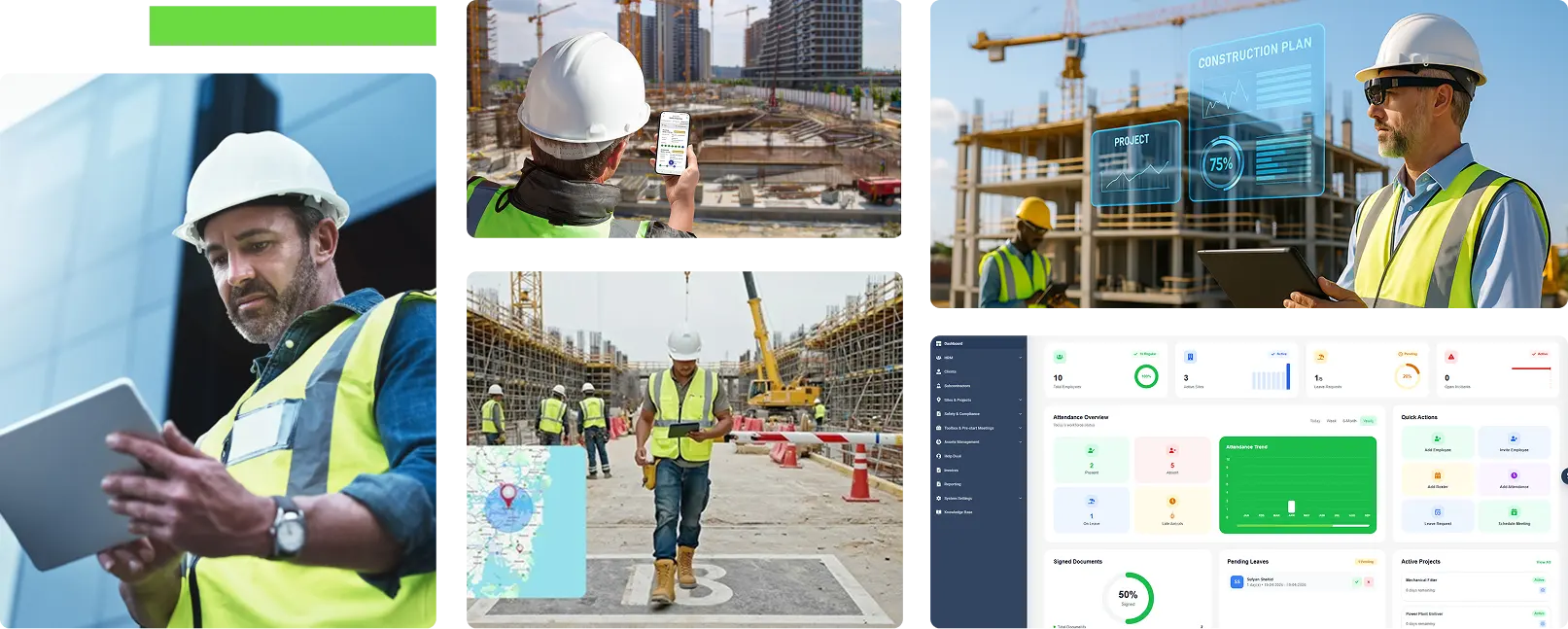
A robust workforce management system directly tackles these pain points through automation and intelligence, delivering measurable improvements in efficiency, cost control, and safety.
The traditional method of scheduling uses phone calls and emails and whiteboards which lead to scheduling errors and require time-consuming updates. The WMS system delivers perpetual operational schedules through its drag-and-drop system with matching capabilities based on employee skills and its AI-based prediction system.
The system enables managers to view employee availability and their certification status together with their previous work performance to schedule shifts which the system will automatically communicate through SMS and app notifications.
The field tracking software uses GPS and geofencing technology to create location-based scheduling capabilities. The system improves resource allocation by decreasing idle periods while stopping overstaffing situations from happening. The system dynamically assigns crews to essential path activities whenever one phase experiences a delay.
The scheduling conflicts that companies experience decrease as their resource utilisation improvements which help to reduce project delays.
The WMS systems provide real-time dashboards that display ongoing labour progress while identifying existing bottlenecks and delivering future performance predictions. Project data integration systems enable early delay detection through their ability to identify missing certified electricians who will be needed for upcoming project stages.
Equipment utilisation forecasting ties into workforce planning, which enables organisations to synchronise their machine usage with their crew deployment. Mobile applications empower field supervisors to conduct on-site status updates but they also provide offline functionality for status updates in multiple situations which helps to maintain team coordination while speeding up recovery from operational breaks.
Safety remains a critical concern. WMS automates certification tracking with its expiration alerts together with its digital safety checklists and toolbox talks and incident reporting functionalities. The system uses geofenced access control and biometric security methods to protect high-risk areas from unauthorised access.
The automated compliance system calculates prevailing wage rates and union regulations and creates audit trails that help companies achieve legal compliance while reducing their risk of lawsuits. The safety monitoring system for compliance needs to use proactive methods which will decrease both workplace accidents and insurance costs.
Overpayment disputes arise when time tracking systems produce incorrect results. GPS-stamped clock-ins together with automated timesheets and job costing solutions create direct links to payroll systems. The system enables accurate labour cost monitoring through project and cost code breakdowns while it minimises errors and controls overtime costs.
Automated cost control processes extend their reach through predictive budgeting, which estimates labour costs by combining past data with ongoing work assignments. Shared portals enable better subcontractor visibility, which results in decreased unknown risks and improved billing accuracy.
Field teams can operate independently through dashboard mobile tools which provide access to multiple functions: they can view their work schedule, submit time off requests, access training materials, and submit production data. The intuitive interfaces of the system lead to higher usage rates which result in improved productivity as workers spend less time on administrative tasks and more time on their specialised duties.
The system enables advanced reporting capabilities through its analytics system which generates insights about worker productivity and crew operational efficiency and absenteeism trends. Data-driven decision making allows leaders to improve their processes through continuous operational enhancements.
The system offers three primary advantages which enhance communication through centralised messaging, improve subcontractor visibility by eliminating coordination challenges, and enable business expansion through platform scalability.
WMS systems have delivered successful results for construction companies that range from small to large enterprises:
A mid-sized general contractor using a mobile-first tool like Raken replaced pen-and-paper processes. The operation scaled up through real-time labour mapping and certification tracking while the team maintained safety compliance. Crews received automatic shift updates which eliminated delays in communication.
Subcontractors who used integrated platforms (e.g., Onetrace-style systems) could access centralised timesheets and planner tools together with signed digital documents for RAMS and safety requirements. The system enhancement delivered better visibility across numerous sites. The system also reduced disputes between parties and improved the accuracy of client reports.
Large enterprises adopted AI forecasting solutions that operate similarly to Bridgit and Procore Resource Planning to conduct 5-year workforce scenario planning. The process improved bidding and resource allocation efficiency which resulted in less idle time for all portfolios.
The companies that adopted attendance tracking with geofencing technology experienced two main benefits. The first benefit included reduced payroll mistakes. The second benefit resulted in faster onboarding procedures which produced cost savings in administration and better employee retention through more equitable scheduling.
The data-driven adjustments saved multiple hours of wasted time by enabling fast resource reallocation to handle minor delays.
Here's a practical comparison of essential features versus traditional manual methods:
Manual Processes vs. Workforce Management System Features
| Aspect | Manual/Traditional Approach | WMS Capabilities | Key Benefit |
|---|---|---|---|
| Scheduling | Spreadsheets, calls, whiteboards | Real-time calendar, skill-matching, AI forecasting | Reduces inefficiencies & delays |
| Time Tracking | Paper timesheets, manual entry | GPS/geofencing, mobile clock-in, automated timesheets | Accurate payroll, cost control |
| Compliance & Safety | Paper checklists, manual certification logs | Digital audits, expiration alerts, and incident reporting | Lower risks, better monitoring |
| Resource Allocation | Gut feel or basic lists | Visual dashboards, equipment integration | Optimised utilisation |
| Reporting & Analytics | Excel reports, delayed insights | Interactive dashboards, predictive analytics | Data-driven decisions |
| Communication | Emails, texts, site meetings | In-app messaging, automated notifications | Improved collaboration |
| Scalability | Breaks at multi-site growth | Cloud-based, integrates with Procore/ERP | Supports business expansion |
This table highlights how WMS shifts from reactive to proactive management.
| Pros | Cons |
|---|---|
| Significant time and cost savings | Initial learning curve for field teams |
| Real-time visibility across sites | Upfront investment and integration effort |
| Improved safety and compliance records | Dependency on mobile/data connectivity |
| Higher employee satisfaction and retention | Potential over-reliance if the data is inaccurate |
| Better forecasting and project outcomes | Vendor selection requires due diligence |
| Scalable for small crews to large GCs | Change management is needed for adoption |
Weigh these against your company size, project complexity, and current tech stack. Many solutions offer trials or phased rollouts.
Successful implementation follows a structured approach:
The organisation should aim for high field adoption because intuitive apps with minimal training requirements deliver the best results. The organisation needs to combine WMS implementation with upskilling programmes and competitive salary packages to achieve complete solutions for their labour shortage problem.
The upcoming period will witness the adoption of three technologies which include AI-based predictive scheduling, wearable systems that track worker fatigue and safety, and advanced sustainability tracking tools which measure idle equipment emissions reduction.
The improved analytics capabilities of cloud platforms will enable organisations to scale their operations while effectively handling subcontractor risk assessment.
FAQs
The core problems stem from labour shortages and scheduling problems and project delays and safety compliance issues and budget overruns. The WMS system delivers automated processes and increased operational transparency to meet all requirements.
The system operates by providing real-time scheduling together with skill-based task distribution and automatic alerts and adaptable forecasting tools which minimise work disruptions.
The answer is yes because the system provides real-time progress monitoring and instant bottleneck detection and resource redistribution capabilities and built-in forecasting tools which help projects stay on schedule and within budget limits.
The necessary elements need to include GPS geofencing time tracking ability for mobile devices and offline functionality together with certification management functions which enable integration between safety systems and payroll systems.
The savings for businesses differ but they typically achieve cost reductions through better control over overtime expenses and payroll mistakes and idle time and administrative work which results in substantial yearly financial benefits through improved optimisation.
Small construction companies can use WMS for their operations. The business provides scalable solutions that developers can access at low costs to meet their basic scheduling and time tracking requirements before they need more advanced analytical tools.
The WMS implementation process encounters three major obstacles which include training field users and maintaining data accuracy and establishing system connections. The organisation needs to select an easy-to-use platform and allocate resources for change management activities to achieve successful results.
The construction sector faces multiple challenges which include difficulties in labour scheduling and resource allocation, while workers experience safety risks and project delays. A company achieves powerful business results through WMS when it implements automated systems that provide real-time data access and mobile application support and analytic capabilities.
Field tracking software implementation together with safety monitoring system enhancement and cost control automation and payroll system improvement, will enable companies to achieve productivity gains through better dashboard access and subcontractor visibility maintenance.
Start by auditing your current processes against the features and benefits outlined here. The process begins with demo exploration from leading platforms which lead to solution pilot testing on one project for result assessment. The appropriate WMS allows organisations to transform workforce problems into market advantages which enable them to complete projects with higher speed and safety while increasing profitability.
Your construction workforce is ready for optimisation. Evaluate your needs today and take the first step toward data-driven, efficient operations.
14 Sep 2026•1 min read

11 Sep 2026•1 min read

10 Sep 2026•1 min read