Employee Management System Australia for Construction Teams
An employee management system centralises HR, payroll, rostering, timesheets and compliance in one platform built for Australian construction teams juggling Awards, EBAs, and multi-site crews.

Share this article
Streamline your frontline operations
See how WMS simplifies scheduling, compliance and workforce management in one powerful platform.
An employee management system is software that centralises HR, payroll, rostering, timesheets and compliance in one platform. For construction businesses in Australia, the right system also handles Award/EBA interpretation, multi-site rostering, and casual/subcontractor payroll problems generic HR tools weren't built to solve.
- All-in-one dashboard: Combines HR, payroll, timesheets and rostering in one place
- Award automation: Automates Building and Construction General On-site Award and EBA rules
- GPS attendance: Tracks attendance across multiple, temporary job sites via GPS
- Mixed payroll: Manages casuals, subcontractors and labour hire in a single payroll run
- Less risk: Reduces admin time and back-pay/compliance risk
Introduction
If you run a construction business, you already know payroll here isn't like other industries. You're juggling casuals, subcontractors and labour hire across sites that open and close within months, all under Modern Awards and EBAs that change pay rates by role, shift and location. Generic HR software wasn't designed for that. It handles a static office workforce well and a mobile, multi-site construction crew badly.
WorkforceMS is an online employee management system built for construction from the ground up, not a generic HR platform with a construction feature bolted on. This guide breaks down what a construction-ready employee management system actually needs to do, where generic tools fall short, and how to evaluate your options including honest coverage of pricing, common mistakes, and what's coming next in AI-driven workforce planning.
What Is an Employee Management System?
An employee management system is a digital platform that stores employee records, runs payroll, manages rosters and timesheets, and tracks compliance documents in one place. In construction, it typically adds award interpretation, site-based time tracking and subcontractor management on top of standard HR functions.
Core HR functions
At minimum, expect a staff directory, leave management, onboarding workflows and document storage (licences, tickets, inductions). These replace scattered spreadsheets and email chains with a single source of truth your whole team can access.
Construction-specific functions
Beyond core HR, a construction-ready system adds Award/EBA rate engines, GPS-verified site clock-ins, and the ability to manage employees, subcontractors and labour hire workers side by side in the same payroll run without manual rate lookups.
Why Construction Businesses Need a Different Employee Management System
Construction workforces are project-based, multi-site and mixed-employment (permanent, casual, subcontractor, labour hire), governed by the Building and Construction General On-site Award and numerous EBAs. Off-the-shelf HR software rarely models this correctly, which is the leading cause of payroll errors and back-pay exposure in the sector.
The multi-site, multi-award problem
A single project might span three sites with different penalty rates, allowances and shift rules. Applying these manually or with software built for single-location retail or office staff is a documented source of non-compliance and fines.
Casuals, subcontractors and labour hire in one payroll run
Most construction crews blend employment types on the same job. Generic systems typically force you to run separate processes for each, doubling admin and increasing the chance of a missed rate or allowance.
Key Features of a Construction Employee Management System
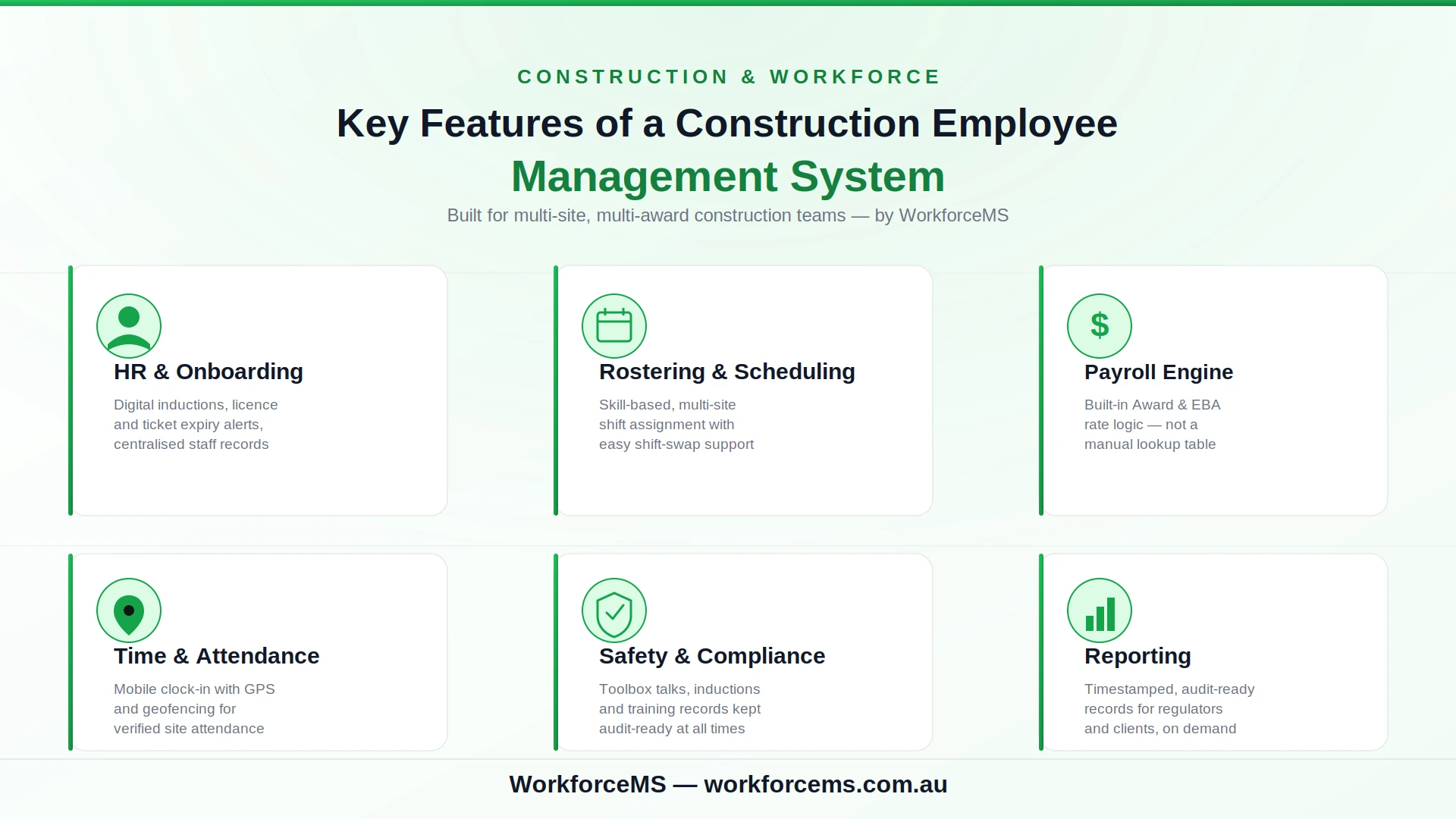
Look for HR and onboarding tools, rostering by project and skill, live award interpretation, GPS-based time and attendance, and payroll that natively handles mixed employment types all in one platform rather than stitched together from separate tools.
- HR and onboarding: digital inductions, licence/ticket expiry alerts, VEVO-style eligibility checks
- Rostering and shift assignment: skill-based, multi-site scheduling with shift-swap support
- Payroll engine: built-in Award/EBA rate logic, not a manual lookup table
- Time and attendance: mobile clock-in with GPS/geofencing for site verification
- Reporting: audit-ready, timestamped records for regulators and clients
How Online Payroll Systems Handle Australian Compliance
Compliant online payroll systems apply Modern Award and EBA rules automatically at the roster or timesheet stage, then handle Single Touch Payroll (STP) and Super Guarantee/Payday reporting to the ATO reducing the manual interpretation errors that cause underpayment claims.
Award and EBA interpretation
The best systems apply penalty rates, allowances and overtime multipliers automatically based on role, shift and site catching errors before they reach a payslip, not after.
STP and Super compliance
With Super Payday changes tightening reporting timeframes, payroll needs to push accurate, on-time data to the ATO without manual re-entry, a common failure point when payroll and timesheets sit in separate systems.
Online Attendance: Site-Based Time Tracking That Actually Works
Paper timesheets and manual sign-in sheets are prone to errors and "buddy punching." Construction-ready attendance tools use mobile GPS/geofenced clock-ins so hours are tied to a verified site and time, feeding straight into payroll without manual re-entry.
GPS and geofenced clock-in
Workers clock in and out from their phone within a defined site radius, creating a timestamped, audit-ready record useful both for payroll accuracy and for proving compliance if a regulator asks for evidence.
Employee Management System vs Generic HR Software
| Factor | Construction-Ready System (e.g. WorkforceMS) | Generic HR Software |
|---|---|---|
| Award/EBA interpretation | Built-in, automated | Manual or unsupported |
| Multi-site rostering | Native | Limited or add-on |
| Mixed employment types (casual/sub/labour hire) | Single payroll run | Often separate processes |
| Site attendance tracking | GPS/geofenced mobile clock-in | Basic or office-only |
| Compliance audit trail | Timestamped, construction-specific | Generic reporting |
Common Mistakes Construction Employers Make With Staff Management
The most frequent, costly mistakes are relying on paper timesheets, applying award rates manually, mixing employment types across disconnected systems, and letting compliance documents (licences, inductions) expire unnoticed, all of which a proper employee management system is designed to prevent.
- Manually calculating penalty rates instead of automating them
- Running separate payroll processes for casuals vs. subcontractors
- Using paper or spreadsheet timesheets prone to buddy-punching
- Not tracking licence/ticket expiries, risking non-compliant site assignments
- Choosing generic HR software because it's familiar, not because it fits construction
Must-Have Tools and Integrations
A construction employee management system should integrate with accounting software (e.g. Xero-style connections), offer a mobile app for site workers, and connect to safety/WHS documentation tools so payroll, HR and compliance data don't live in disconnected systems.
Accounting integrations
Direct sync with your accounting platform avoids duplicate data entry and reconciliation errors between payroll and your books.
Mobile app for site workers
Workers need to clock in, view rosters and submit leave from their phone office-only software creates adoption problems on-site, which undermines the whole system.
Proven Results: What Construction Businesses Gain From WorkforceMS
Businesses moving from spreadsheets or generic HR tools to a construction-ready employee management system typically report significant admin time savings, fewer payroll disputes, and faster audit readiness because timesheets, awards and compliance data live in one connected system instead of several.
- Reduced hours spent per pay cycle reconciling timesheets manually
- Fewer underpayment/back-pay incidents from automated award interpretation
- Faster response time when a regulator or client requests compliance evidence
Replace with your own verified customer metrics before publishing, the figures above are directional, not claimed statistics.
Advanced Award & EBA Automation for Construction Payroll
Beyond basic rate lookup, mature systems let you configure multiple EBAs per project, apply site-specific allowances automatically, and flag exceptions for manual review giving payroll teams confidence without needing to manually re-check every Award clause each pay run.
For businesses running several EBAs across different sites or client contracts, the system should let you assign the correct agreement per project and per worker, rather than applying one blanket rate set across the whole business, a common source of error when systems aren't construction-specific.
The Future: AI and Predictive Workforce Planning in Construction
AI in workforce management is shifting from reactive rostering to predictive planning forecasting headcount needs from historical and project data, and modelling fatigue/rest-period compliance before shifts are published, which is increasingly relevant as safety regulation tightens.
As jurisdictions like NSW introduce stricter WHS codes, expect employee management systems to increasingly combine payroll and rostering data with safety compliance forecasting, rather than treating them as separate systems.
Choosing the Right Employee Management System: Your Checklist
Does it natively handle your relevant Award(s) and any EBAs?
Can it run casuals, subcontractors and labour hire in one payroll cycle?
Does it offer GPS/geofenced mobile time tracking for site workers?
Does it integrate with your existing accounting software?
Can it produce an audit-ready compliance report on demand?
Is pricing transparent for your business size and worker count?
Employee Management System Pricing in Australia
Pricing for employee management systems in Australia is typically per-employee, per-month, with tiers based on features like payroll, rostering and award automation. Free plans usually cover only basic HR record-keeping, full payroll and award automation are paid features, especially for construction-specific complexity.
Expect to compare a base HR/timesheet tier against higher tiers that add full payroll, Award/EBA automation and premium support construction businesses generally need at least the mid tier to get reliable award interpretation.
Get Started With WorkforceMS
Construction payroll and staff management don't have to mean spreadsheets, manual award lookups and separate processes for every worker type. WorkforceMS brings HR, payroll, rostering and site-based attendance into one system built for the way construction actually works multi-site, multi-award, and multi-employment-type.
If your current setup is costing you admin hours or compliance risk, it's worth comparing what a construction-specific system can automate versus what you're doing manually today. Book a demo to see your Award rules and site structure modelled in the platform before you commit.
Optimise your operations with WMS
Streamline scheduling, compliance, and workforce management in one platform.
Frequently Asked Questions
Software that centralises HR records, payroll, rostering, timesheets and compliance documents in one platform, replacing spreadsheets and manual processes.
Some providers offer free basic HR record-keeping, but full payroll and Award/EBA automation essential for construction are typically paid features.
Most platforms offer a web login plus a mobile app; your employer or provider issues site-specific login credentials during onboarding.
Yes, a mobile app is standard for construction-ready systems, letting workers clock in via GPS, view rosters and submit leave from any site.
A construction-ready system should process all three in a single payroll run; many generic HR tools require separate manual processes for each.
It applies penalty rates, allowances and overtime rules automatically based on role, shift and site, and lets you configure multiple EBAs across projects.
GPS/geofenced mobile clock-ins tie each entry to a verified site and time, reducing errors from paper timesheets or manual sign-in sheets.
Pricing is usually per-employee, per-month, scaling with features; construction businesses typically need a mid-to-top tier for full award automation.
Related Articles
Explore more insights on workforce management, compliance, and operations.

Security Operations and Monitoring Workforce Planning
Plan guard rosters, track live attendance and cover every shift with WorkforceMS. Strengthen security operations and monitoring with smarter workforce planning.

Muhammad Asim
09 Oct 2026

Telehealth and Digital Healthcare Scheduling WMS
Simplify telehealth and digital healthcare scheduling with WorkforceMS. Manage rosters, remote clock-ins and compliance records in one easy-to-use platform.
Muhammad Asim
08 Oct 2026

Healthcare Workforce Management for Aged Care
Simplify rostering, credential tracking and payroll for aged care healthcare teams. Discover how WorkforceMS gives your carers more time with residents.
Muhammad Asim
05 Oct 2026
Ready to secure your operations?
