Employee Rostering Software Australia: Construction Teams
Employee rostering software schedules staff and crews, but on a construction site a generic roster app quickly hits its limits when crews move between sites, subcontractors rotate in and out, and labour costs must tie back to tenders and budgets.
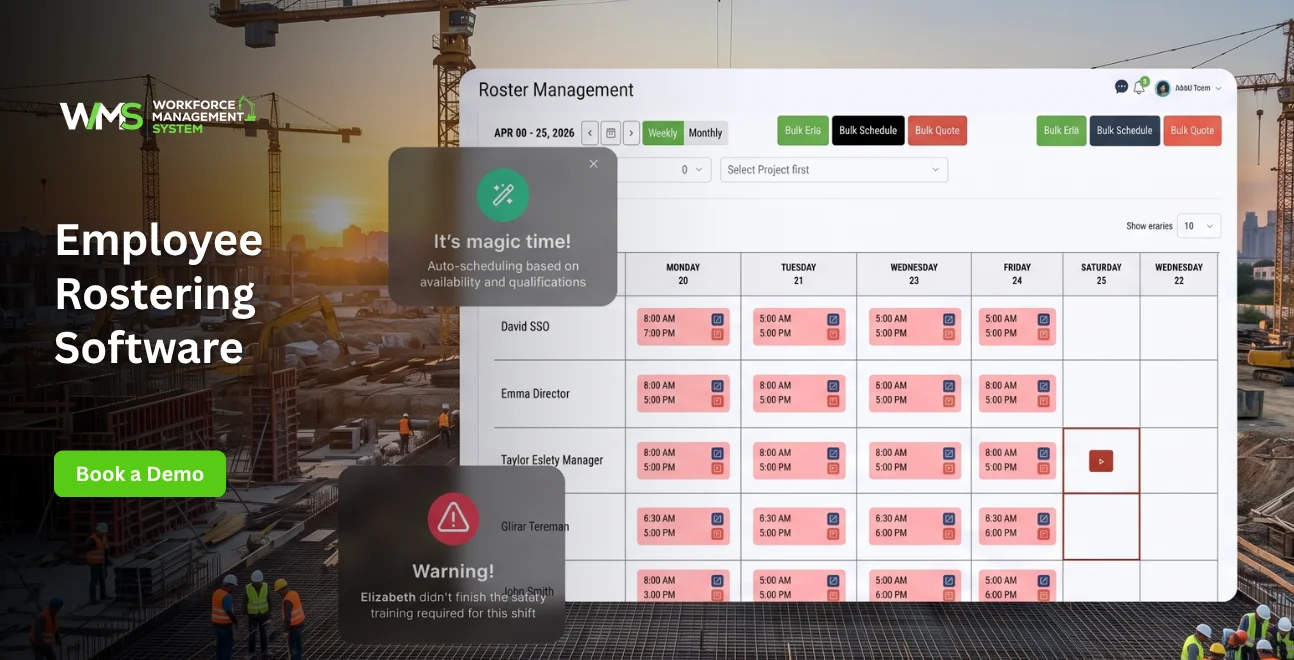
Streamline your frontline operations
Employee rostering software is a digital system for building, publishing and adjusting staff and crew schedules but on a construction site, a generic roster app quickly hits its limits. Here's why:
- Crews move between sites & projects, not just shift slots
- Rosters need to account for subcontractors as well as direct employees
- Compliance means both Fair Work awards and site Safety & Compliance
WorkforceMS builds rostering as one connected part of a construction management platform, rather than a bolt-on scheduling app.
Introduction
Most Australian businesses trying to solve staff scheduling end up comparing the same handful of generic rostering apps tools built for cafés, retail stores and NDIS providers. None of them were designed around how construction actually runs: multiple sites on the go at once, subcontractors moving in and out of a job, and labour costs that need to tie back to a tender, a Client, and a project budget.
This guide breaks down what to actually look for in an employee roster system if you run a construction business, where generic tools fall short, and how rostering fits into the bigger picture of running sites, crews and compliance across the business the way WorkforceMS was built to handle it.
What Is an Employee Roster System? (and Why Construction Needs a Different One)
An employee roster system is software that schedules who works where and when, tracks availability and leave, and in Australia applies award and Fair Work rules to that schedule automatically.
For a retail or hospitality business, that's the whole job. For construction, it's only the starting point. A roster also needs to reflect which Sites & Projects a crew is assigned to that week, whether a Subcontractor or a direct employee is filling a slot, and whether the right safety inductions are current before anyone is scheduled onto site at all.
The Real Cost of Manual Rostering on Australian Job Sites
Spreadsheet rosters and phone-call scheduling create three recurring problems on construction sites: double-booked crews across sites, labour costs that aren't visible until payroll runs weeks later, and safety gaps where someone is rostered onto a site without a current induction or Toolbox & Pre-start sign-off.
Each of these directly affects project margins and Fair Work exposure, and each is preventable with software that connects rostering to the rest of site operations rather than treating it as an isolated task.
Core Features to Look for in Rostering Software Australia-Wide
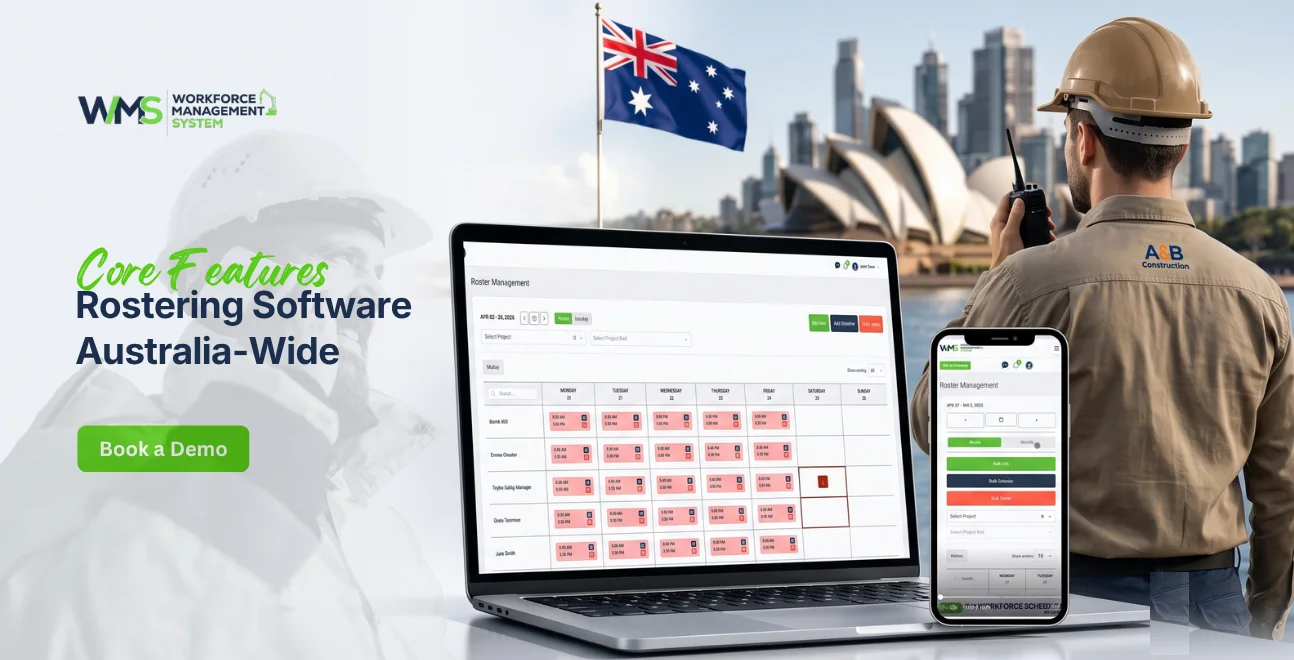
Any rostering software worth using in Australia needs to handle award interpretation, mobile access, and shift management as standard. For construction businesses specifically, the feature list needs to go further covering multi-site scheduling, subcontractor visibility, and a direct link between the roster and site safety records.
Shift & Crew Scheduling by Site
Rosters should be built around Sites & Projects, letting a supervisor see which crews are allocated where, spot gaps before a shift starts, and reassign workers between sites in a couple of taps rather than a string of phone calls.
Fair Work Awards and Safety & Compliance
Award interpretation calculates penalty rates, overtime and allowances automatically, reducing wage-theft risk. Layered on top of that, Safety & Compliance checks licences, tickets, inductions should block a worker from being rostered onto a site if their credentials have lapsed.
Mobile Apps for Supervisors and Crews
Supervisors need to build and adjust rosters from site, not from an office desktop. Crew members need to see their next shift, confirm availability, and receive Toolbox & Pre-start briefings all from a phone.
Rostering Across Sites & Projects, Not Just Shifts
Generic rostering apps assume a single location with recurring shifts. Construction doesn't work that way; a business might be running five Sites & Projects simultaneously, each with a different crew mix, start date and finish date.
Rostering software built for this needs to let a business view labour allocation across every active project at once, and reassign people as one job winds down and another ramps up, without rebuilding the roster from scratch each time.
Rostering Subcontractors vs Direct Employees
A construction workforce is rarely made up of employees alone. Rosters typically blend direct staff with subcontractor crews brought on for a specific trade or project phase, and the two need different handling subcontractors are usually scheduled against a scope of work and a project timeline rather than a fixed shift pattern, and their hours often need to reconcile against a Tender Management budget rather than an internal payroll run.
Software that only understands "employees on shifts" misses this entirely, leading businesses back to spreadsheets to track subcontractor allocation manually.
How Rostering Connects to the Rest of the Business
Rostering data is far more useful when it isn't sitting in its own silo. Once a roster is built, that same information should feed HRM records for leave and qualifications, link to Project Task Management so labour is assigned against actual scopes of work, and flow through to Reporting so labour cost against budget is visible in real time rather than after the fact.
It should also connect outward to client visibility on project progress, and through to asset management so plant and equipment bookings line up with the crew rostered to use them, and ultimately to invoices once work is complete.
WorkforceMS vs Generic Rostering Apps
| Feature | Generic Rostering App | WorkforceMS |
|---|---|---|
| Multi-site scheduling | Limited or manual | Native, across all active sites & projects |
| Subcontractor scheduling | Not supported | Built-in, linked to tender management |
| Safety compliance link | Separate system | Connected to toolbox & pre-start records |
| Labour-to-invoice flow | Manual export | Automatic, into invoices |
| Asset/plant scheduling | Not included | Included via asset management |
| Reporting | Roster-only metrics | Whole-business reporting dashboard |
Common Rostering Mistakes Construction Businesses Make
Three mistakes show up repeatedly: rostering crews without checking site safety and compliance status first, treating subcontractor labour as an afterthought instead of scheduling it properly, and using a rostering tool that doesn't talk to payroll, invoicing or project reporting which means someone still has to reconcile hours manually every single week.
Is There Free Rostering Software in Australia?
Several free or freemium rostering apps exist in Australia, and they can work for very small teams with simple, single-site shifts. Once a business is coordinating multiple sites, mixing subcontractors with employees, or needs safety compliance tied to the roster, free tools generally can't keep up which is where a connected platform built for construction becomes worth the switch.
Make Rostering Part of How You Run the Whole Job
Employee rostering software solves more than a scheduling headache when it's built around how construction actually operates across sites, subcontractors, safety and budgets, not just shifts. Getting rostering wrong costs businesses in wage compliance risk, safety gaps, and hours lost to manual reconciliation every week.
WorkforceMS connects rostering to the rest of the business HRM, tender management, project task management, asset management, invoicing and reporting so a roster built on Monday morning already reflects what the job actually needs. If you're comparing rostering software for a construction business, start with whether it was built for single shifts, or built for sites.
Optimise your operations with WMS
Streamline scheduling, compliance, and workforce management in one platform.
Rostering Software FAQs
It's software that schedules staff and crews, tracks availability and leave, and applies Australian award rules automatically reducing manual admin and compliance risk.
Yes, several basic free tools exist, though most are built for simple single-location shift work rather than multi-site construction scheduling.
Generic rostering apps usually can't. Construction-specific platforms like WorkforceMS schedule subcontractors alongside direct staff and link that labour back to tender budgets.
Yes award interpretation calculates penalty rates and overtime automatically, which reduces the risk of underpayment errors.
In a connected platform, yes. Rosters can check safety & compliance status inductions, licences, toolbox & pre-start sign-off before a worker is scheduled onto a site.
Yes, and it scales a small business benefits from simpler compliance and time savings, while growth into multiple sites is handled without switching systems.
Good platforms feed rostered and worked hours directly into payroll and invoices, removing manual timesheet reconciliation.
Labour data from the roster flows into reporting dashboards, showing cost against budget per site or project in real time.
Related Articles
Explore more insights on workforce management, compliance, and operations.

Top AI Solutions To Manage Construction Workforce
Explore the top AI solutions for managing a construction workforce, from onboarding to payroll and safety, with human review built in.
WorkforceMS Team
14 Sep 2026

Streamline Job Tracking with AI Construction Management Software
Discover how AI construction management software streamlines job tracking, project planning, risk alerts, defect reporting and safety compliance.
WorkforceMS Team
11 Sep 2026

Skills and Compliance Management for Construction Teams
Manage skills and compliance for construction teams with WorkforceMS. Track licences, SWMS, inductions and audits in one workforce management system.
WorkforceMS Team
10 Sep 2026
Ready to secure your operations?
