Prequalifying Subcontractors the Right Way in Australia
A subcontractor rarely tells you they're in trouble. The insurance has quietly lapsed, the licence covers a narrower scope than the quote implied, or the business is stretched thinner than its turnover suggests and none of it surfaces until something on-site forces the issue.
Streamline your frontline operations
A subcontractor rarely tells you they're in trouble. The insurance has quietly lapsed, the licence covers a narrower scope than the quote implied, or the business is stretched thinner than its turnover suggests and none of it surfaces until something on-site forces the issue.
This guide sets out how to prequalify subcontractors AU-wide: what serious buyers actually check, how the TfNSW prequalification list works in practice, and how to build a process that keeps catching problems after the contract is signed, not just before it.
Every Buyer Runs Its Own Version of This Check
Government agencies aren't the only ones running formal prequalification. Tier 1 builders, mining operators, and energy companies all maintain their own vendor requirements, and many lean on third-party compliance platforms names like Cm3, Avetta, and ISNetworld come up constantly in this space to keep subcontractor documents current across dozens of active sites at once.
What these different systems have in common matters more than what makes them different. Every one of them is answering the same underlying question: can this business deliver the scope, safely, without running out of money halfway through? A government prequalification scheme and a Tier 1 vendor portal are really the same test, dressed differently.
For a builder without access to an enterprise-grade platform, the lesson isn't to copy every field on a mining major's supplier form. It's to borrow the discipline a baseline that applies to everyone, extra scrutiny for higher-risk trades and ongoing monitoring rather than a form filled out once and filed away.
The Baseline No Subcontractor Should Skip
Regardless of trade or contract size, a genuine subcontractor prequalification process should have the following sighted and verified before work starts:
- Current certificate of currency for public liability insurance, at a level suited to the job
- Current workers' compensation insurance certificate
- Trade licence or registration, checked against the issuing authority rather than taken on trust
- Financial statements or a trade reference for anything above an agreed contract value
- Safe Work Method Statements (SWMS) for high-risk construction work
- A WHS policy or management system, plus incident history from the past two to three years
- References from at least two comparable recent projects
A $30,000 painting package and a $3 million structural steel contract shouldn't be assessed with the same level of scrutiny. Match the depth of the check to the size of the risk, not to how much paperwork feels reasonable to ask for.
Money Matters More Than a Licence Number
This is the part of the process most builders either skip or skim, and it's usually where the real risk is hiding. A subcontractor can hold a valid licence and a clean safety record and still be one late payment away from collapse.
Financial capacity is generally assessed through working capital current assets minus current liabilities as a measure of whether a business can absorb the cash flow demands of a contract over its full length. A healthy-looking turnover figure doesn't mean much if working capital is thin.
A quick ratio (liquid assets divided by current liabilities) is a common benchmark for this kind of check, and a business sitting well under 1.0 is carrying more short-term pressure than its revenue suggests. A one-page summary from the subcontractor's accountant, dated within the past twelve months, is usually enough for anything short of major-project scale.
It's also worth asking directly what else the subcontractor is currently juggling. Over-commitment across several jobs at once not a lack of skill is one of the more common reasons a genuinely capable subcontractor still fails to deliver.
Evidence at a Glance
| Document | What It Confirms | Refresh Frequency |
|---|---|---|
| Certificate of currency (public liability) | Cover is current and adequate for the job | Annually, before the renewal date |
| Workers' compensation certificate | Staff are properly covered | Annually |
| Trade licence / registration | Legal entitlement to the scope quoted | At engagement, then each renewal cycle |
| Financial statement or reference | Capacity to fund the contract | Every 12 months, or per contract value |
| SWMS | High-risk work is planned and controlled | Before work starts, updated on scope change |
| WHS incident history | Safety track record over recent projects | Reviewed every 12 months |
| Project references | Performance on comparable past work | At initial check, refreshed periodically |
Why Continuous Monitoring Beats a One-Off Form
Larger organisations that manage supplier risk at scale rarely treat prequalification as a single event. Certificates, licences, and training records are tracked on a rolling basis, and a lapsed document typically suspends a subcontractor's eligibility automatically rather than waiting for someone to notice at the next renewal.
Most builders can't run that level of infrastructure and don't need to. But the underlying principle scales down easily: if a document has an expiry date, something should be watching that date, rather than relying on whoever filed the paperwork to remember when it runs out.
This is also where searches for how to prequalify subcontractors online usually land. A digital record that tracks expiry automatically, rather than a folder that only gets checked when someone thinks to look, closes the exact gap that causes most subcontractor compliance to quietly lapse mid-project.
A subcontractor management system built around this idea keeps every certificate attached to the business it belongs to, with alerts firing before anything expires the same principle larger platforms run at an enterprise scale, sized for a builder who doesn't need the enterprise price tag.
Inside the TfNSW Prequalification Scheme
Where Transport for NSW specifies it in a tender, contractors bidding for road, bridge, paving, specialist works, or intelligent transport systems must be prequalified before they can even lodge a submission. This is the TfNSW prequalification list most NSW civil contractors run into sooner or later.
The scheme classifies contractors by technical and managerial expertise, financial capacity, and previous performance. It supports the tender assessment on each project rather than replacing it and protects both Transport for NSW and contractors against over-commitment.
Categories include Roadworks, Bridgeworks, Concrete Paving (Machine Placed), Asphalt Paving (Machine Placed), Pretensioned Concrete, Steel Fabrication, Protective Treatment (Field), and Traffic Signals. Financial capacity sits alongside these as a separate financial level, ranging from F0.25 through to F150 PLUS, broadly indicating the largest contract value a business is considered capable of carrying.
Prequalification runs on a three-year cycle, with reapplication required to stay current. Mandatory prequalification generally applies to civil construction contracts valued above $250,000 (excluding GST), and a status earned with one road agency can sometimes be recognised by others through mutual recognition.
The Registration Scheme Explained
Sitting alongside the prequalification scheme is the Registration Scheme for Construction Industry Contractors, which covers supporting trades outside the core road and bridge categories drainage, earthworks, formwork, and traffic control among them.
The two schemes are built to work together. A contractor already prequalified under roadworks or bridgeworks is generally considered registered under the matching category here too, so the same evidence doesn't need to be submitted twice for overlapping scopes.
For subcontractors in supporting trades without a primary prequalification category, this registration scheme is often the pathway that actually applies to them.
Safety Numbers Worth Asking For
Beyond a WHS policy document, larger buyers increasingly ask subcontractors for their actual safety performance data incident frequency rates tracked over several years, not just a statement that a safety system exists.
A subcontractor with a clean policy on paper but a rising injury trend over the past two years is a different risk proposition to one with a flat or improving record, even if both hold identical certifications. Asking for a short trend summary, rather than just a current policy, gives a much better read on whether safety is actually being managed day to day or simply documented.
This doesn't need to be complicated for smaller trades. A brief written summary of incidents and near misses over the past two to three years, alongside the WHS policy, is enough to spot a pattern without demanding a level of reporting only a large contractor could produce.
ESG and Modern Slavery Are Quietly Becoming Standard
A newer category of evidence is showing up in prequalification requests that didn't exist a decade ago. Businesses with consolidated revenue of $100 million or more are required under the Modern Slavery Act to publish an annual statement addressing risks in their operations and supply chains and that obligation flows down through the subcontractors they engage.
Even where a subcontractor sits well under that revenue threshold, being asked a handful of supply chain questions is becoming more common, particularly on projects connected to a larger head contractor or government client further up the chain.
For most builders, this doesn't need to become a formal audit. A simple question about labour hire arrangements, subcontracting practices, and where materials are sourced from is usually enough to flag anything that needs a closer look, without turning prequalification into a compliance exercise better suited to a much larger organisation.
Spotting Trouble Before It Starts
Some risk signals show up in the documents themselves, well before a subcontractor sets foot on site. A prequalification process that's actually being used, rather than filed away, should catch these before a contract is signed:
- A certificate of currency close to expiry rather than freshly issued
- A licence class that doesn't quite match the trade being quoted
- Financial statements older than twelve months, or none supplied at all
- No incident history provided often a sign it's never been asked for
- References limited to smaller jobs than the one being quoted for
- Resistance to providing any of the above without repeated follow-up
None of these are automatic dealbreakers on their own. Together, they're exactly the pattern a proper check is meant to catch and exactly what gets missed when checking is rushed at tender close.
Where Contracts Pick Up the Slack
Vetting a subcontractor before they start is only half the risk picture. What the contract does with that information once work begins matters just as much, and it's where a lot of otherwise solid prequalification effort loses its value.
Security of payment legislation gives subcontractors a statutory right to progress payments, which protects them from being underpaid but it also means payment can't simply be withheld as leverage if a prequalified subcontractor's performance slips later. Retention money, performance guarantees, and defects liability periods are the practical backstops that pick up where prequalification finishes.
Insurance obligations belong in the subcontract itself too, not just at the prequalification stage. Requiring cover to be maintained for the life of the contract, with notice of any change, closes the gap between the certificate sighted at tender and the coverage actually in place months into the job.
The Habits That Keep a Process Honest
Knowing what is prequalification in procurement in theory is one thing. Running it consistently across every trade and every project, without cutting corners under deadline pressure, is the harder part and it's where most processes quietly fail.
Rushing the check at tender close is the most common failure point. A licence number or insurance claim gets accepted verbally because a quote is due tomorrow, with the intention of following up on paperwork later a follow-up that rarely happens once the job is underway.
Treating prequalification as a one-off event is a close second. A subcontractor engaged for a single short job may not need re-checking. One engaged repeatedly over several years absolutely does, and that's exactly the group most likely to slip through if nothing is tracking renewal dates.
Approval Is a Starting Point, Not an Ending
A subcontractor rated low-risk at tender assessment isn't guaranteed to stay that way for the life of a longer project. Insurance renews annually, financial positions shift, and a clean safety record can change after a single incident on a completely different site.
Linking subcontractor records to Safety & Compliance tracking means a lapsed certificate is flagged the moment it happens, instead of surfacing during an incident investigation when it's already too late to matter.
It's worth building this check into Tender Management directly so status is visible before a subcontractor is even invited to quote not discovered afterwards once they've already mobilised on site.
Bringing It All Into One System
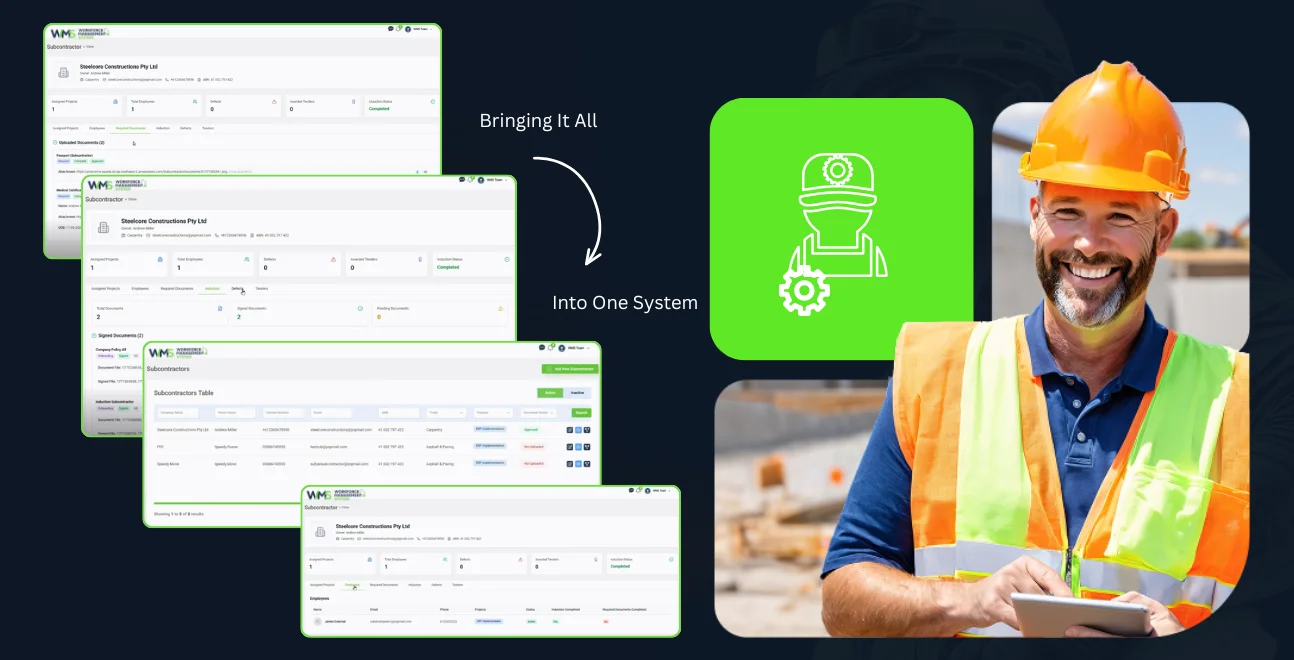
Builders who've worked out how to qualify a subcontractor properly eventually hit the same wall: the process makes sense, but tracking it by hand across dozens of trades and several live sites doesn't hold up once the business grows.
WorkforceMS was built for exactly this gap. Subcontractor profiles, licence and insurance expiry tracking, safety documentation, and tender history all sit in one system, linked to the Sites & Projects they're actually engaged on.
Instead of rebuilding a subcontractor's compliance file from scratch for every new job, project managers pull up an existing, current profile and get warned well before anything lapses. Paired with Reporting across every active project, prequalification stops being a form filled out once and becomes a live, auditable record.
If your business is still tracking subcontractor compliance across spreadsheets and shared drives, it's worth seeing what a centralised system looks like in practice. Explore WorkforceMS pricing or book a walkthrough of the subcontractor module directly.
Conclusion
Prequalifying subcontractors isn't a gate you pass through once. It's a live process that shifts with every renewal date, every new project, and every subcontractor added to the books and the businesses that treat it that way are the ones that don't get caught out by a lapsed certificate mid-build.
Whether you're navigating the TfNSW Prequalification Scheme or building a private vetting process from scratch, the discipline doesn't change: check properly at the start, document it well, and keep checking after approval. A platform like WorkforceMS exists to make that discipline sustainable across every trade and every site, without needing an enterprise-scale system to do it.
Optimise your operations with WMS
Streamline scheduling, compliance, and workforce management in one platform.
Frequently Asked Questions
Use a digital platform where subcontractors upload their own licenses, insurance, and financial details, with expiry dates tracked automatically. This removes manual chasing and gives project managers a live view of who's compliant, rather than a file checked once at the tender stage.
Contractors bidding for Transport for NSW road, bridge, or traffic systems work apply through the TfNSW Prequalification Scheme, are assessed against technical expertise, financial capacity, and past performance across defined categories, and are renewed every three years. The Registration Scheme for Construction Industry Contractors covers supporting trades alongside it.
It's the register of contractors formally prequalified with Transport for NSW across categories including roadworks, bridgeworks, asphalt paving, steel fabrication, and traffic signals, used to shortlist eligible tenderers on projects above the mandatory contract value threshold.
It's the process of checking a contractor's technical capability, financial capacity, and safety record before they're allowed to tender or be engaged, reducing the risk of default, poor workmanship, or insolvency mid-project.
At least once a year, and always before renewing a longer-term contract. Insurance and licences typically renew annually, so a check done only at project kickoff will miss anything that lapses partway through a longer build.
Check trade licensing, insurance currency, financial capacity against the size of the job, and safety or WHS history, then set a fixed review schedule so approval doesn't quietly go stale over a long project.
Related Articles
Explore more insights on workforce management, compliance, and operations.

Top AI Solutions To Manage Construction Workforce
Explore the top AI solutions for managing a construction workforce, from onboarding to payroll and safety, with human review built in.
WorkforceMS Team
14 Sep 2026

Streamline Job Tracking with AI Construction Management Software
Discover how AI construction management software streamlines job tracking, project planning, risk alerts, defect reporting and safety compliance.
WorkforceMS Team
11 Sep 2026

Skills and Compliance Management for Construction Teams
Manage skills and compliance for construction teams with WorkforceMS. Track licences, SWMS, inductions and audits in one workforce management system.
WorkforceMS Team
10 Sep 2026
Ready to secure your operations?
