How to Win Construction Tenders in Australia
Learn how to win construction tenders in Australia with proven strategies on methodology, compliance, pricing, and scoring criteria that evaluators use.

Share this article

Streamline your frontline operations
See how WMS simplifies scheduling, compliance and workforce management in one powerful platform.
Hundreds of Australian builders and subbies submit tenders every week that go nowhere. Not because the work was wrong for them, and often not because the price was wrong either.
Most get knocked out earlier than that, before the price even gets compared, because the business behind the bid never built a proper process for it.
Learning how to win construction tenders AU wide comes down to treating tendering as its own discipline, not something you scramble together whenever an opportunity lands in the inbox. Here's how tenders are done in Australia, what buyers are genuinely scoring, and how to build a bid process that holds up under pressure.
Why Bids Get Rejected
Most contractors assume price is what loses a tender. In practice, it's usually further back than that.
Bids get knocked out for missing a mandatory requirement, for a methodology that reads generic, or for compliance gaps that make an evaluator nervous. None of that has much to do with your number.
Learning how to win a construction tender starts with a mindset shift: the client isn't shopping for the cheapest quote. They're shopping for the least risky option, and price is only one part of that equation.
What Buyers Score
Government and private clients assess tenders against a weighted scoring matrix, not a gut feel. Miss one category and your overall score takes a hit, no matter how sharp the rest of your submission is.
| Scoring category | What evaluators look for |
|---|---|
| Price | Realistic, well-supported, matched to scope |
| Technical capability | Methodology, sequencing, resourcing plan |
| Past performance | Referee checks, similar project history |
| Safety systems | WHS documentation, incident record |
| Financial stability | Capacity to carry the contract to completion |
Address each of these directly, using the client's own wording from the Request for Tender. Evaluators mark what's actually written on the page, not what you assumed they'd understand.
Tender Terms Worth Knowing
Australian procurement leans heavily on acronyms, and misreading one can cost you the opportunity before you've written a word.
| Term | What it means | When it's used |
|---|---|---|
| EOI | Expression of Interest | Shortlisting suppliers before a full tender opens |
| RFT | Request for Tender | Formal, detailed process for larger or complex work |
| RFQ | Request for Quote | Simpler, faster process for lower-value goods or services |
| ATM | Approach to Market | Umbrella term covering any of the above |
Knowing which process you're dealing with changes how much detail is expected and how much time you should set aside to respond properly.
Who Should Write the Bid
Tender writing shouldn't sit entirely on one person's desk, especially once you're chasing larger or governmental work. The strongest submissions usually pull input from a few different people.
Your estimator owns the pricing and needs current supplier rates, not last year's numbers. Your operations or project manager should shape the methodology, since they're the one who'll actually run the job if you win it. Whoever holds your WHS documentation needs to sign off on the safety section before it goes anywhere near submission.
For smaller businesses without a dedicated bid writer, it's tempting to have the owner do everything solo late at night. That's usually where quality slips and mandatory requirements get missed. Even a quick second read before submission catches errors a tired writer won't spot.
Your Methodology Matters Most
Price gets you shortlisted. More often than not, it's the methodology statement that decides who takes the job home.
A solid methodology spells out exactly how you'll deliver, sequencing, resourcing, risk controls, and quality checkpoints, written for that specific site and that specific client, rather than lifted from your last submission with the project name swapped.
Evaluators read a lot of these, and generic answers stand out for the wrong reasons. Reference the client's actual site conditions and programme constraints wherever the tender format allows it.
Pair a clear delivery timeline with a genuine point of difference, a safer sequencing approach, a faster programme, or better site logistics, and you start looking like the lower-risk option even against a cheaper bidder.
A Strong Bid vs an Average One
Picture two civil contractors bidding on the same council roadworks package. Both have similar pricing, similar equipment, and similar experience on paper.
The first submits a methodology that reads like a template, generic staging, a generic risk register, and no mention of the actual road or the residents living along it. The second references the specific traffic challenge on that stretch and proposes a staged closure that keeps one lane open during school pickup, backed by a case study from a similar job nearby.
On price, the two might sit within a few percent of each other. On methodology, they're not close. The second contractor wins, not because they were cheaper, but because they clearly understood the site and treated the brief as something worth answering properly.
That's the pattern of tendering rewards. Evaluators aren't chasing perfection. They're looking for evidence you've genuinely thought about their project, rather than adapted your last one and hoped nobody would notice it.
Good Reporting Wins Repeat Work
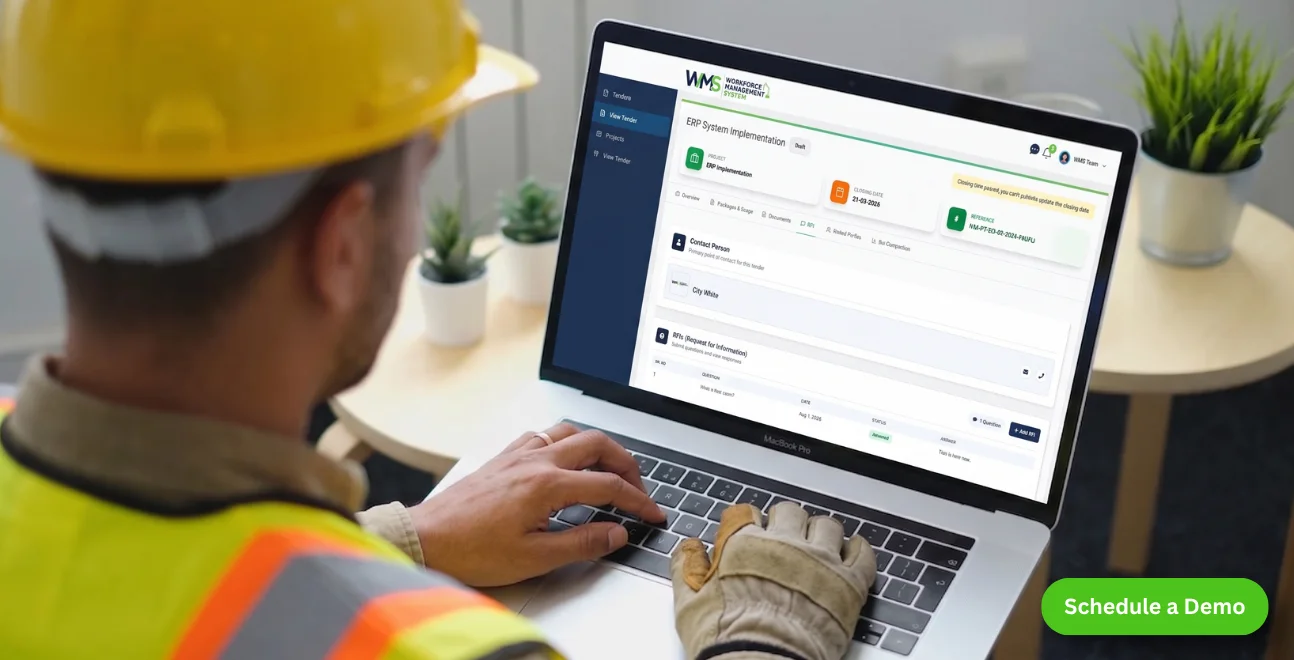
Winning a tender is the first hurdle. Winning the client's trust during delivery is what gets you invited back without having to tender again.
Clients increasingly expect real visibility into labour hours, site attendance, and progress once work is underway, not just an invoice at the end of the month with no detail behind it.
Centralised reporting tools that draw straight from timesheets and HR records give clients that transparency without adding hours of admin to your week. It's also the track record your referees will be vouching for on your next bid.
Pick Your Tenders Wisely
Not every opportunity that lands in your inbox is worth chasing. Bidding on everything wears out your estimator and quietly drags your win rate down.
Before committing, weigh up:
- Your capacity to actually deliver the project on the stated timeline
- Your existing relationship (or lack of one) with the client
- Your realistic chance of winning against the likely field
If two of the three are shaky, it's usually smarter to pass and put that time into a bid you can actually win.
Where to Find Tenders
Knowing how tenders are done in Australia starts with knowing where they're published. Most federal work goes through AusTender, the Commonwealth's free procurement portal.
Each state and territory runs its own system on top of that, eTenders in Queensland, Tenders VIC in Victoria, the NSW eTendering site, and similar platforms elsewhere. Local councils often publish separately again, so it pays to check both levels.
Register across whichever portals cover your trade and region, and keep an eye on guidance published by industry bodies such as Master Builders Australia.
Keep Your Documents Ready
Contractors who win tenders consistently aren't pulling documents together the night before a deadline. They keep a compliance library ready year-round.
| Document | Why it matters | Refresh cycle |
|---|---|---|
| Public liability insurance certificate | Confirms you can cover project risk | Annually or on renewal |
| WHS management plan | Shows a documented safety system | Annually |
| Financial references or statements | Confirms capacity to carry the contract | Annually |
| Capability statement | Summarises experience and resourcing | Every six months |
| Case studies and referee list | Validates past performance | Tailored per tender |
| Environmental management plan | Required on sites with environmental risk | Annually |
When a tender lands, you're assembling a response from material you already have, rather than starting from a blank page under deadline pressure.
Common Pricing Structures
Two structures dominate construction tendering in Australia, and a third turns up often enough to know.
| Structure | How it works | Best suited to |
|---|---|---|
| Lump sum | Fixed price for the full, clearly defined scope | Well-defined projects where the client wants cost certainty |
| Schedule of rates | Priced per item, paid on actual quantities completed | Projects where quantities aren't fixed upfront |
| Cost-plus | Actual costs reimbursed plus an agreed margin | Projects with genuine scope uncertainty |
Under-quoting to win a tender contract is one of the quickest ways to win a job that ends up costing you money. Price from current rates and build in a sensible contingency. Evaluators can usually tell a considered number from a guess.
Show You Can Resource the Job
A strong price and a strong methodology don't count for much if you can't back them up with real plant, equipment, and crew. Evaluators cross-check resourcing claims against your current workload.
List what you own, what's leased, and what's genuinely free for this project's timeline, rather than a fleet list that's already committed to another site.
Keeping a live, accurate register of asset availability means resourcing questions get an honest, fast answer instead of a guess.
Keep Your Safety Records Handy
Safety documentation isn't a formality anymore. On plenty of tenders, it carries as much weight as price.
That means toolbox talks, pre-start checklists, incident records, and site inductions that are logged, dated, and easy to produce the moment a client asks for them.
Keeping safety and compliance records centralised means you're pulling a report rather than chasing paperwork across three sites when it counts.
What Tier 1 Contractors Want
Subcontractors chasing work with Tier 1 and Tier 2 head contractors face an extra layer of scrutiny, and a competitive price barely gets you in the room.
Head contractors want to see:
- Enough spare capacity to genuinely take on the work
- Financial stability to pay your crew while waiting on payment
- Safety procedures that line up with their own systems
Knowing exactly who's available, where, and for how long matters here. A visible scheduling gap can sink an otherwise strong submission. Purpose-built subcontractor workforce management tools give you that visibility without a spreadsheet marathon every time a tender lands.
Manage Tenders in One Place
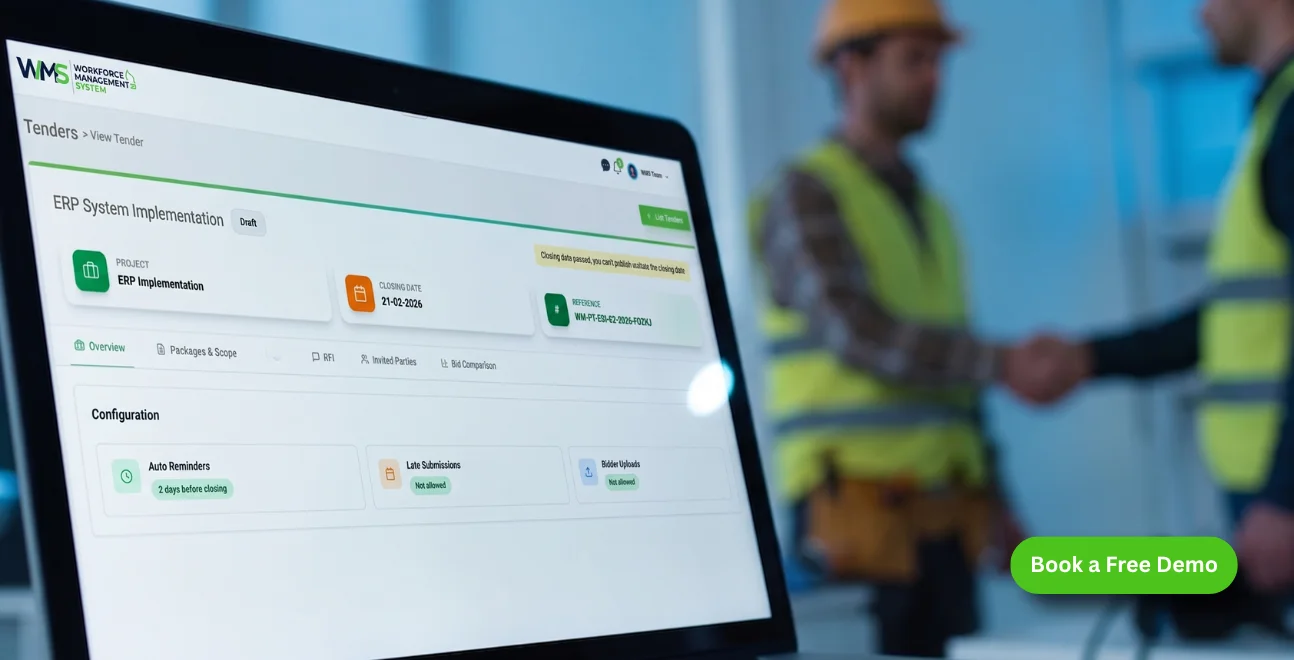
For a lot of construction businesses, tender management still lives across scattered emails, shared drives, and whoever happens to remember what was submitted last time.
WMS's tender management feature tracks every opportunity from first sighting through to award, with deadlines and documents visible to the whole team rather than one person's inbox.
Your compliance library, project history, and case studies live in the one place, ready to be pulled into the next bid within minutes rather than days. Pair it with project task management once you've won the work, so the platform that helped you bid also helps you deliver.
Always Ask for a Debrief
Unsuccessful bidders can request a debrief, and it's genuinely one of the more useful half-hours available to anyone still working out how to win tenders in Australia.
The feedback tells you exactly where you dropped points, whether that's price, methodology, or a mandatory requirement you missed altogether. Contractors who make debriefing a habit tend to see a real lift in win rate over twelve months.
Treat every loss as information. Adjust the template, tighten the number, and go again with a sharper submission next time.
Common Bidding Mistakes
- Bidding on everything. It wears out your estimator and drags your average win rate down.
- Under-pricing to win. A job won on a bad number is worse than no job at all.
- Ignoring the scored criteria. Write to what's assessed, not what you feel like saying.
- Leaving it late. Rushed submissions miss requirements, and it shows.
- No centralised records. Chasing certificates under deadline pressure is where errors creep in.
Conclusion
Winning construction tenders in Australia comes down to answering the brief properly, proving your capability with evidence, and having documentation ready well before the deadline bites.
The contractors who win consistently have usually built a system for it. Compliance sits in one place. Project history is tracked and easy to pull up when a client or evaluator asks for it.
If your tender process is still running out of spreadsheets and shared folders, it's worth a look at what a purpose-built platform changes. Explore WorkForceMS's tender management features, browse the full feature set, or start a 14-day trial.
Optimise your operations with WMS
Streamline scheduling, compliance, and workforce management in one platform.
Frequently Asked Questions
The buyer posts a request for tender on a government or private tendering website, and the businesses write the responses to the tender and respond to the criteria, and then the contract goes to an evaluation panel that rates each bid based on price, quality, experience, and risk before deciding on the winner.
Keep to a manageable number of tenders that you believe you can win, don't start bidding too broadly, respond directly to each of the criteria scored, bid with reasonable contingency, have compliance documents up-to-date and ready to submit.
An EOI is a process that is used to shortlist suitable suppliers before the formal bid process (RFT) is opened, whereas an RFQ is a simpler, quicker process that is often used for lower-dollar goods or services.
A government construction tender response is usually prepared properly in about 40-80 hours, depending on how complicated the construction tender is and how up-to-date your compliance documentation is.
Yes. Most Australian government agencies provide unsuccessful bidders an opportunity to receive a debrief, and if you incorporate the lessons learned from that debrief regularly, you are more likely to be a successful bidder later on.
While it is not a requirement, having your compliance library, project history, and submission tracking all in one place will cut down preparation time and will decrease the chances of missing a mandatory requirement.
Generally not. Every hour spent on a low-probability bid is an hour not spent sharpening a submission you actually have a realistic shot at winning.
Related Articles
Explore more insights on workforce management, compliance, and operations.

AI-Powered Employee Management for Modern Businesses
Discover how AI-powered employee management helps businesses simplify scheduling, attendance, payroll, and compliance across shift-based teams.

Muhammad Asim
01 Oct 2026

Top AI Solutions To Manage Construction Workforce
Explore the top AI solutions for managing a construction workforce, from onboarding to payroll and safety, with human review built in.
Muhammad Asim
14 Sep 2026

Streamline Job Tracking with AI Construction Management Software
Discover how AI construction management software streamlines job tracking, project planning, risk alerts, defect reporting and safety compliance.
Muhammad Asim
11 Sep 2026
Ready to secure your operations?
