Plant & Equipment Register Requirements in Australia
Understand plant and equipment register requirements in Australia: WHS rules, state differences, and how to keep your construction business audit-ready.
Streamline your frontline operations
Construction sites run on machinery: cranes, excavators, hoists, compressors, and EWPs. Most of it needs to be tracked somewhere, and a fair chunk needs to be registered with a regulator before it touches a job.
Confuse the two and you're exposed. A plant and equipment register is your own internal record. Plant registration is a legal obligation under work health and safety law. Plenty of Australian builders mix them up.
This guide clarifies the definition of 'plant' under WHS law, what requires formal registration, and the differences in the rules between states, as well as how to create a register to ensure that the register is audit-ready for your business.
This article is about the general WHS obligations at the time of writing. This is a general guideline and may differ depending on state and type of plant; please check with the relevant WHS regulator before using it as a definitive source of information.
What Counts as Plant Under WHS Law
"Plant" is not only limited to what most people think of as a plant. It applies to machinery, equipment, appliances, containers, implements, and any tools attached or connected to them under the model WHS Act.
In a construction application, that includes excavators, concrete pumps, cranes, elevated work platforms, compactors, forklifts, pressure vessels, and numerous hand-held power tools.
Not everything on that list needs formal registration. But everything on it needs to be on your radar for inspection, maintenance, and risk management, which is where your internal register comes in.
The Register and the Registration Aren't the Same Thing
A plant and equipment register is a document, often a spreadsheet or a system, that lists every item your business owns or hires, along with service history and inspection dates.
Plant registration is different. It's a formal process with a state or territory WHS regulator, required only for specific high-risk items listed in Schedule 5 of the WHS Regulations.
You can have a perfect internal register and still be non-compliant if a registrable crane on your site was never formally registered. Both matter, but they solve different problems.
Which Items Actually Need Registering
Registrable plant in construction is a defined list, not a judgement call. It typically includes:
- Tower cranes, including self-erecting tower cranes
- Hoists designed to lift people, with platform movement over 2.4 metres
- Mobile cranes above a set lifting capacity
- Pressure vessels and boilers rated hazard level A, B, or C
- Lifts and escalators
- Gantry or bridge cranes handling molten metal or hazardous chemicals
Standard hand tools, most EWPs, and general earthmoving equipment usually fall outside this list, though they still need inspection records under your general WHS duties.
Design Registration Versus Item Registration
Plant design registration lookup requests trip a lot of people up, mostly because design and item registration are two separate steps.
Design registration covers the engineering concept behind a type of crane or pressure vessel and applies to every unit built to that design. A manufacturer can't legally supply a plant unless the design is registered first.
Item registration applies to the specific physical unit you own or operate. Each individual crane, hoist, or pressure vessel of a registrable type needs its own item registration, even where the design was registered years ago.
If a design is already registered in one state, most other jurisdictions recognise it under the model WHS laws, so you're not starting from scratch every time you cross a border.
Where the Rules Differ by State
Most of Australia runs on the model WHS laws, but a few states go their own way. It's worth knowing which regulator you're dealing with before lodging anything.
| State/Territory | Regulator | Notes |
|---|---|---|
| NSW | SafeWork NSW | Follows model WHS laws; design registration recognised nationally |
| QLD | WorkSafe QLD | Follows model WHS laws; strict Schedule 5 plant list |
| VIC | WorkSafe Victoria | Operates under the OHS Act 2004, not the model WHS Act |
| WA | WorkSafe WA | Adopted model WHS laws in March 2022; registrations are perpetual |
| SA | SafeWork SA | Follows model WHS laws; detailed pressure equipment rules |
| ACT | Access Canberra / WorkSafe ACT | Follows model WHS laws; interstate registration recognised |
Victoria is the one to watch closest if you're used to the model laws elsewhere. Its plant requirements sit under different legislation entirely, so paperwork from NSW or QLD doesn't transfer automatically.
Finding an Existing Plant Design Registration
Bidding on a job involving hired plant or buying second-hand equipment means checking whether the design is already registered before relying on it.
Most regulators, including SafeWork NSW, offer a formal search process for existing design records, usually through a written application confirming ownership or authorisation from the design owner.
It's slower than most people expect. Build the lookup time into your project planning rather than leaving it until the equipment is due on site.
Building a Register That Actually Works
Beyond formal registrations, every construction business needs its own working plant and equipment register: the practical document showing what you own, where it is, and when it's due for service. A solid register generally tracks:
- Item description, make, model, and serial number
- Purchase or hire status and current site location
- Registration status and expiry, where applicable
- Last inspection date and next one due
- Maintenance and repair history
A plant and equipment register template in Excel can get a small operation started, but it ages fast. Static spreadsheets don't flag an overdue inspection or update automatically when a crane moves between sites.
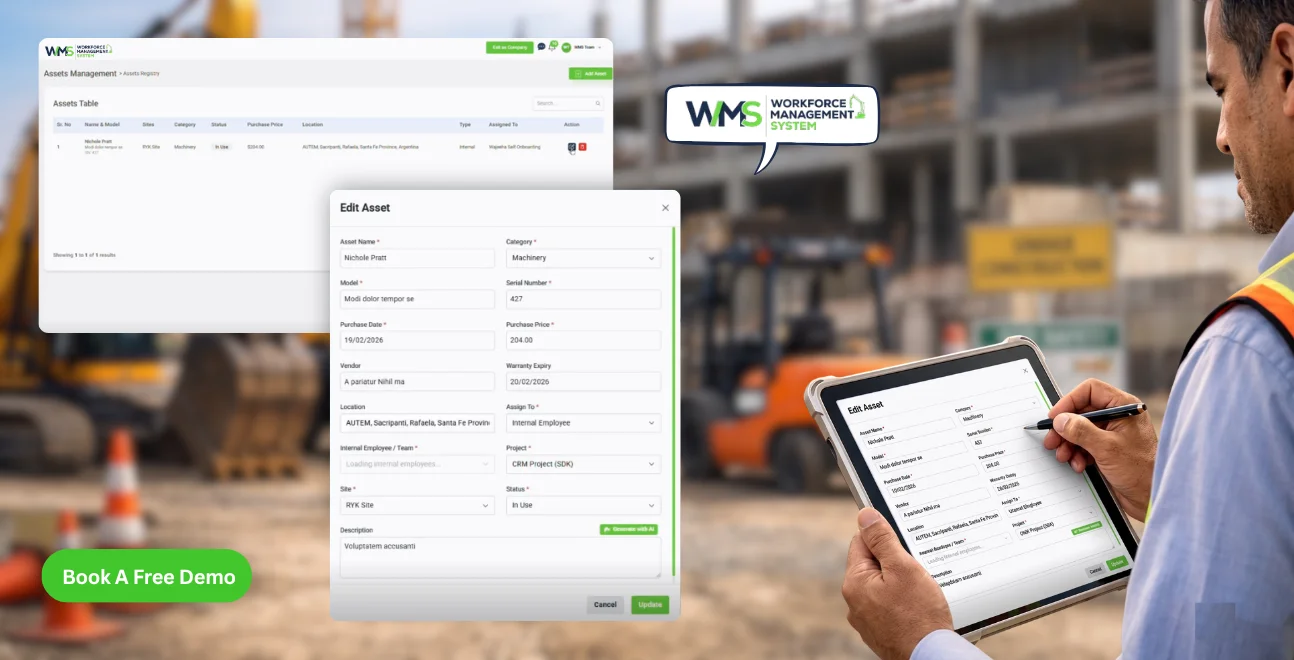
A live asset management system keeps one accurate record instead of five competing spreadsheets, with due dates and locations updated as equipment actually moves.
Inspections and Keeping Records Current
Registration is a one-off event. Inspection is ongoing, and it's usually where compliance quietly breaks down over time.
Mobile and tower cranes require major inspections at set intervals, often tied to manufacturer guidance. Pressure equipment carries its own inspection cycle under Australian Standards.
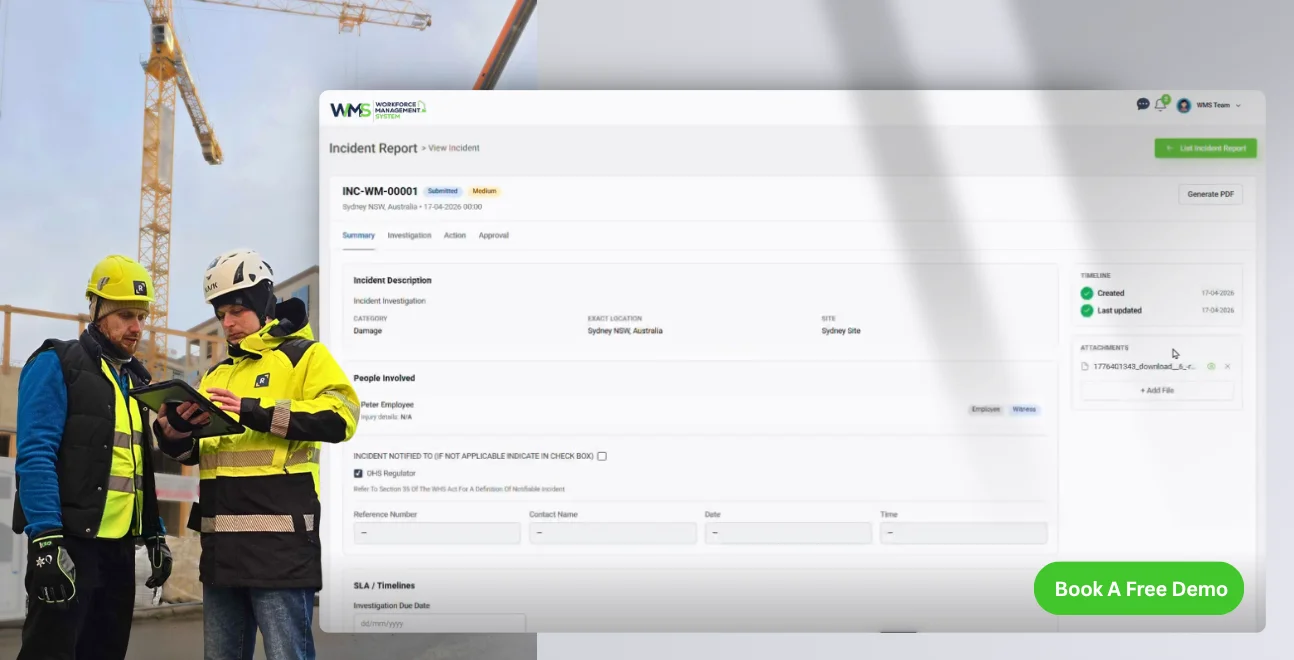
Keeping safety and compliance records centralised alongside your asset register means an inspection date doesn't get missed because it was buried in someone's inbox.
Duty of Care: Where WMS Closes the Gap
WHS law puts the obligation on the "person conducting a business or undertaking", or PCBU, not on a single job title. On most sites, that duty sits with whoever has management or control of the plant.
That can be the owner, but it can just as easily be a head contractor managing a hired crane or a subcontractor who brought their own compactor onto someone else's site. Ownership and WHS duty aren't automatically the same thing.
If you're the head contractor with control of the site, you can still carry out duties for plants you don't own. Knowing what's on site and whether it's within its inspection window matters just as much for subcontractor equipment as your own. Visibility across subcontractor workforce management and asset tracking together closes a gap a lot of businesses don't spot until an inspector points it out.
What Happens When Records Fall Behind
A mid-sized civil contractor is running three sites at once. A mobile crane's major inspection lapses by six weeks because the reminder lived in one supervisor's calendar, and that supervisor was on leave when it came due.
A SafeWork inspector turns up for an unrelated audit and asks for the crane's current certificate. It isn't there. Work on that section of the site stops immediately while the inspection is arranged.
It's a lost week, a missed milestone, and an uncomfortable conversation with the client. None of it came from bad intentions. It came down to one date sitting in the wrong place. That's the practical cost of running compliance on memory and personal calendars.
What It Costs to Get This Wrong
Operating an unregistered plant, or a plant with an expired inspection, is a genuine WHS breach, not an administrative technicality. Regulators treat plant failures seriously given the injury and fatality risk involved.
Penalties vary by state and by the severity of the breach and can extend to significant fines or, in serious cases, prosecution under the WHS Act.
If you're unsure whether a specific item needs registration, contact your state WHS regulator directly rather than assuming. It's a faster conversation than dealing with a stop-work notice.
Who Can Actually Sign Off an Inspection
Registration and inspection paperwork usually needs sign-off from a "competent person": someone with the right qualifications or demonstrated knowledge of the specific plant type being assessed.
For pressure equipment, that often means relevant engineering qualifications. For cranes and hoists, it can mean specific technical training tied to that equipment class rather than a general trade licence.
Get this wrong and the inspection itself can be challenged later, even if it was carried out in good faith. It's worth confirming a contractor's competency credentials before booking them, not after the certificate's already been issued.
Buying a Second-Hand Plant: What to Check First
Second-hand equipment is common on Australian sites, and it comes with its own compliance checklist before it ever reaches the gate.
Before buying, confirm the item's design registration status, whether its item registration transfers with ownership, and how current its last inspection actually is. A seller's word isn't enough on its own.
Request a full written history of the plant (registration certificates, inspection records, modification history, etc.). Changes made to a design which affect safety will require re-registration for reuse, if that is the case.
One of the more common ways that businesses get unregistered equipment on their premises is by not doing it, as the previous owner's paperwork usually doesn't transfer with the equipment automatically.
Why This Matters Beyond Compliance
A clean plant and equipment register isn't only about avoiding a stop-work notice. It also becomes evidence of capability when you're chasing new work.
Tender evaluators and head contractors regularly ask for proof of registered plant, current inspection dates, and resourcing availability before awarding a contract. A business that can produce this instantly looks lower-risk than one that promises to "get back to them".
The same register that keeps you compliant day to day doubles as a credibility asset the moment a bigger opportunity lands. Businesses that treat their equipment records as strategic assets, not just a filing obligation, tend to win larger and more consistent work over time.
Operator Licensing Sits Alongside Plant Registration
Registering the plant itself is only half the picture. Certain high-risk items also require the operator to hold a specific licence, separate from the plant's own registration status.
Tower cranes, mobile cranes above set capacities, and certain hoists fall under high-risk work licensing classes set out in the WHS Regulations. An unlicensed operator on a correctly registered plant is still a compliance breach.
Cross-checking operator licences against the equipment they're assigned to is easy to overlook when scheduling is done manually across multiple sites. Building this check into your rostering process, rather than trusting it to memory, closes a gap that's just as costly as an expired plant registration.
Common Mistakes to Avoid
- Assuming hired equipment is someone else's problem. You still carry WHS duties as the person with management or control on site.
- Registering the item but not tracking the inspection cycle. Registration without ongoing inspection isn't compliance.
- Running the register in someone's personal spreadsheet. It disappears the day that laptop dies or that person leaves.
- Assuming interstate recognition covers everything. Design registration usually transfers; item registration and inspections don't always.
- Treating VIC and WA the same as everywhere else. Both differ enough to catch out a business used to the model laws.
Conclusion
Getting plant and equipment register requirements right in Australia comes down to keeping two things straight: your own internal record of what you've got and the formal registrations the law actually requires.
Miss either one and you're carrying risk to your workers, your project timelines, and your standing with regulators and head contractors. It's rarely a dramatic failure that causes the damage. More often it's a missed date or an out-of-date spreadsheet.
If your current system is a spreadsheet nobody fully trusts, it's worth seeing what a connected platform changes. Explore WorkforceMS's asset management features, read more on safety and compliance for construction teams, or start a 14-day trial.
Start a 14-day trialOptimise your operations with WMS
Streamline scheduling, compliance, and workforce management in one platform.
Frequently Asked Questions
It's an internal record listing every item of plant a business owns or hires, including registration status, inspection history, and current location, separate from any formal registration lodged with a WHS regulator.
Under the model WHS Act, plant includes machinery, equipment, appliances, containers, implements, and tools, along with any components fitted or connected to them.
Design registration is generally recognised across states operating under the model WHS laws, but item registration and inspection requirements can still differ, so confirm with the relevant regulator.
Most regulators, including SafeWork NSW, provide a formal search process requiring proof of ownership or authorisation, submitted as a written application rather than an instant online search.
If the item falls under Schedule 5 of the WHS Regulations, it needs to be registered regardless of whether you own or hire it. The obligation follows the person with management or control of the plant.
It's treated as a genuine WHS breach and can result in a stop-work notice, fines, or prosecution depending on severity and the state you're operating in.
Related Articles
Explore more insights on workforce management, compliance, and operations.

Top AI Solutions To Manage Construction Workforce
Explore the top AI solutions for managing a construction workforce, from onboarding to payroll and safety, with human review built in.
WorkforceMS Team
14 Sep 2026

Streamline Job Tracking with AI Construction Management Software
Discover how AI construction management software streamlines job tracking, project planning, risk alerts, defect reporting and safety compliance.
WorkforceMS Team
11 Sep 2026

Skills and Compliance Management for Construction Teams
Manage skills and compliance for construction teams with WorkforceMS. Track licences, SWMS, inductions and audits in one workforce management system.
WorkforceMS Team
10 Sep 2026
Ready to secure your operations?
