Subcontractor Compliance Checklist: A Builder's Shield Against Fines and Shutdowns
Free subcontractor compliance checklist for Australian construction. Covers NSW rules, required documents, templates, and audit red flags to avoid fines.
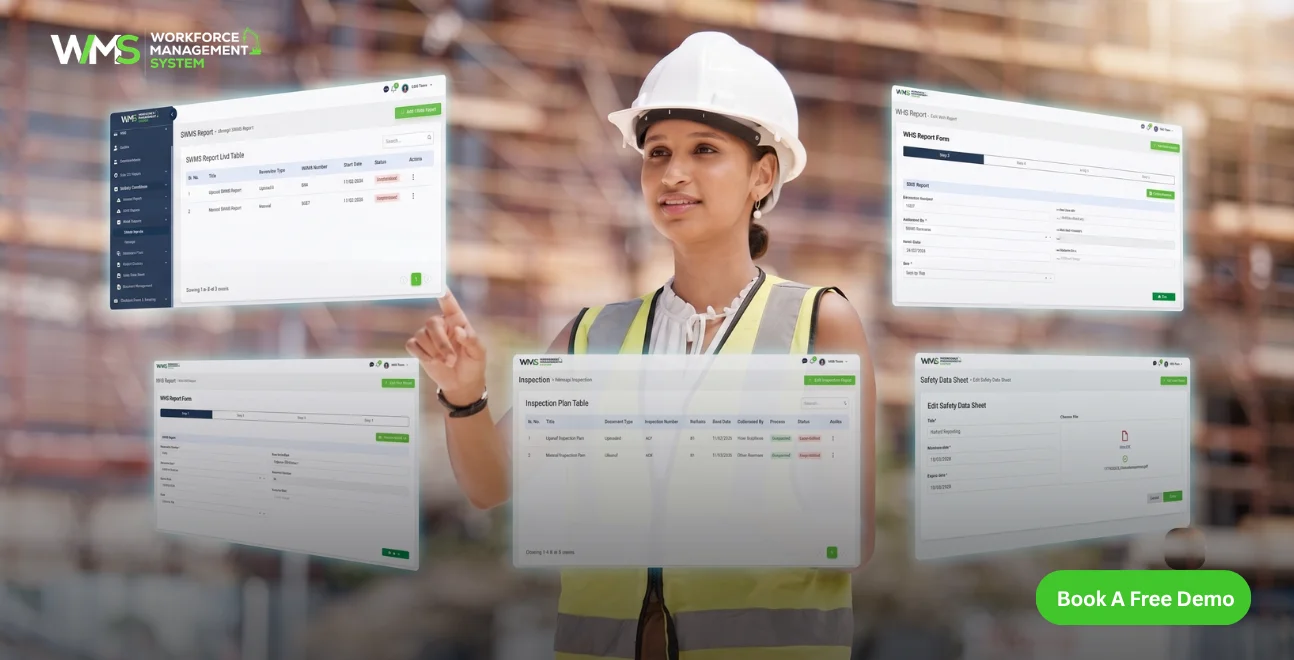
Streamline your frontline operations
A single unverified subcontractor can shut down your site, trigger a Fair Work investigation, or leave your business exposed to unpaid superannuation claims. In Australian construction, compliance isn't paperwork for paperwork's sake: it's the difference between a project that runs and a project that gets stopped dead by a regulator.
This guide breaks down exactly what a proper subcontractor compliance checklist needs to cover, why NSW and federal rules keep tightening, and how builders across Australia are moving away from clunky PDFs towards systems that verify subcontractors automatically.
Whether you're a principal contractor managing forty trades on a residential build or a tier-one head contractor running a $50 million commercial job, the fundamentals below apply to you.
From Site Risk to Boardroom Risk
Construction insolvencies have surged over the past two years, and a large share trace back to poor subcontractor oversight: unpaid super, uninsured trades, or workers misclassified as contractors when they should have been employees.
Regulators have noticed. The Australian Taxation Office now cross-matches Taxable Payments Annual Report (TPAR) data against ABN records, superannuation reporting and Single Touch Payroll to flag warning signs such as a contractor working almost exclusively for one business, or an individual holding an ABN while failing to declare income or lodge tax returns. Construction is one of the industries that is closely monitored.
Meanwhile, the Fair Work Ombudsman is still pursuing sham contracting cases: those where a business deliberately or negligently classifies its employees as contractors to avoid entitlements. Each violation can attract very heavy penalties to the business and to the persons involved.
For a principal contractor, this means compliance isn't a "nice to have" filed away in a site office drawer. It's a legal and financial exposure that sits with your business the moment a subcontractor steps onto your project.
What a Compliance Checklist Actually Covers
A compliance checklist is a detailed document that demonstrates that a subcontractor has fulfilled all legal, contractual and safety requirements before, during and after the engagement. It will normally include insurance, tax status, worker entitlements, and safety paperwork and documentation along with licensing.
When done right, it's not an after-thought document that's signed at induction time and then put aside. A document that is continually updated and examined at licence expiration, insurance renewals and risk changes to the project.
So many builders are looking for a subcontractor compliance checklist template, or a subcontractor compliance checklist PDF, hoping to find a ready-made checklist. The reality is that static documents go stale within months: a licence lapses, a policy expires, and nobody notices until an incident forces the issue.
The Rules Sitting Behind Every Checklist
Australian construction compliance rests on multiple frameworks, and compliance with any one single framework equates to actual liability.
- Genuine contracting and sham contracting are regulated by the Fair Work Act 2009. Its sham contracting provisions forbid an employer knowingly or recklessly giving the appearance of an independent contractor and also prohibit an employer from terminating an employee and re-engaging him as a contractor to evade obligations arising out of the original contract.
- Australian Taxation Office obligations: superannuation guarantee, TPAR lodgement and ABN verification. In some cases, an active ABN holder may also be entitled to superannuation benefits, as if they were an employee.
- State work health and safety inspectors: SafeWork NSW, WorkSafe Victoria, WorkSafe Queensland and others (depending on the state or territory which will require site specific safety documentation, inductions and licensing checks prior to commencing work).
- State building and construction authorities: issuing the trade licences, contractor licences and registration numbers that must be verified and kept current for every subcontractor on site.
Because these frameworks intersect, a genuinely useful checklist has to pull from all four, not just the insurance certificate a subcontractor happens to email through.
Documents Every Subcontractor Must Hand Over
Before any subcontractor is allowed on site, principal contractors should collect and verify the following. This answers one of the most common questions builders ask: what documents do I need from a subcontractor?
- Australian Business Number (ABN): active and registered for the correct trade classification
- Public liability insurance: currently active, with an adequate coverage limit for the scope of works
- Workers' compensation insurance: or evidence of personal cover if operating as a sole trader
- Trade or contractor licence: valid for the relevant state and specific trade classification
- White Card (General Construction Induction Card): for every worker attending the site, not just the business owner
- Safe Work Method Statement (SWMS): for any high-risk construction work being undertaken
- Superannuation compliance evidence: particularly where the working arrangement resembles employment
- Site-specific induction sign-off: confirming the subcontractor understands project-specific hazards and rules
Each item on this list carries a different renewal cycle, which is precisely why a static spreadsheet becomes a liability of its own. A licence checked in January can quietly lapse by June with nobody the wiser.
Verification Requirements at a Glance
| Compliance Area | Documents Required | Verification Frequency |
|---|---|---|
| Business identity | ABN, GST registration, business insurance certificate of currency | At engagement, then annually |
| Public liability | Certificate of currency (minimum coverage per contract) | At engagement and on renewal |
| Workers' compensation | Policy schedule or sole trader personal accident cover | At engagement and on renewal |
| Licensing | State trade or contractor licence number | At engagement, then before each renewal date |
| Site safety | White Cards, SWMS, site induction record | Before first site access |
| Worker classification | Contract for services, control and independence indicators | At engagement, reviewed at contract renewal |
| Superannuation | Evidence of SG compliance where applicable | Quarterly, aligned with SG due dates |
| Sham contracting risk | Declaration of Compliance / self-assessment checklist | At tender and annually thereafter |
This table can be quite difficult to keep up to date on dozens of subcontractors with different expiration dates on real projects.
Building Your Own Checklist Template
If you're assembling a checklist from scratch rather than sourcing a free subcontractor compliance checklist online, structure it in three stages.
- Stage one: pre-engagement vetting. Verify ABN status, licensing, and insurance before a tender is even accepted. This is where sham contracting risk is easiest to catch, since you're assessing the working arrangement before it exists.
- Stage two: onboarding and induction. Collect White Cards, SWMS documents, and site-specific induction sign-offs. No subcontractor or their workers should access the site before this stage is fully closed out.
- Stage three: ongoing monitoring. Track expiry dates for licences and insurance, review superannuation compliance quarterly, and re-run sham contracting self-assessments annually or whenever the scope of engagement changes materially.
A generic contractor compliance checklist PDF downloaded from the internet rarely accounts for stage three, which is where most real-world breaches actually occur: not at onboarding, but months into a project when a certificate quietly lapses.
NSW Rules: What's Different
NSW builders carry a few additional obligations beyond the national baseline.
The documentation for high-risk construction work is required by SafeWork NSW, and the frequency of site safety inspections (SIs) has been increased in NSW in recent years. It is important that SWMS documents are stored and remain up to date for all high-risk tasks and are not left in the head office.
The NSW Long Service Corporation scheme requires registration of eligible workers in the building and construction industry, which principal contractors should confirm as part of onboarding for longer-term subcontract arrangements.
icare NSW governs workers' compensation for the state, and coverage evidence should be checked against icare's requirements specifically, rather than assuming a generic national policy automatically satisfies NSW rules.
Victoria runs a parallel but distinct approach worth noting. The Building Industry Consultative Council (BICC) has created its Sham Contracting and Visa-Compliance Code of Conduct to educate principal contractors and subcontractors about their legal responsibilities in terms of immigration and workplace laws. It's worth reviewing even for builders operating primarily in NSW, since the underlying VEVO and declaration principles are increasingly adopted as best practice nationwide.
Where Free PDF Checklists Fall Short
A downloadable subcontractor checklist PDF is a genuinely useful starting point for a business engaging two or three trades. It becomes a liability the moment you're managing twenty, forty or a hundred subcontractors across multiple live sites.
The problem isn't the checklist itself: it's what happens after it's filled in. A signed PDF sitting in an inbox doesn't alert anyone when a licence is thirty days from expiring. It doesn't flag that a subcontractor's insurance lapsed last week while their crew is still on site today.
This is where builders start searching for a subcontractor audit checklist template that can actually be tracked over time, rather than a one-off form. The honest answer is that a template alone can't solve a tracking problem: only a system built around ongoing monitoring can.
Automating Compliance With WMS
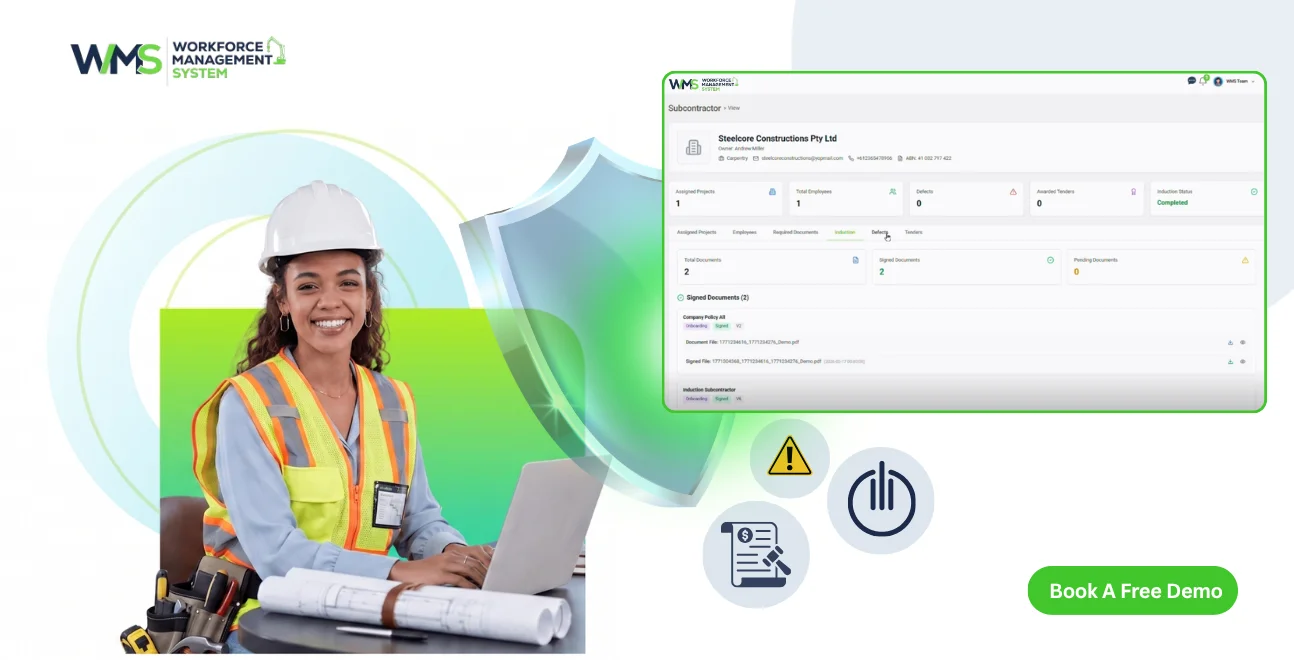
This is precisely the gap that a purpose-built subcontractor management platform is designed to close. Instead of chasing certificates over email, compliance data lives in one place, with automatic alerts before anything expires.
WMS was built for Australian construction businesses managing exactly this problem: HR, subcontractors, sites, and safety, all in a single platform rather than scattered across spreadsheets and inboxes. The Safety & Compliance module tracks licence and insurance expiries automatically, so a lapsed certificate gets flagged weeks in advance rather than discovered during an audit.
Because subcontractor records sit alongside site and project management, a principal contractor can see instantly which trades on which sites have outstanding compliance items, rather than manually cross-referencing a spreadsheet against a project schedule.
For businesses managing the tender process itself, the Tender Management feature allows compliance checks to happen at the pricing stage, before a subcontractor is even engaged, closing the gap that catches most sham contracting risk early.
The result is a checklist that enforces itself. No subcontractor gets scheduled onto a site without current documentation, because the system won't allow it.
Red Flags During an Audit
Certain patterns should prompt a closer look at any subcontractor relationship, particularly during a formal subcontractor audit checklist review.
A subcontractor who works exclusively for one business, uses only that business's tools and equipment, and has no other clients is displaying classic sham contracting indicators. So is a worker whose ABN was registered only days before starting on your project.
Insurance certificates that don't match the trade being performed, or coverage limits well below the industry standard for the scope of work, both warrant a follow-up conversation before work proceeds. The same applies to a subcontractor unable to produce evidence of superannuation payments to their own workers when they employ staff.
None of these red flags alone proves wrongdoing. Together, and left unaddressed, they build the kind of pattern that regulators are specifically trained to detect through TPAR data matching.
How Often to Review Compliance
Annual review is the minimum, but it isn't sufficient for active sites. Insurance and licensing should be reviewed on each renewal period, superannuation compliance should be done on a quarterly basis, and sham contracting self-assessment should be undertaken at every engagement when there is a change in nature or duration.
If a project is to be implemented over a period of more than twelve months, then compliance needs to be incorporated into the monthly site meetings rather than be an annual administrative requirement. This is precisely the cadence that manual PDF-based tracking struggles to maintain consistently across a live project.
The Real Cost of Poor Tracking
Consider a mid-sized commercial builder running three concurrent sites with around sixty active subcontractors. A single plumbing subcontractor's public liability insurance lapses mid-project. Nobody notices for six weeks, because the original certificate was filed in an inbox at the start of the job.
During that window, an incident occurs on site involving that subcontractor's crew. The principal contractor now carries exposure that a current insurance policy should have covered: exposure that a simple expiry alert would have prevented entirely.
This scenario plays out across Australian construction sites regularly, and it's rarely due to negligence. It's a tracking failure, born from relying on static documents to manage a moving target.
Getting Compliance Right, For Good
A subcontractor compliance checklist only protects your business if it's actually maintained: not signed once and filed away. Every trade on your site, from a first-week apprentice to a long-standing subcontractor, needs current licensing, insurance and safety documentation for the entire life of a project, not just its first day.
For builders still managing this through spreadsheets and email folders, the risk isn't hypothetical. It's a lapsed certificate away from a Fair Work investigation, a WorkCover claim, or a site shutdown.
If you're looking to make compliance tracking easier and more efficient than it's been in a spreadsheet, see how our subcontractor and compliance tools work together, or contact us to schedule a customised walkthrough for your project, depending on the size.
Book a demoOptimise your operations with WMS
Streamline scheduling, compliance, and workforce management in one platform.
Frequently Asked Questions
It's a document that is regularly updated to show that a subcontractor's licence, insurance, tax registration and safety records are compliant with law and contract, as opposed to just at the time of engagement.
At minimum, an active ABN, current public liability and workers' compensation insurance, a valid trade licence, White Cards for site workers, and evidence the working arrangement doesn't resemble disguised employment.
Contractor compliance spans the Fair Work Act's sham contracting provisions, ATO obligations around superannuation and TPAR reporting, state licensing rules, and work health and safety documentation required before site access.
Federally, obligations centre on the Fair Work Act's treatment of genuine versus sham contracting arrangements, along with the ATO superannuation guarantee and the Taxable Payments Annual Report obligations that apply Australia-wide regardless of state.
ABN details, certificates of currency for public liability and workers' compensation, a valid trade licence, White Cards for all workers attending the site, and a completed site-specific induction and SWMS where high-risk work applies.
Free templates are a reasonable starting point for small operators, though they typically only cover onboarding. Businesses managing multiple subcontractors across active sites generally need ongoing tracking, which a workforce management platform provides rather than a static document.
Related Articles
Explore more insights on workforce management, compliance, and operations.

Top AI Solutions To Manage Construction Workforce
Explore the top AI solutions for managing a construction workforce, from onboarding to payroll and safety, with human review built in.
WorkforceMS Team
14 Sep 2026

Streamline Job Tracking with AI Construction Management Software
Discover how AI construction management software streamlines job tracking, project planning, risk alerts, defect reporting and safety compliance.
WorkforceMS Team
11 Sep 2026

Skills and Compliance Management for Construction Teams
Manage skills and compliance for construction teams with WorkforceMS. Track licences, SWMS, inductions and audits in one workforce management system.
WorkforceMS Team
10 Sep 2026
Ready to secure your operations?
