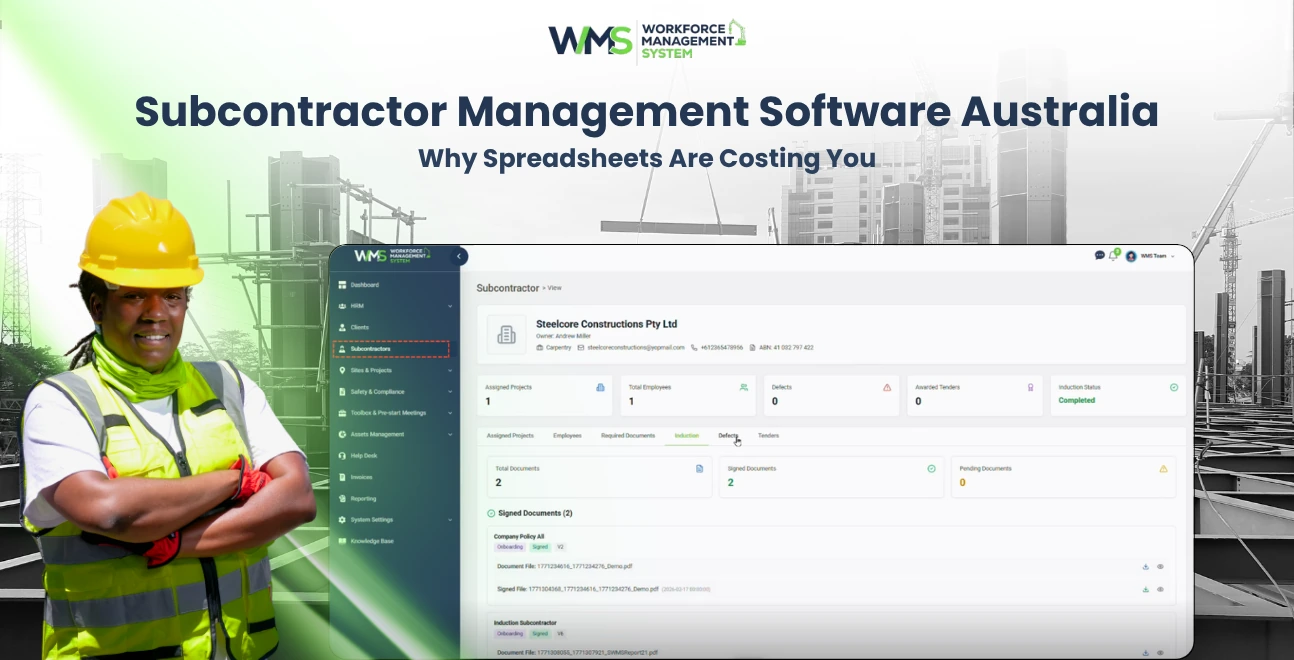
Subcontractor Management Software Australia: Why Spreadsheets Are Costing You
Discover how subcontractor management software helps Australian construction businesses track compliance, manage trades, and ditch the spreadsheet chaos.

Share this article
Streamline your frontline operations
See how WMS simplifies scheduling, compliance and workforce management in one powerful platform.
Every construction business reaches the same turning point. A spreadsheet and a few group chats work fine at first, until the subbie list grows, a licence lapses unnoticed, and the cracks start to show.
This guide covers what subcontractor management software should do, the compliance risks of managing it manually, and how the right platform solves it.
1. The Limits of Manual Subcontractor Management
Spreadsheets are a place to start for any small construction business. The thing is, spreadsheets have some problems. They are not very good when the construction business gets bigger. Spreadsheets do not tell you when there is a problem. Someone has to remember to update spreadsheets all the time.
This is not a system because construction businesses like these rely on spreadsheets to keep track of things. Spreadsheets are not the tool for construction businesses because they do not work well when the business gets bigger and they need someone to always update them. Construction businesses need something other than spreadsheets.
As subcontractor numbers grow, manual systems break down in five predictable areas.
1.1 Licence and Insurance Expiry
Manually checking every subcontractor's documents each month is rarely consistent. The first sign of an issue is often a workplace incident or a compliance audit, not a routine check.
1.2 Scheduling Conflicts and Double-Booking
There's a real problem when we don't have some kind of system that makes it clear who's available to work, and then everything kind of turns into scheduling conflicts, plus double booking. This means that the same subcontractor can be booked for two jobs at the time. We usually find out about this problem on the day of the job, which's too late to fix it easily.
1.3 Communication Gaps
When we send job details by text message, or maybe even in a group chat, we kind of have no record of what was sent, not really, and no actual way to know if the message was received, either. That whole thing makes it easier for errors to slip in and then, later on, misunderstandings and disagreements.
1.4 Invoicing and Hours Reconciliation
Without a system that keeps track of the hours worked, it is hard to line up the hours on a subcontractor's invoice with the hours that were actually worked. And yeah, this process is pretty time-consuming; it drags on more than you'd expect. Often leads to disagreements.
1.5 Compliance Documentation
If someone in charge, or a regulator, asks for proof that every person on the site has the licence and that they've been properly trained, it is hard to locate all of that information quickly inside a spreadsheet, you know what I mean.
And the problems that show up because of these gaps aren't only about paperwork. Scheduling conflicts and double-booking, communication gaps, invoicing and hours reconciliation, plus compliance documentation issues can all contribute to accidents, disputes, failed cheques, and honestly strained relationships with subcontractors too.
2. Spreadsheet vs Subcontractor Management Software
| Function | Manual / Spreadsheet System | Subcontractor Management Software |
|---|---|---|
| Licence and insurance expiry | Checked manually, often missed | Tracked automatically with advance alerts |
| Scheduling and availability | Conflicts discovered on the day | Live visibility, conflicts prevented |
| Communication | No audit trail | Job-linked, timestamped records |
| Timesheets and invoicing | Manually reconciled, dispute-prone | Pre-filled, supervisor-approved |
| Compliance reporting | Slow and incomplete | Instant and audit-ready |
| Scalability | Breaks down past a certain size | Scales with business growth |
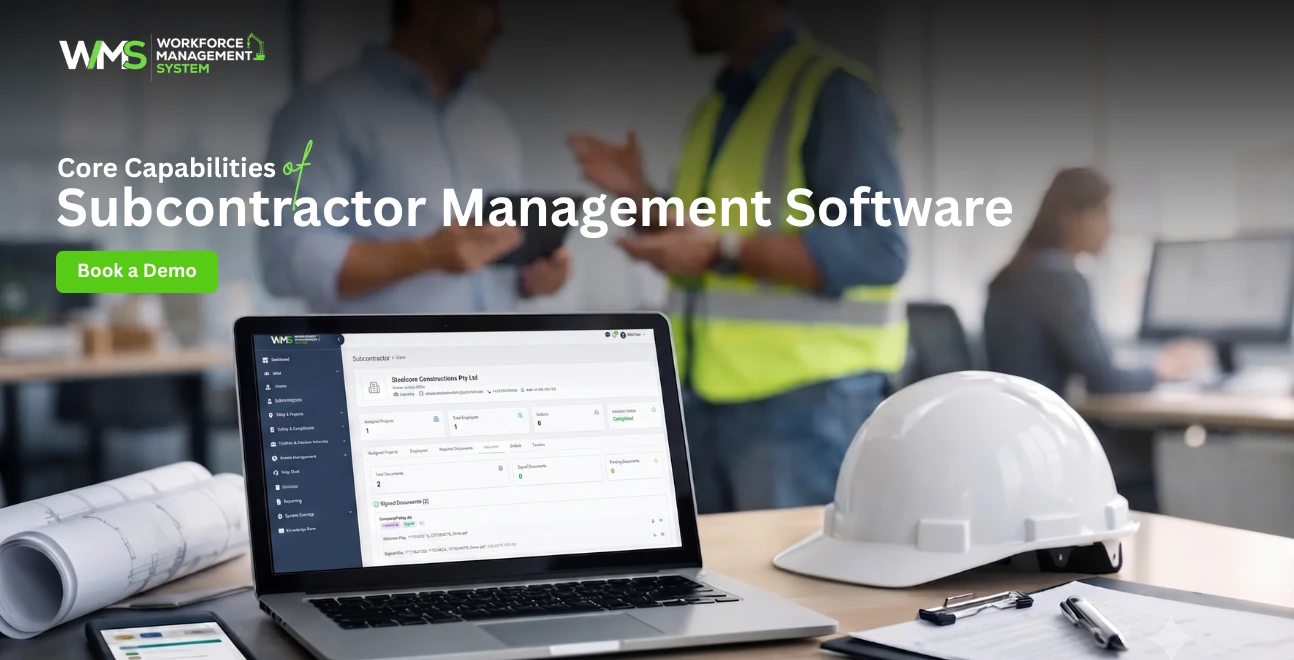
3. Core Capabilities of Subcontractor Management Software
3.1 Availability and Scheduling
A reliable system maintains live visibility of each subcontractor's availability, not just confirmed bookings. This allows project managers to filter by trade, location, availability, and compliance status simultaneously, something a spreadsheet cannot support at scale.
3.2 Subcontractor Compliance Tracking
Subcontractor compliance tracking is the foundation of risk management on any construction site. Software should monitor expiry dates for white cards, trade licences, public liability insurance, and other certifications and prevent rostering when credentials have lapsed.
Under Australian WHS law, principal contractors carry a duty of care extending to subcontractors on site. If an incident occurs involving a subcontractor with expired credentials, compliance records become central to any investigation. Guidance from the Australian Building Codes Board and Master Builders Australia confirms that documented evidence of licensing and induction is expected as standard practice.
3.3 Job-Linked Communication
Structured communication tools attach job briefs, scope changes, and safety instructions directly to the relevant engagement. This creates a timestamped, retrievable record, reducing rework, miscommunication, and disputes.
3.4 Timesheets and Hours Management
Subcontractor hours need to be tracked like direct employee hours.
- We should have a system that automatically fills in timesheets based on scheduled shifts.
- This system should let people submit their hours on their phones.
- Also, a supervisor needs to approve the hours before payment is made.
- The system should be connected so that everything is in one place.
4. What to Look for in a Subcontractor Management Platform
Not all Workforce Management System is built with subcontractors in mind. Many platforms are designed primarily for direct employees, with contractor functionality added as a secondary feature. The following capabilities are essential.
| Requirement | Why It Matters |
|---|---|
| Separate contractor profiles | Distinct compliance fields for ABN, insurance, and licences |
| Automatic expiry alerts | Reduces reliance on manual tracking |
| Compliance-gated rostering | Prevents scheduling non-compliant subcontractors |
| Mobile-first access | Enables on-site use for schedules, forms, and timesheets |
| Job-linked communication | Creates an auditable record per engagement |
| Timesheet integration | Aligns subcontractor and employee approval workflows |
| ABN and insurance verification | Tracks policy numbers and renewal dates accurately |
Under Fair Work rules on contractor classification, businesses must also maintain clear, accurate records distinguishing genuine independent contractors from employees. A well-designed subcontractor portal supports this by keeping documentation consistent and verifiable.
5. How WMS Manages Subcontractors End to End
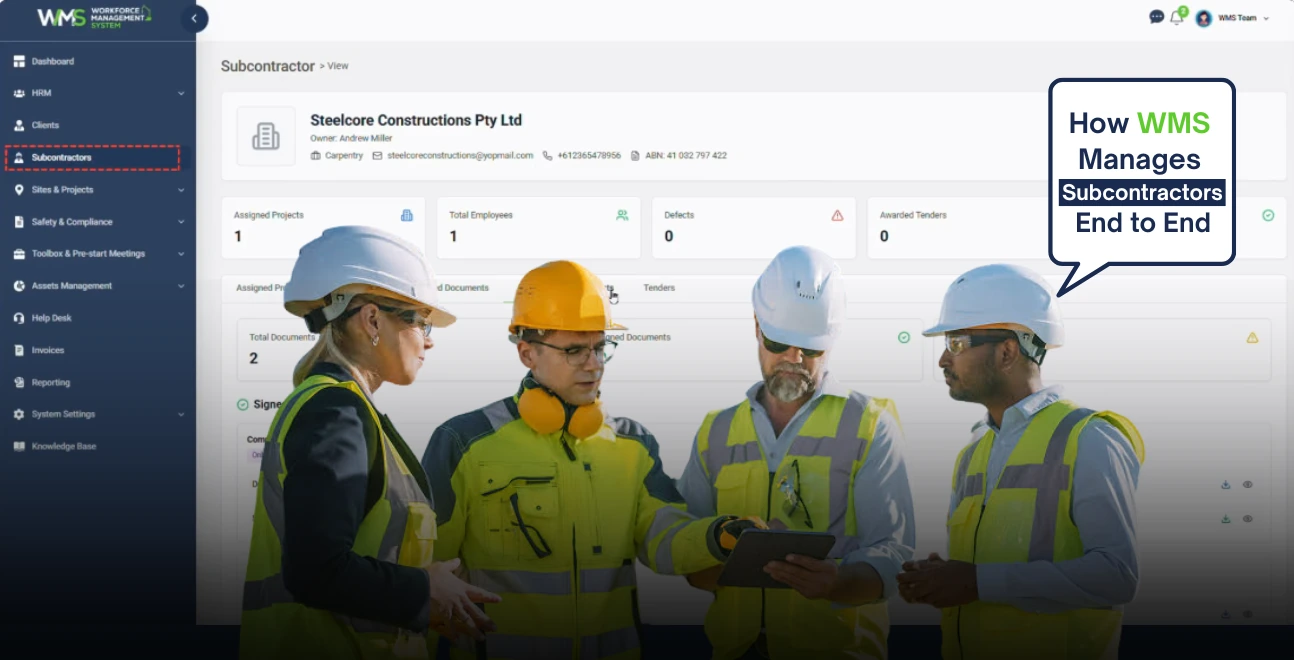
WMS (Workforce Management System) is built specifically for Australian construction and trades businesses. Subcontractors are managed within the same platform as direct employees, rather than as a separate, disconnected system.
The WMS Subcontractor Module is designed to remove manual chasing from subcontractor coordination through the following capabilities.
5.1 Centralised Contractor Profiles
Every subcontractor has a dedicated profile, where ABN, trade licences, insurance details, certifications and those expiry dates sort of live all together in one place.
5.2 Compliance-Gated Scheduling
WMS alerts your team when credentials are approaching expiry and blocks rostering automatically if documentation has lapsed.
5.3 Live Availability Management
Subcontractors update their own availability through the mobile app, giving project managers an accurate, real-time view when filling jobs.
5.4 Integrated Timesheets
Subcontractor hours are tracked through the same system as direct employees: pre-filled from the roster, submitted on mobile, and approved by a supervisor.
5.5 Job-Linked Messaging
All communication is tied to a specific job, timestamped and stored, creating a complete record of what was communicated and when.
5.6 Digital Forms and Inductions
Pre-start checks, induction forms, and other compliance documentation are completed by subcontractors on mobile before work begins.
5.7 The WMS Subcontractor Portal
The WMS Subcontractor Portal gives subcontractors direct access to view jobs, submit hours, complete forms, and communicate with your team, reducing the coordination workload carried by office staff.
5.8 Full Platform Integration
The Subcontractor Module sort of connects directly with HRM, Sites and Projects, Safety and Compliance, Toolbox and Pre-start, and also with invoicing. The data moves automatically between those modules, so there is less manual entry, and yeah, it helps minimise errors as well.
6. The Cost of Poor Subcontractor Management
Disorganised subcontractor management rarely shows up as a single cost. It accumulates across several areas of the business simultaneously.
6.1 Rework
When coordination goes sideways (the wrong subcontractor shows up on the wrong day, or the works start out of sequence), the outcome can be a pretty expensive cycle of rework. Industry data suggests that rework on a $5 million project may climb to something like $200,000 to $300,000, and in practice that figure can wipe out the project's whole margin.
6.2 Compliance Penalties and Reputational Risk
WHS breaches can bring large fines, and if there is a serious incident that traces back to subcontractors who were not compliant, it can mess with tender eligibility later, plus strain client relationships too.
6.3 Lost Administrative Time
The hours spent chasing documentation by hand, and then reconciling timesheets, turn into a direct and ongoing cost. Over a year, that can stack up to tens of thousands of dollars in lost productivity.
7. Conclusion
Proper subcontractor management really leans on visibility, automation, and steady record-keeping, not manual tracking and definitely not relying on memory. As the number of subcontractors increases, the hazards connected with manual systems rise right along with it, sometimes faster than expected.
The WMS Subcontractor Module gives Australian construction businesses a more centralised, compliant and efficient way to manage subcontractors from engagement through project completion, sort of without the usual admin headache. It's kind of like everything is handled all together in one place, not, you know, scattered all around, and then you can move things through more smoothly even when it gets hectic and loud.
Optimise your operations with WMS
Streamline scheduling, compliance, and workforce management in one platform.
Frequently Asked Questions
The gap between a subcontractor and an employee matters for a bunch of reasons, like what they're entitled to, what tax obligations they have to meet, and also who's on the hook if something goes wrong.
Yes. The White Card is mandatory for anyone performing construction work in Australia, regardless of employment status or ABN.
A Certificate of Currency from the subcontractor's insurer confirms the policy number, coverage amount, and expiry date. This is typically a minimum of $10–20 million cover for construction work, though principal contractors may require higher limits.
Yes, with something like a platform such as WMS. Subcontractors can log in to see jobs, send timesheets, fill out forms, and directly message the engaging business in a kind of smoother way. It's not only about access; it's more like keeping things in motion, even if nobody notices.
At minimum: ABN, certificate of currency, trade licences, White Card, site-specific induction records, and hours worked. Records should be retained for at least 7 years for Fair Work purposes.
A centralised system maintains a single contractor profile applicable across all engagements, with compliance credentials updated once and hours tracked individually per job.
Related Articles
Explore more insights on workforce management, compliance, and operations.

Security Operations and Monitoring Workforce Planning
Plan guard rosters, track live attendance and cover every shift with WorkforceMS. Strengthen security operations and monitoring with smarter workforce planning.

Muhammad Asim
09 Oct 2026

Telehealth and Digital Healthcare Scheduling WMS
Simplify telehealth and digital healthcare scheduling with WorkforceMS. Manage rosters, remote clock-ins and compliance records in one easy-to-use platform.
Muhammad Asim
08 Oct 2026

Healthcare Workforce Management for Aged Care
Simplify rostering, credential tracking and payroll for aged care healthcare teams. Discover how WorkforceMS gives your carers more time with residents.
Muhammad Asim
05 Oct 2026
Ready to secure your operations?
