WHS Requirements AU 2026: What Every Builder Must Know
2026 WHS changes for Australian construction: NSW Regulation 2025, SA fall thresholds, mandatory hearing tests, broader incident reporting, SWMS triggers, and how to prove compliance on every site.

Share this article
Streamline your frontline operations
See how WMS simplifies scheduling, compliance and workforce management in one powerful platform.
If you run a construction business in Australia, 2026 has already thrown a fair bit at you. New reporting rules, mandatory hearing tests, a rewritten NSW regulation, and South Australia dropping its fall-risk threshold, all within a few months.
None of this is red tape for its own sake. Get it wrong and you're looking at a stop-work notice, a blown tender, or in the worst cases, a Category 1 prosecution. Here's what's actually changed, state by state, and how to stop chasing paperwork and start managing it properly.
Why This Is a Boardroom Issue Now
Construction is still one of the most watched industries in the country. Regulators have flagged it as a priority sector for 2025–2026, right up there with healthcare and manufacturing.
Falls, unguarded plant, and psychological strain cause most of the serious incidents on site. Courts aren't going easy either. Gross negligence convictions have carried six and seven-figure fines this year alone.
Directors now carry a personal duty to check compliance systems actually work, not just that they exist on paper. The unacceptable standard of "I didn't know" is no longer acceptable in the Magistrates' Court.
The Relevance of WHS Regulations 2017
Many people are still looking for "WHS Regulations 2017", as this is what they learnt years ago. It's not clear where it actually is.
What the Act Covers
The Work Health and Safety Act has a broad obligation with regard to the duty of a PCBU (person conducting a business or undertaking) to keep workers safe, "so far as reasonably practicable". The detail is then written under the regulation as shown in the regulations.
When you are asked, "What are the WHS regulations?", the answer is "They're the details." How to manage asbestos, SWMS and periodic inspections of the plant, and what constitutes 'high-risk work'. The principle is in the Act, and the rules of the game are in the regulations.
From 2011 to 2017 to 2025
The model regulations have been completed in the context of national harmonisation in 2011. NSW redrafted its version as the 2017 regulation, which the majority of builders have been building under for nearly 10 years.
That is until August 2025, when it changed. The 2017 regulation was replaced by NSW's Work Health and Safety Regulation 2025. The construction tasks were all more or less the same, with the numbers of the clauses changing, however, and now any old PDF on your shared drive is obsolete.
If your team is still using a 2018 "WHS Regulations NSW PDF", you should throw it out. Instead, use the copy currently available from the regulator's website.
This is the model WHS regulations, one template, eight versions.
Unlike other countries, there is no one national WHS law in Australia. Safe Work Australia develops a model set of regulations which are then adopted by each state and amended or ignored by Victoria.
It is for this reason that "WHS Regulations Australia" is not one document that you can download. It's a basic template that can be customised with local changes. Where crews travel between states, this is one factor that will alter your scheduling, induction and compliance processes.
Quick State Snapshot for 2026
| State/Territory | Core Legislation (2026) | What's Changed |
|---|---|---|
| NSW | WHS Regulation 2025 | Replaced the 2017 version: new Codes on moving plant and overhead structures |
| Queensland | WHS Regulation 2011 (amended) | Ongoing focus on falls and psychosocial risk |
| Victoria | OHS Act 2004 | Never harmonised; runs its own separate OHS regulations. |
| Western Australia | WHS Act 2020 / Regulations 2022 | New certified roles required under mining regulations |
| South Australia | WHS Regulations (amended 2026) | The fall threshold dropped from 3m to 2m from 1 July 2026 |
| Tasmania | WHS Regulations 2022 | Adopted the fatigue management Code in February 2026 |
| ACT | WHS Regulation 2011 | Closely follows the national model |
| Northern Territory | WHS (National Uniform Legislation) Regulations | Broadly mirrors the model regulations |
Victoria's the one that catches people out. It never signed up for the harmonised model, so anything described as "national" doesn't automatically apply there.
What Actually Changed in 2026
A handful of real changes landed this year. Check these against what you're currently doing.
Hearing Tests Are Now Mandatory
From 1 January 2026, workers exposed to hazardous noise need audiometric testing: a baseline within three months of starting, then every two years after. That covers most operators running saws, compactors, and jackhammers.
If you missed the deadline for existing staff, get it sorted now. Waiting for an inspector to raise it is the wrong way to find out you're behind.
Incident Reporting Got Broader
Notifiable incidents now go well past physical injury. Employers must report violent incidents, work-related suicides or attempts, and absences of 15 days or more from a work-related injury or illness.
Psychological harm is being treated with the same weight as a broken arm. Site supervisors need a clear process for these, not just for falls and equipment failures.
South Australia Lowered the Fall Threshold
From 1 July 2026, SA classes any fall risk over two metres as high-risk construction work, down from three. This brings SA in line with most other states.
In practice, that means almost all residential roofing and second-storey work now needs a documented SWMS before anyone starts. It's a small number change with a big practical impact.
NSW Rolled Out New Codes
NSW has introduced Codes of Practice covering moving plant and overhead protective structures, with more drafts still open for feedback. These sit under the new 2025 regulation and show where SafeWork NSW is focusing enforcement.
Psychosocial Hazards Are Enforceable
Since December 2025, construction businesses must actively manage psychosocial hazards, stress, bullying, harassment, and poor support. It's no longer a soft HR nice-to-have. It carries the same legal weight as a physical hazard.
What Triggers a SWMS in 2026
High-risk construction work usually means one of these applies:
- A fall risk above the threshold (2m in SA, 3m in most other states)
- Work near live electrical installations or in a confined space
- Demolishing a load-bearing structure
- Work near live traffic
- Use of explosives or work involving asbestos
Once any of these apply, a Safe Work Method Statement needs to be in place before work starts and kept on hand for the workers doing the job. Inspectors are checking whether the SWMS reflects what's actually happening on site, not just whether one exists.
What Non-Compliance Actually Costs
This isn't just a legal risk; it's a financial one too. Over 2,300 construction firms have gone under since 2023. A $5 million project can lose around $150,000 to productivity gaps, and rework alone often runs $200,000 to $300,000 per project.
A serious incident hits all three at once. Work stops. Your tender eligibility takes a hit. And rework from a safety failure piles more cost onto a project that was already tight.
Courts have already handed down Category 1 convictions this year where directors knew about a hazard, removed edge protection or a bypassed emergency stop, and did nothing. These aren't hypotheticals. They're 2026 case outcomes.
Industrial Manslaughter Is No Longer Rare
Every state and territory now has some form of industrial manslaughter offence on the books. Tasmania was the last to bring theirs in, commencing in October 2024, which means the whole country is now covered.
The maximum penalties vary, but they're all serious. Most jurisdictions sit around $10 million to $18 million for a body corporate, with individuals facing up to 20 or 21 years in prison. NSW's version pushes further still, with penalties of up to $20 million for companies.
This isn't theoretical anymore. In March 2026, a Queensland mining contractor became the first company convicted of industrial manslaughter following a fatal roof collapse and was sentenced two months later to a $7 million fine plus nearly $300,000 in costs, a record for the country.
Construction hasn't escaped scrutiny either. Between April 2024 and March 2026, regulators across four states ran 71 WHS prosecutions worth a combined $27.6 million, and 29 of those involved a worker's death. NSW alone has already recorded Category 1 convictions this year tied to removed edge protection and bypassed safety systems.
The pattern in almost every one of these cases is the same: a known hazard, documented somewhere, that nobody acted on. Courts aren't punishing bad luck. They're punishing the gap between what a business knew and what it actually did about it.
For construction PCBUs, that's the real takeaway. Having a policy isn't the same as having a system that catches problems before they become fatalities. Regulators can see the difference, and increasingly, so can juries.
Making Compliance Something You Don't Have to Chase
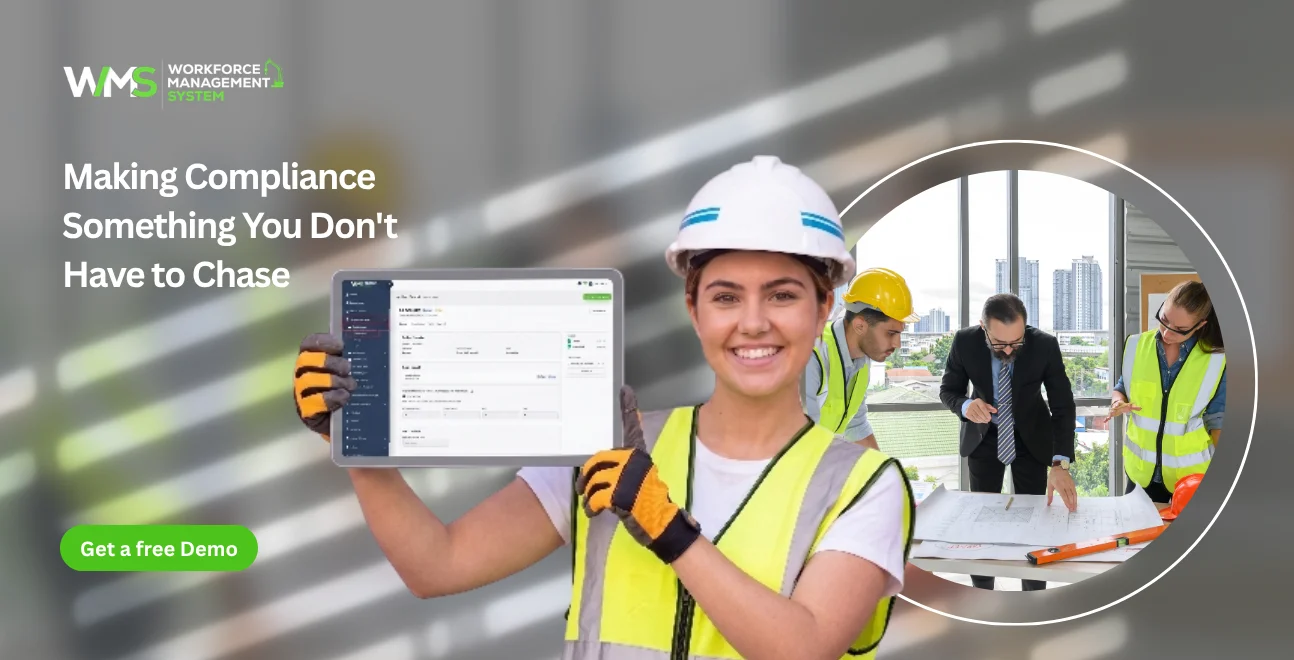
Knowing the rules is one thing. Proving you're following them, every day, on every site, with every subcontractor, is where most businesses actually fall behind. Spreadsheets stop working once you're juggling more than one project.
A Safety & Compliance system tied to your workforce fixes this. Instead of hunting for a paper SWMS, records, inductions, and certifications sit against each worker and each site, ready the moment someone asks.
Toolbox Talks That Actually Get Logged
Psychosocial and fatigue duties depend on daily communication, not a folder of templates nobody opens. Toolbox & Pre-Start tools log attendance and sign-offs against every shift automatically.
Subcontractors Without the Follow-Up Calls
Insurance certificates and licences expire quietly and always at the worst time. The Subcontractor module flags anything close to lapsing, so principal contractors aren't left exposed.
One Place for Worker Records
With longer absences now notifiable, HR and site teams need to see the same information. HRM tools keep it centralised so nothing slips through because two systems didn't talk to each other.
Managing Multiple States Without the Guesswork
Running crews across NSW, WA, and SA means three different rulebooks at once. Sites & Projects lets you apply the right threshold, like SA's new 2-metre rule, to the right site automatically.
Records Ready Before the Inspector Asks
When SafeWork NSW or WorkSafe WA turns up, the businesses that handle it well already have their records sorted. Reporting pulls it all into one audit trail, so you're not digging through folders under pressure.
A Quick Compliance Checklist for 2026
- Confirm you're citing the 2025 NSW Regulation, not the 2017 version
- Book audiometric testing for anyone exposed to hazardous noise
- Update SWMS templates for SA's new 2-metre fall threshold
- Make sure incident reporting covers psychological harm and extended absences
- Document your psychosocial hazard controls; don't just talk about them
- Check subcontractor insurance and licence expiry dates
- Confirm toolbox talks are actually being logged, not just held
- Cross-check rules if crews move between states
What Due Diligence Actually Looks Like
Officers keep hearing that they have a "due diligence duty", but the phrase itself doesn't tell you much. In reality there are several key elements regulators and courts are seeking in practice.
They do not want to see that a director or senior manager is aware that "safety is important", but they want to see that they are up to date with things relevant to WHS in relation to their business. It is important to have an appreciation of what has developed, not just what was the case five years ago.
They also want resources and processes to actually remove or reduce risk and the processes to be checked as well as implemented, but not forgotten. A SWMS in a filing cabinet which has not been reviewed for site conditions in 6 months is not a SWMS.
Businesses which know that there is a problem, such as missing edge protection or a safety switch not tripped (bypassed), and no one raised the alarm have taken that risk. Where a business is aware that a problem exists, e.g., edge protection is missing or a safety switch is not tripped (bypassed), and no one raises the alarm, courts have consistently ruled against the business. What you do is what makes a difference in the process of due diligence. Whether the paper trail indicates someone actually looked, and then acted upon what he/she found.
It's here that things go awry for construction officers managing multiple sites simultaneously. People don't go out of their way to not care about safety. It is really difficult to know what is going on on a site if one doesn't have access to it at the moment with manual systems.
Who's Actually Checking
It's good to be familiar with individuals you're dealing with in each state. Each and every SafeWork (NSW, WA, SA and similar in other jurisdictions) has its own inspection schedule, and no one has the same database.
Just because you have a clean track record with one regulator, it doesn't mean you automatically have one with another if you're doing business on the other side of the border. No summary of documentation from elsewhere is satisfactory for each inspector; he/she wants to see the documentation of his/her patch.
That's one reason for all the duplication of effort by multi-state builders. If there's no system in place, some teams tend to have individual compliance folders for each state just to prevent any confusion, but only to increase space for something to get in the way.
Keep It a System, Not a Scramble
WHS in Australian construction is more detailed and more actively enforced in 2026 than it's ever been. The businesses getting caught out are usually the ones still relying on memory and shared drives.
A workforce management system built for construction turns all of this into something that just happens in the background, across every site, subcontractor, and state. If your compliance still depends on someone remembering to open a folder, it might be time to look at something better.
Start your 14-day trial with WMS and see what staying ahead of the regulator actually looks like.
Optimise your operations with WMS
Streamline scheduling, compliance, and workforce management in one platform.
Frequently Asked Questions
The template drafted by Safe Work Australia that states can adopt into their own laws. Most have, in some form. Victoria hasn't and still runs its own OHS framework.
The detailed rules under the WHS Act. They cover high-risk work, plant inspections, hazardous substances, and incident reporting, the specifics the Act itself doesn't spell out.
A PCBU has to keep workers safe so far as reasonably practicable, and officers have a personal duty to check their compliance systems genuinely work, not just exist on paper.
Queensland still operates under regulations from that era, as amended since. Always check your state regulator's current version rather than assuming the original year still applies.
WA moved to its own WHS Act in 2020 and regulations in 2022, replacing the older OSH framework, with further updates to mining-specific roles since.
Yes. The duty of care and reporting obligations apply regardless of company size. A smaller business with fewer resources to manage compliance is arguably more exposed, not less, since a single gap is harder to absorb.
Related Articles
Explore more insights on workforce management, compliance, and operations.

AI-Powered Employee Management for Modern Businesses
Discover how AI-powered employee management helps businesses simplify scheduling, attendance, payroll, and compliance across shift-based teams.

Muhammad Asim
01 Oct 2026

Top AI Solutions To Manage Construction Workforce
Explore the top AI solutions for managing a construction workforce, from onboarding to payroll and safety, with human review built in.
Muhammad Asim
14 Sep 2026

Streamline Job Tracking with AI Construction Management Software
Discover how AI construction management software streamlines job tracking, project planning, risk alerts, defect reporting and safety compliance.
Muhammad Asim
11 Sep 2026
Ready to secure your operations?
