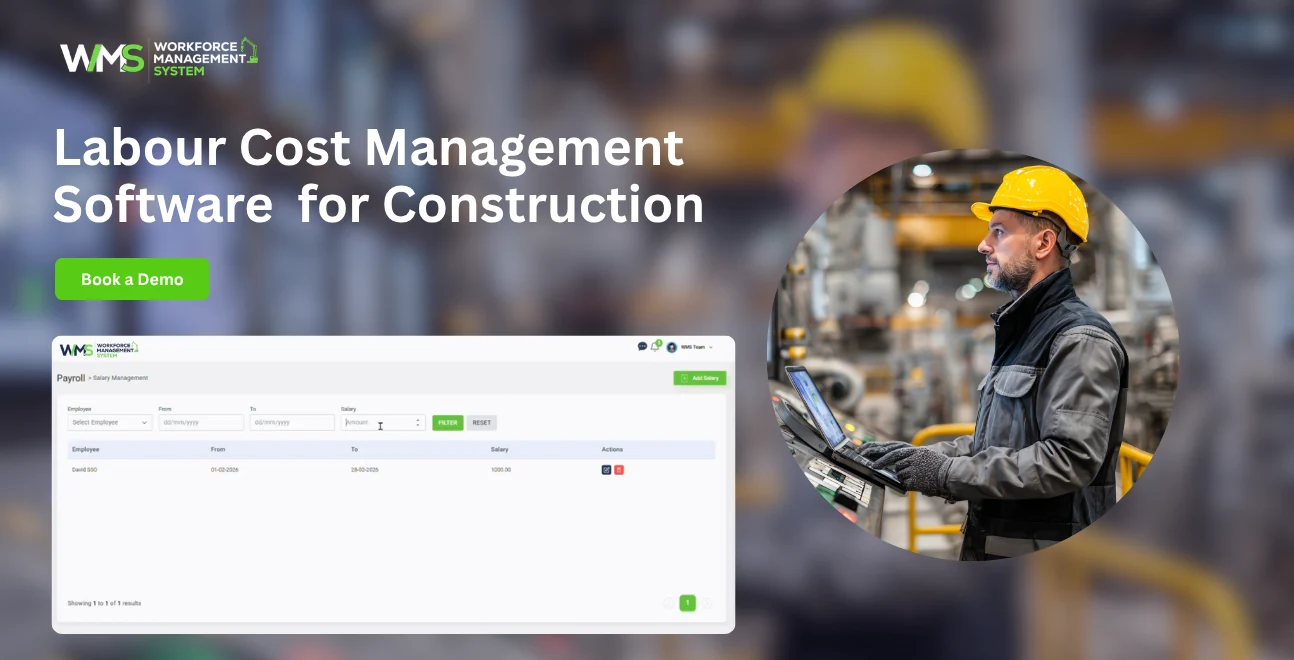
Labour Cost Management Software for Construction
Manage construction labour costs smarter. WorkforceMS tracks hours, automates payroll, and delivers real-time cost visibility for Australian builders.

Share this article
Streamline your frontline operations
See how WMS simplifies scheduling, compliance and workforce management in one powerful platform.
Managing labour costs is one of the challenges that construction companies face. Whether you have a business or you are working on a big project, the cost of your workers can make or break your business. When you do not track labour expenses properly, projects go over budget. You lose money fast.
This is where labour cost management software comes in. It gives construction businesses the tools to track and control. Reduce workforce expenses with accuracy and confidence. In this article, we will cover everything you need to know about labour cost management, from the basics to choosing the software and reducing labour costs without compromising the quality of your work.
What Is Labour Cost Management?
Managing the cost of labour is really about keeping track of what you spend on your workers. You need to know how much they cost you and make sure that the cost is worth it for the work they do.
For companies that build things, the cost of labour is usually the expense for any project. Most of the time, labour costs are between 30% and 50% of the cost of a project. So if you do not manage labour costs well, you can lose a lot of money over time.
Managing labour costs includes a few things:
- Tracking the hours worked by each employee and subcontractor
- Calculating what you owe them in wages, overtime and other benefits
- Figuring out which project or department to charge these costs to
- Comparing what you actually spend on labour to what you planned to spend
- Finding problems and fixing them before they cost you much money
When you do labour cost management correctly, you can see exactly how your money is being spent on labour. This helps you make decisions about your projects. It is not about saving money. It is about making sure you get the return on investment for your labour costs.
Labour cost management is essential for businesses because labour costs are a part of the total cost.
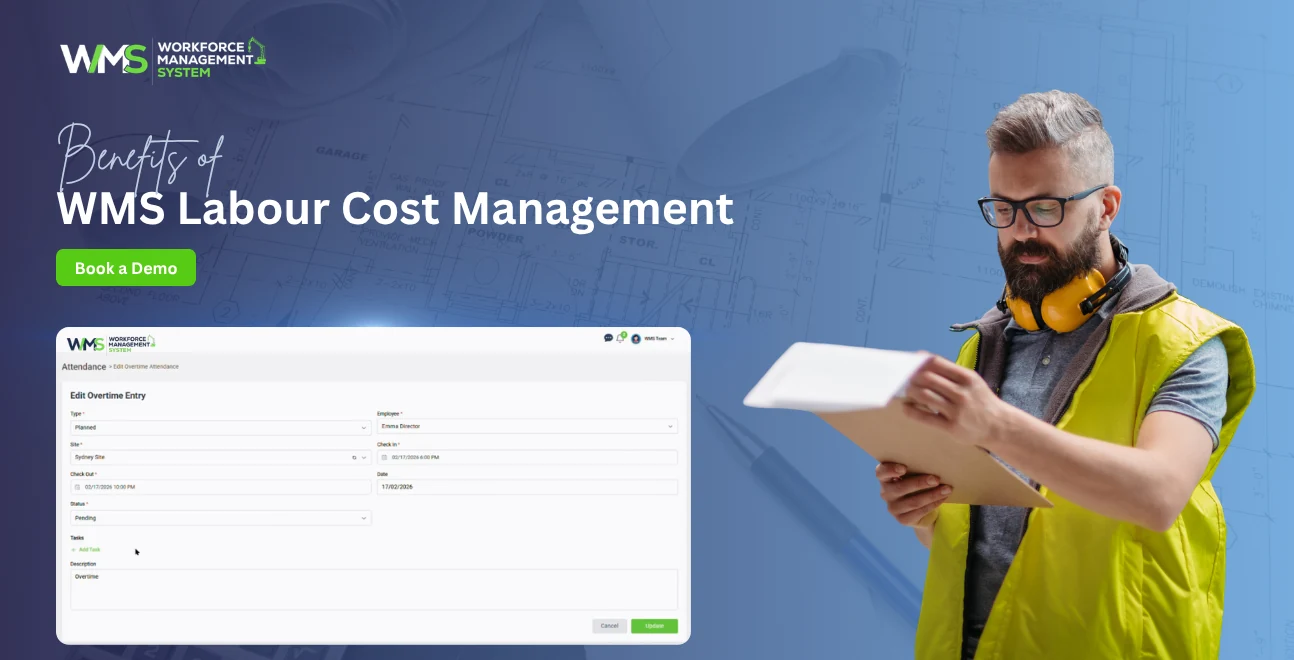
Benefits of WMS Labour Cost Management
| Benefit | What It Does |
|---|---|
| Improved Labour Cost Visibility | This system gives us sort of real-time updates on how much we're spending on labour across each project. It also lets us keep a close eye on profit margins, so the costs don't quietly get out of hand, you know? |
| Reduced Payroll Errors and Compliance Risk | It calculates award rates and overtime automatically for people covered by the Building and Construction General On-Site Award 2020. So we lower the compliance danger and reduce the chances of underpaying, plus it saves a bunch of time on payroll stuff. |
| Better Project Budget Control | Labour costs are tracked constantly so managers can see what we have actually spent vs what we budgeted, at any point. That way, they can troubleshoot issues quickly, before the budget starts drifting or gets complicated. |
| Smarter Workforce Planning | With the labour cost info in hand, managers can decide how many staff to place on each project. Result is we don't overstaff, and we avoid wasting money on labour that we don't really need. |
| Faster Payroll Processing | It handles timesheets and pay calculations automatically, which means we spend less time on payroll chores. Then our teams get time back for more important tasks, instead of admin, and re-checks. |
WMS Labour Cost in HRM
In human resource management, labour cost refers to the amount a business pays to hire, employ and keep its workers. This includes more than basic pay and covers all financial obligations that come with hiring people. A Workforce Management System brings all this labour cost data together, giving construction managers a picture of total workforce spending at any time.
Labour cost typically includes:
- Base pay and salaries. The regular pay workers receive for their hours of work
- Overtime pay. Extra pay for hours worked beyond the week
- Employee benefits. Super contributions, health insurance and other workplace benefits
- Payroll taxes. Government taxes that employers must pay
- Recruitment and onboarding costs. Stuff like advertising for roles, interviewing the candidates, and training employees
- Turnover costs. The full cost of replacing workers who leave, including lost productivity
In construction, labour costs are complex because workforces vary from project to project. A WMS manages subcontractors, casual workers and full-time employees in one system, adapting to changing workforce needs without work.
With all worker costs, benefits and obligations tracked in one place, managers can see true workforce costs. Enabling hiring, better planning and accurate project budgeting. Labour cost is a part of this, and a WMS helps manage it.
Labour Costing in Cost Accounting
Labour costing is a method used in cost accounting to calculate, record and allocate labour costs to jobs, projects or departments. This is very important in construction accounting because each project needs to have an accurate cost record.
In cost accounting, labour costs are divided into two categories:
Direct Labour Costs
These are wages paid to workers who do the actual construction work, like bricklayers, carpenters and electricians. Direct labour costs are directly linked to a project.
Indirect Labour Costs
These are costs related to workers who support the project but do not do the construction work, like site supervisors and administrative staff. Indirect labour costs are spread across projects.
Accurate labour costing helps construction businesses to:
- Assign the costs to the right project
- Calculate the cost of completing each job
- Identify where labour budgets are being exceeded
- Produce job cost reports for clients and management
- Make more competitive and profitable bids on future projects
Without accurate labour costing, a construction company may win projects on price but still lose money because the actual labour cost exceeds what was budgeted. This is a reason construction businesses struggle financially.
Good labour costing also supports cash flow management.
Labour Management Accounting with WMS
Labour management accounting is about using accounting rules to manage workers. This helps construction businesses see where their money is going. A system that manages workers connects timesheets, payroll and project costs. This makes it easy to get financial reports right away.
Real-Time Labour Cost Visibility
A system that manages workers gives construction managers up-to-date information on labour costs for all their projects. This means they can see if they are spending too much money and fix the problem right away. They do not have to wait weeks to find out.
Smarter Financial Decision Making
When labour management accounting is backed up by a WMS, managers can compare actual labour spending against budgets in real time. Then construction businesses are able to make smarter decisions around scheduling, overtime, and subcontractor utilisation, while not losing sight of margins on each project they deliver. It's kind of like getting that live overview, and not just waiting for reports.
Common Labour Cost Challenges in Construction
When you are trying to choose software for your construction business, it is a good idea to think about the specific problems you have with labour costs. Construction businesses have problems that you do not find in other industries, so you need special tools to solve them.
Inaccurate Timesheets
Paper timesheets are not very reliable on construction sites. Workers might fill them out at the end of the week from memory. They might round up their hours. Sometimes a colleague will fill out a timesheet for a worker who's not there. These mistakes can cause errors when you are paying your workers and can also make your project cost data incorrect.
Buddy Punching
Buddy punching is a problem in construction. This is when one worker clocks in for another worker. It is hard to catch this when you are using systems, and it means that the business is paying for hours that were never actually worked. If you use clock-ins that are verified by GPS, you can eliminate this problem.
Award Compliance Complexity
In Australia, the Building and Construction General On-Site Award 2020 has a lot of rules about pay rates, penalty rates, shift allowances and overtime entitlements. It is very complicated to apply these rules for every worker, every shift, every week if you are doing it manually.
Lack of Real-Time Visibility
When you are using systems managers, often they don't really know how much of a project has been spent on labour until the end of the pay period. At that point, it is a bit too late, like, to do anything about it.
Also, if there isn't real-time visibility, then you end up learning about labour cost overruns after the fact… meaning once they already happened.
Subcontractor Cost Tracking
A lot of construction companies use a mix of employees and subcontractors on the project. It is hard to track and compare the costs of both types of workers in one system without software. But it is very important to understand the cost of delivering each project, so you need to be able to do this.
Construction businesses need to be able to track labour costs for both employees and subcontractors. Labour costs are a part of the cost of a construction project, so you need to be able to track them accurately. Construction businesses need to choose software that can help them with labour cost challenges.
What Is WMS Labour Costing Software?
The WMS labour costing software is a tool that helps construction companies keep track of their workforce costs. It does this by automating the process of tracking, calculating and reporting on these costs. This means that companies do not have to use timesheets, spreadsheets and separate payroll processes anymore. The WMS labour costing software does all of this in one place, and it does it in time.
For construction businesses, the WMS labour costing software has key features.
- Digital time and attendance tracking: Workers are able to clock in and out using an app or a device that's on-site. This ends up making records that, once created, cannot be altered later.
- Project-based cost allocation: The system automatically assigns labour hours and wages to the project or task. This means that companies do not have to enter this data
- Award rate automation: The system then takes the pay rates and assorted rules and runs them automatically, based on each worker's classification and the hours that were worked.
- Payroll integration: Once the timesheets are approved, they can be sent straight into the payroll system, so there's no need to re-enter that information twice or again.
- Real-time cost dashboards: Managers can see labour cost data at any time, broken down by project, worker or time period.
- Variance reporting: The system flags where actual costs are different from budgeted costs so managers can take action before costs get out of control.
Switching to the WMS labour costing software can kind of move the needle for a construction business. It makes the data more accurate, helps save time, reduces the chance of mistakes and gives managers the view they need to steer projects. Basically, the WMS labour costing software works like a practical instrument for construction companies.
Why Construction Companies Need Labour Cost Management Software
The construction industry has some things that make it really hard to manage labour costs. This is why special software is not something it is something you really need.
Multiple Projects and Sites
Construction companies usually work on projects at the same time in different places. It is very hard to track labour costs for each project on its own. To do it right now. If you are using old systems that are done by hand. Software makes it easy; it gives managers a view of how much labour costs for every project from one place.
Complex Workforce Structures
The people who work in construction are different. Some are full-time employees, some work, some are subcontractors, and some are hired from labour companies. Each of these people gets paid differently, has different benefits and pays different taxes. Software can handle all of these types of workers in one place, so nothing gets missed.
Award Compliance
In Australia, construction workers are covered by the Building and Construction General On-Site Award 2020, which basically lays out the minimum pay rates, the penalty rates too, plus allowances and those general conditions. If an employer doesn't follow it, you can run into trouble with the law and end up having to pay a lot of money.
Overtime and Penalty Rates
Construction work tends to begin early, finish up on weekends and carry on through public holidays. That ends up meaning pay rates change, depending on the award.
It is pretty easy to make small errors if you're doing all the number-crunching by hand for every worker each week, and you end up thinking about it all day. Software handles these calculations automatically, so you don't have to.
Accurate Project Quoting
To get construction jobs that make a profit, you need to be good at guessing how much labour will cost. Labour cost management software helps you because it keeps track of what has happened in the past. So you can make guesses based on what really happened.
How WorkforceMS Handles Labour Cost Management
WorkforceMS is a workforce management platform built for construction companies. It brings together all labour cost management functions into a one-to-use system that works on desktop and mobile.
The key capabilities of WorkforceMS for labour cost management are:
- GPS-verified clock-ins. Workers clock in from their devices with GPS confirmation that they are on site. This eliminates buddy punching and inaccurate timesheets.
- Digital timesheets. Hours are captured automatically. Flow into a digital timesheet. Supervisors can. Approve these from anywhere at any time.
- Project-based labour costing. Every hour worked is allocated to the project and cost centre in real time. This gives a running total of labour spent on every active job.
- Automated award calculations. The system applies the pay rates, overtime rules and allowances based on the Building and Construction General On-Site Award 2020. This keeps the business compliant without calculations.
- Payroll integration. Approved timesheets are exported to the payroll system. This saves hours of data entry every week. Eliminates payroll errors.
- Real-time cost reporting. Live dashboards show labour spend, by project, trade and time period. This way, you always know where your money is going.
WorkforceMS eliminates the guesswork from labour cost management. It gives construction businesses the clarity they need to win work, deliver projects profitably and grow with confidence using WorkforceMS.
WMS Setup for Labour Cost Management
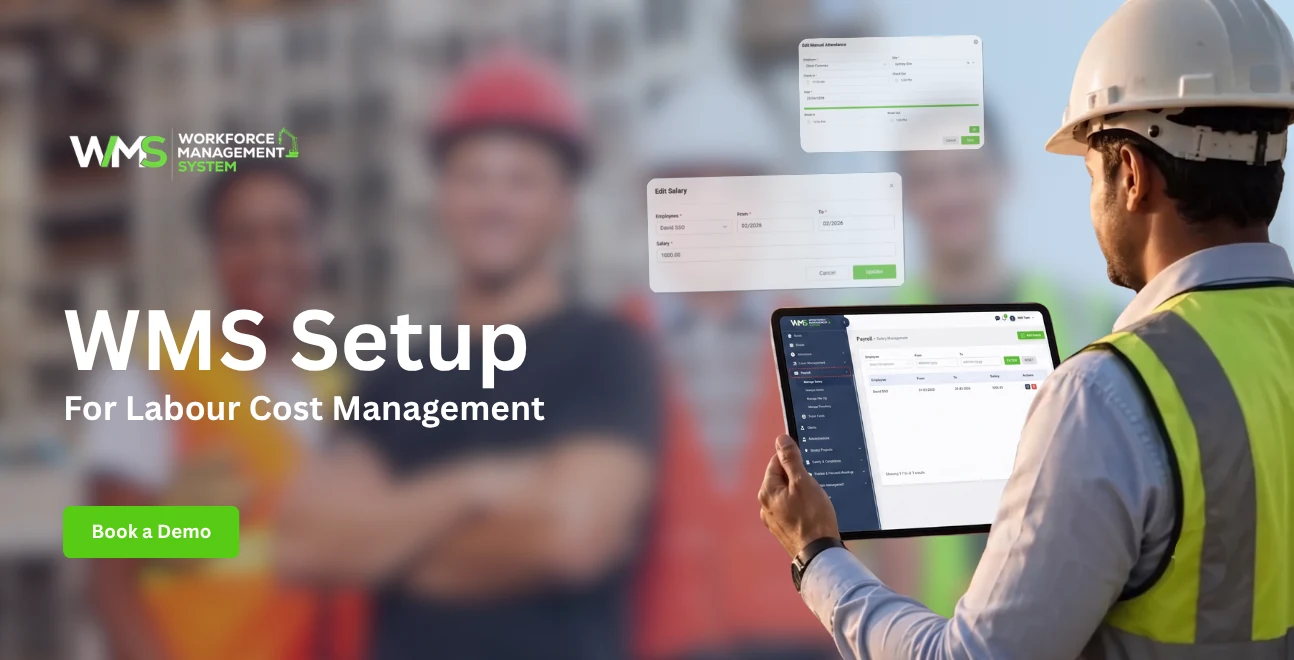
For construction businesses, using a Workforce Management System is a great way to control labour costs. A WMS is a system that helps manage workers, replacing paper timesheets and manual calculations with one platform.
Choose the Right WMS for Labour Cost Management
Not every system is built for construction management. A good WMS should have features like the following:
- GPS-verified clock-ins
- Automated calculations for award rates
- Labour costing based on projects
- integration with payroll
When your WMS is set up with worker details, site locations and project costs, your team can start tracking labour costs accurately from day one. This gives management real-time information to keep construction projects on budget and on schedule.
A WMS helps construction businesses make decisions about labour costs. Using a WMS can help reduce errors and save time. Construction businesses can benefit from using a WMS to manage labour costs.
Conclusion
Labour costs are, like, the biggest kind of controllable expense on most construction jobs. Trying to manage them well — be it from the HRM, cost accounting, or labour management accounting angle — needs both solid financial knowledge and the right WMS just sitting there ready.
Labour cost management software that's built into a dependable workforce management system pretty much pulls these things together in one place. It gathers the right data, automates the annoying calculations, supports award compliance, and gives construction companies the real-time insight they need so they can stay profitable on every job.
Optimise your operations with WMS
Streamline scheduling, compliance, and workforce management in one platform.
Frequently Asked Questions
Labour cost management software is a tool that helps us track how much we are spending on our workforce. It does this in time so we can see exactly what is going on. This software gets rid of the way of doing things with paper timesheets and spreadsheets. Labour cost management software is really useful for construction businesses.
WorkforceMS is a labour cost management software for Australian construction companies. It has lots of features like GPS-verified clock-ins, automated award calculations and payroll integration all in one place. WorkforceMS is a leading labour cost management software.
An important tool for managing labour costs is software that tracks time and allocates costs to projects. It also needs to automate payroll calculations. Without this construction, businesses cannot see if they are spending too much money before it affects how much profit they make from a project. Labour cost management software is essential for this.
Labour management software is like a platform that helps businesses keep an eye on what their employees are doing, and, sort of, yeah. It supports a bunch of everyday stuff, such as logging the hours, building schedules, figuring out wages and managing costs all in one place.
There are some tools out there, but they are not usually good enough for construction businesses. Free software often lacks features like award compliance, project-based costing and payroll integration. These features are necessary for managing labour costs. Free labour cost management software is not always the option.
The best way to reduce labour costs is to track hours and get rid of mistakes on timesheets. It is also important to identify when employees are not being productive. Using labour cost management software gives managers the information they need to control costs before they go over budget.
Related Articles
Explore more insights on workforce management, compliance, and operations.

Security Operations and Monitoring Workforce Planning
Plan guard rosters, track live attendance and cover every shift with WorkforceMS. Strengthen security operations and monitoring with smarter workforce planning.

Muhammad Asim
09 Oct 2026

Telehealth and Digital Healthcare Scheduling WMS
Simplify telehealth and digital healthcare scheduling with WorkforceMS. Manage rosters, remote clock-ins and compliance records in one easy-to-use platform.
Muhammad Asim
08 Oct 2026

Healthcare Workforce Management for Aged Care
Simplify rostering, credential tracking and payroll for aged care healthcare teams. Discover how WorkforceMS gives your carers more time with residents.
Muhammad Asim
05 Oct 2026
Ready to secure your operations?
