Staff Monitoring Software: Smarter Visibility for Construction Sites
Discover how staff monitoring software (WMS) boosts construction site visibility, attendance tracking, productivity and labour cost control.

Share this article
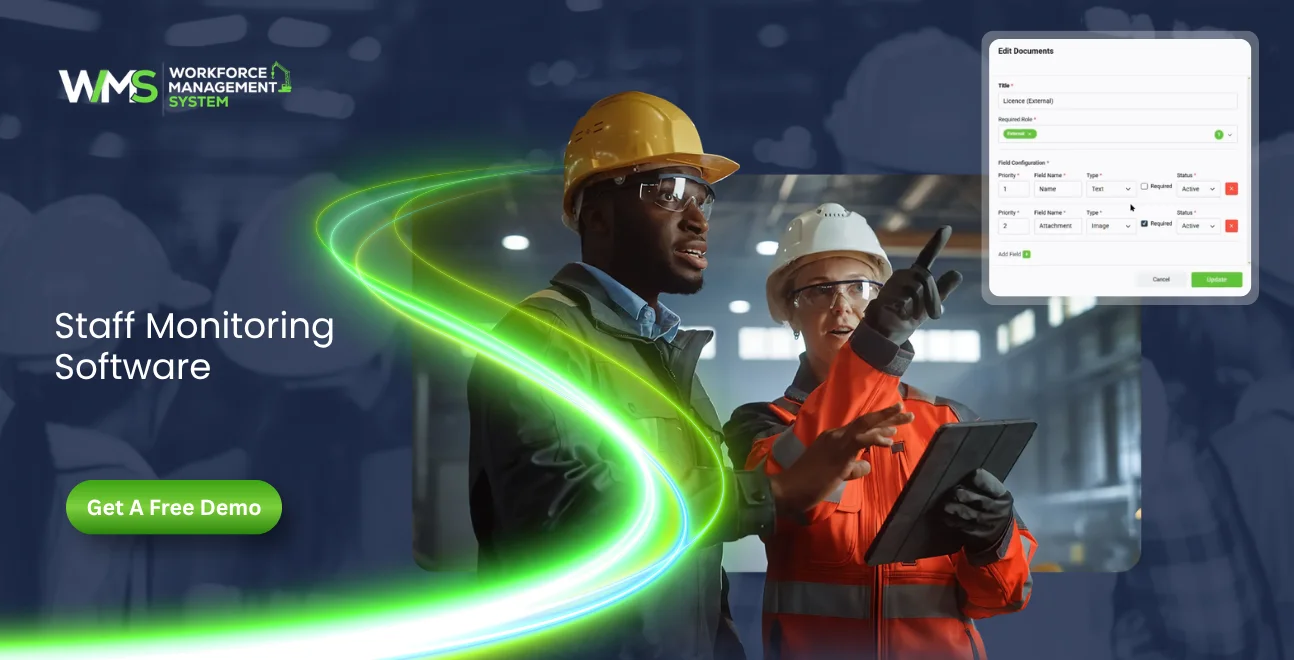
Streamline your frontline operations
See how WMS simplifies scheduling, compliance and workforce management in one powerful platform.
Introduction
A construction site is active, and it is difficult to control all the workers on the site, working from multiple locations. Staff monitoring software enables site managers to have a clear view of what's going on on their projects to ensure they are managed on budget, safely and effectively. This guide will detail how the appropriate system can revolutionise everyday operations.
What Is Staff Monitoring Software for Construction?
Staff monitoring software is software that is used to monitor staff activity, attendance and productivity at construction sites. It is designed to meet the specific requirements of construction projects, such as working on various job sites, portable teams and physically demanding jobs that demand accurate real-time information.
Construction Software is more than just clock-in and clock-out for construction companies. Records location of workers, tasks being performed and time spent on each task. This provides a clear picture to the manager for daily operations, which can help them to make better decisions.
In addition to attendance, these are also platforms that can give a more comprehensive overview of operations, correlating the activities of individual workers to the overall process of a project. This will eliminate the need for owners and site supervisors to compile data from various sources – it will all be in one system that is accessible.
Core Features That Define Modern Systems
The majority of staff monitoring software will feature GPS tracking, the ability to record digital timesheets and task tracking dashboards. These capabilities, combined, eliminate the guesswork from workforce management and leave behind paper systems for accurate, up-to-the-minute digital records.
Why Construction-Specific Tools Matter
Typical monitoring applications don't take into account engineering site requirements (e.g., moving locations, outdoor conditions, and the like). Purpose-built tools are made with these challenges in mind and are much more practical in use on an active job site.
Construction Sites Need Better Workforce Visibility
There are numerous elements of a construction project, and if there is no transparency, minor problems can escalate into costly problems. Poorly executed timelines, attendance records and allocation of tasks are all a result of a lack of accurate, real-time information about what is going on at the site.
Workforce visibility provides managers with an overview of who is onsite, what they are doing, and what could be causing a delay. This kind of detail can ensure that there's no miscommunication between the office staff and on-site teams, one of the most frequent sources of over-budget projects.
The farther away from the project you are, the more likely it is to become a problem when it comes to communication. Clear visibility acts as a protective measure: everyone from site managers to head office managers is operating on the right and current information.
The Cost of Poor Visibility
Managers will make assumptions when they don't have accurate data. This can result in too many employees in some areas and too few in others, which will result in higher costs and lower overall efficiency.
Building Trust Through Transparency
One advantage that is associated with visibility is that it helps create a sense of trust among employees and managers. The use of appropriate staff monitoring systems, which allow staff to be aware and feel that they are being monitored fairly, can lead to a more positive and accountable working environment for all.
Staff Monitoring Software Improves On-Site Visibility
Construction managers can get a real-time view of what's happening on all of their sites with staff monitoring software. Managers can view real-time dashboards to track where teams are working and how far they have come, without making phone calls and/or on-site visits.
This enhanced visibility enables bottlenecks to be identified in advance and to prevent major delays. In the event a specific work item is taking longer to complete than usual, managers will be able to easily redistribute resources to other work items, or explore the root cause without having to wait days to a week to catch up at the site.
One of the biggest benefits of digital tracking is the ability to move from a reactive to proactive approach to management. Instead of waiting for weekly information, they can react to problems when they occur and prevent small problems from becoming big setbacks.
Real-Time Dashboards for Quick Decisions
Dashboards combine data from multiple locations and enable managers to make instant comparisons of progress on projects. This will make it more convenient to use resources where they are needed the most, thus enhancing the project timelines.
Mobile Access for Field Teams
Field supervisors have access to the same information from their mobile devices, allowing everyone to work from the same information and data at the latest time, location, etc.
WMS Helps Track Attendance and Working Hours
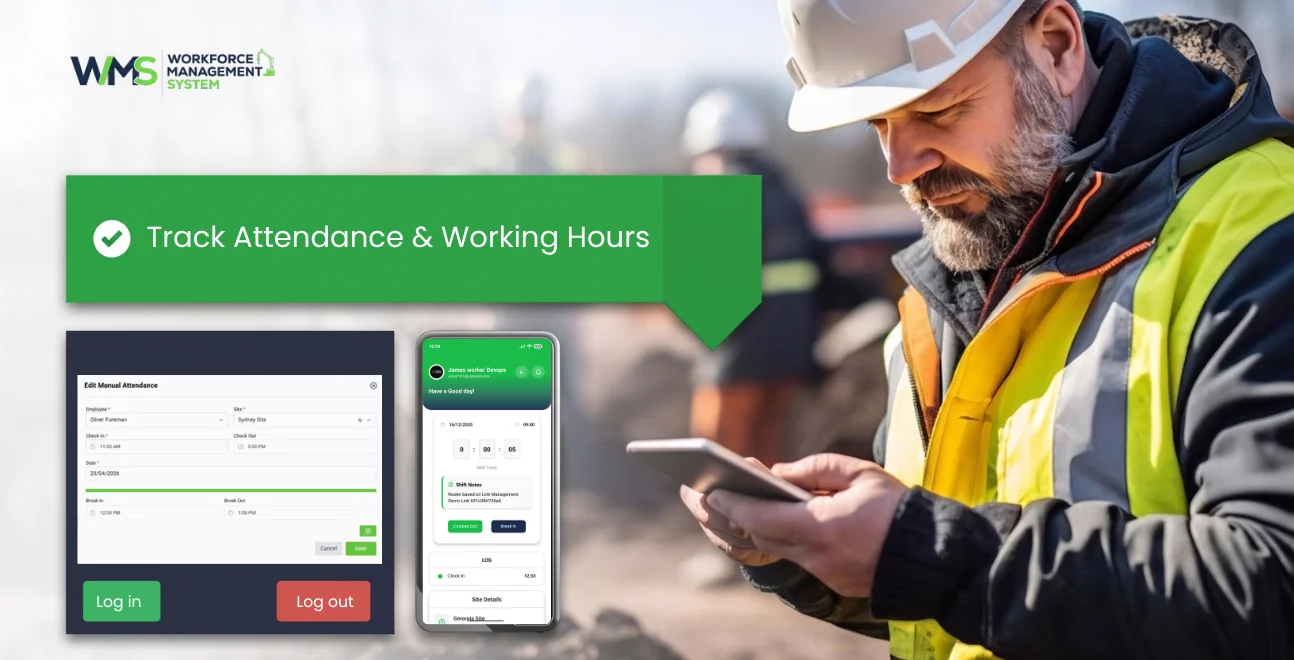
Having an accurate attendance system is one of the most valuable features that a workforce management system can provide. While manual timesheets may have errors and take time to fill out, digital timesheets can automatically record accurate clock-in and clock-out times.
When it comes to payroll processing and the observance of workplace regulations, this accuracy is crucial. A secure WMS will make sure that each hour is logged accurately, minimising disputes and HR and payroll administration burdens.
Good attendance records are also used to produce other reports and provide leadership with insight into labour trends over weeks and months. The extended sightline will enable improved planning for future work and to recognise any seasonal staffing trends.
Automated Time Capture
Automated systems do away with manual entry, minimising errors and saving administration time. All employees log in via a mobile app or via a kiosk on site, and the information automatically feeds into payroll.
Handling Overtime and Breaks
Overtime calculations and right-to-rest breaks are also more easily managed when accurate tracking is achieved, ensuring workplace laws are abided by, and records do not become a muddle for employers and employees.
Staff Monitoring Software Supports Crew Productivity
Construction businesses can use productivity tracking to gain insight into the time spent on various tasks and projects. This information will identify tasks that are taking longer than anticipated and can help managers adapt tasks to increase efficiency over time.
Modern staff monitoring is not about watching, but noticing trends and looking for areas to improve. This can allow for a more efficient working process for crews to avoid the feeling of being micromanaged and allow for a balance of surveillance and trust that can be beneficial for wider project management objectives.
This information can then be utilised for training and development over the years. The information that managers can get from these observations can help them identify which crews are consistently performing well, and inform their onboarding strategies for new crew members.
Identifying Productivity Trends
Managers can identify patterns from past performance, for example, that certain tasks are often over time, and deal with the causes of these patterns by improving plans and/or providing further training.
Encouraging Accountability Without Micromanagement
If productivity information is presented candidly to the teams, it fosters accountability organically because people are able to view their own productivity trends and make themselves accountable for the results.
Connect Staff Scheduling With Actual Site Activity
Scheduling is only beneficial if it is accurate to the actual activities occurring on-site. Staff monitoring software helps plans be aligned with staff attendance and tasks completed, providing managers with a more accurate representation of how plans are being realised in practice.
This connection can provide more rapid changes when conditions alter, e.g. due to bad weather or lack of materials. The teams don't need to rely on schedules that are outdated, but rather they can adjust swiftly in accordance with the real-time data and stay on track even when unexpected events happen.
It can be especially useful in organisations that are working on multiple projects simultaneously, where a disruption in one project can ripple throughout the portfolio of projects.
| Aspect | Planned Schedule | Actual Site Activity |
|---|---|---|
| Data Source | Office-based planning | Real-time GPS check-ins |
| Update Frequency | Weekly or fortnightly | Continuous, live updates |
| Accuracy | Estimated based on assumptions | Verified through actual data |
| Flexibility | Requires manual revision | Adjusts automatically |
Reducing Scheduling Conflicts
Live activity information can help managers identify conflicts early, such as when several jobs have overlapping schedules, and stop problems from impacting project schedules.
Coordinate Multi-Site Teams With a Workforce Management System
A number of construction businesses tend to have numerous jobs at the same time, frequently in numerous locations. This coordination can be organised in a single workforce management system, which provides head office teams with a shared insight into staffing and activity at each site where staffing is in operation.
This centralisation eliminates the need to maintain several spreadsheets or disparate systems. In contrast, all workforce data is centralised, allowing easier comparison of performance across sites, re-allocating staff to the site where they are needed the most, and enabling wider asset management for equipment and crews.
It becomes more and more essential for growing businesses to have centralised coordination. Once the number of active sites grows, it becomes impossible to keep track of the coordination without a digital system, and the need for coordination becomes urgent.
Centralised Reporting Across Locations
Centralised reporting lets management create consolidated reports of all locations—making compliance checks and performance reviews effortless, without having to open at all sites to manually gather data.
Simplifying Resource Allocation
If staffing requirements change overnight, a single system can make it much easier to shift staff from one location to another, ensuring there is enough staffing on any project.
Use WMS Data to Improve Labour Cost Control
Labour is one of the most important expenses in any construction project, and it is crucial to be able to track labour costs properly to make sure that the project is profitable. A WMS can also give businesses a detailed breakdown of how labour hours are being converted into project costs, which helps them know how and where they're going over budget.
The information can assist managers in making intelligent employment decisions, overtime approval, and allocation. It ultimately leads to better project budgeting, better tender management when estimating future projects and decreasing unplanned cost overruns that might affect profit.
Improved cost visibility also aids more assured discussions with clients and stakeholders. Businesses can make more accurate and credible pricing decisions with actual data, as opposed to estimates, that support labour costs.
| Cost Factor | Without WMS Data | With WMS Data |
|---|---|---|
| Overtime Tracking | Manually estimated | Automatically calculated |
| Budget Forecasting | Based on past projects | Based on live labour data |
| Cost Overrun Detection | Identified after completion | Identified during the project |
| Reporting Accuracy | Prone to human error | Verified and consistent |
Forecasting Future Project Costs
Using past labour information, firms can make more accurate predictions for potential future tasks, which can help to make reliable estimates and ensure that jobs are not underquoted.
Support Safety, Compliance and Accurate Workforce Records
The construction sector is deemed to be a high-risk industry with the need to keep up-to-date records of the workforce to comply with safety and compliance requirements. Staff monitoring helps to ensure that induction records, their certifications, and attendance information are all documented and easily accessible.
The accurate records also benefit faster incident investigation in the event of incidents occurring, allowing managers to quickly ascertain who was on site at any time and what they were doing at that time, addressing not only safety concerns, but legal compliance as well.
Good records not only show the client and regulators that a good safety culture exists, but they are also important when there's an incident. This will be a good differentiator in a tender for a larger project where they will need to demonstrate strong workplace practices.
Maintaining Certification Records
The simplicity of tracking certifications' expiry dates makes it easy for the worker to be kept current with site safety requirements, without having to rely on a paper file or manual reminders through safety and compliance tracking.
Supporting Audit Readiness
Accurate and organised records are easily available and allow for audits and compliance reviews to occur with ease, allowing all the pertinent documentation to be accessed as needed by regulators.
Choosing the Right Staff Monitoring Software for Construction
The best platform for your construction business will vary depending on the needs of your business, whether you're looking to handle the needs of a few sites or a more complex team. When looking for a system, it's crucial to find one that integrates with your existing payroll and project management systems.
Seek out software that has mobile access, easy reporting and excellent customer support. WorkforceMS is a platform especially made for construction firms, giving flexibility and accuracy to effectively manage complex, multi-site teams.
Consider how easy it will be for the existing staff to adopt a new system. I have experienced excellent uptake rates with tools that are self-explanatory and require little training both in the office and on the field.
Key Features to Prioritise
Ease of use, GPS tracking, and payroll integration, being essential to the day-to-day workflows and user adoption, are among some of the factors to consider.
Evaluating Long-Term Value
Don't only think of the one-time cost, but how much value a system will add to your company's business over time by cutting down on administration time, payroll mistakes and the ability to keep a better track of project costs.
You can choose the ideal staff monitoring software for your business by selecting a solution that is both suitable for your business now and will accommodate your projects and teams as they expand.
Conclusion
Construction companies need to be more accurate, accountable and in control, and staff monitoring software has emerged as a key tool to help them accomplish these goals.
It puts real-time data into the hands of team members and into everyday decision-making, making them more efficient in all locations. There are many benefits to investing in the right system today, including creating a strong and efficient base for future projects.
Optimise your operations with WMS
Streamline scheduling, compliance, and workforce management in one platform.
FAQ: Staff Monitoring Software for Construction
It monitors the presence, location and status of workers on construction sites in real time, providing construction managers with timely and accurate monitoring.
Actually, it can do much more than just record time, such as scheduling, productivity tracking, compliance with safety regulations and managing labour expenses.
Yes, most of the systems have a common dashboard to centralise all data from all sites, which helps with efficient and simple multi-site coordination.
Yes, it identifies overtime trends and inefficiencies, which assist businesses to budget accurately and manage their spending.
Not by any means; most platforms are based on simple mobile check-in or kiosks, which field staff can easily learn to use.
It keeps up-to-date records of attendance and certification, and facilitates compliance checks and incident investigations quickly and easily.
Related Articles
Explore more insights on workforce management, compliance, and operations.
Trades and Field Services Job and Invoice Management
Book jobs, record on-site hours, and send accurate invoices with WorkforceMS. Simplify trades and field services job and invoice management and get paid faster.

Muhammad Asim
14 Oct 2026

Cleaning Firm Roster Management with Task Verification
Plan cleaning rosters, track attendance and prove every task is done with WorkforceMS. Simplify cleaning firm roster management and keep clients confident.
Muhammad Asim
13 Oct 2026

Security Incident and Crisis Management Solutions
Plan rosters, track attendance and keep records ready with Workfoce Management System. Strengthen security incident and crisis management with clear, up-to-date staffing.
Muhammad Asim
12 Oct 2026
Ready to secure your operations?
