Smarter Workforce Management Solutions for Builders
Time, manpower and accuracy sit at the heart of every Australian construction site. A modern workforce management system brings scheduling, compliance and reporting together so builders running multiple projects and subcontractors can work with real visibility.
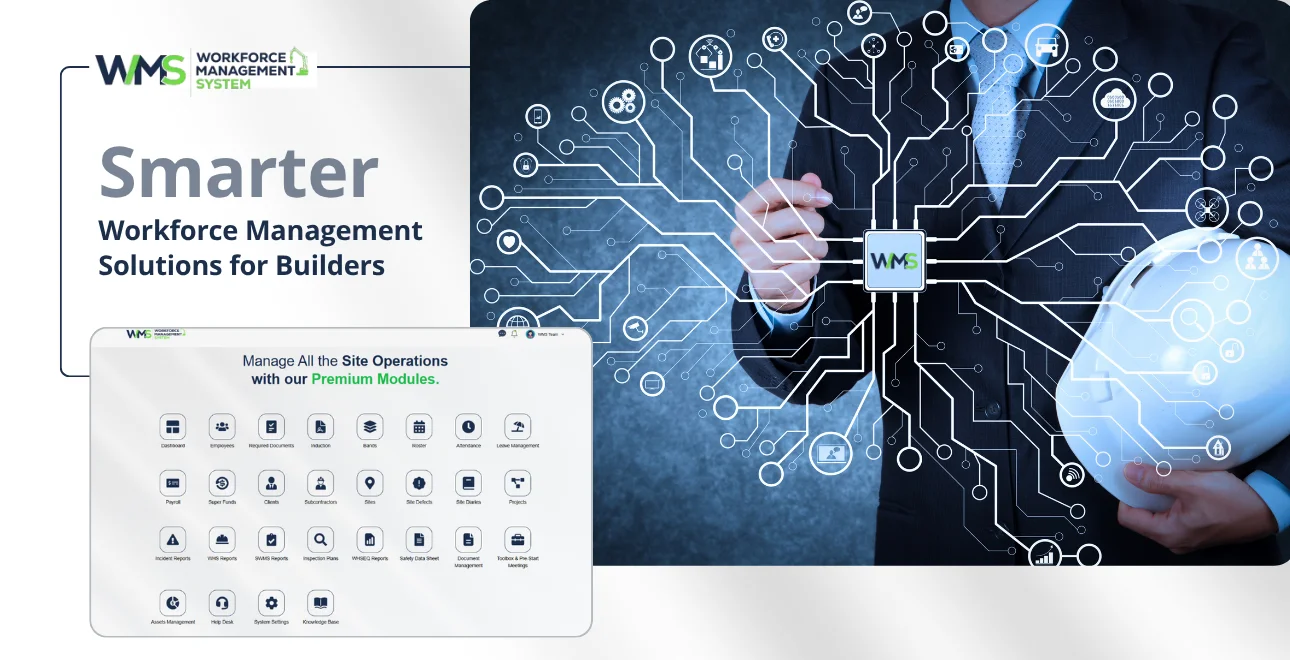
Streamline your frontline operations
The main elements of construction sites all over Australia are time, manpower and accuracy. If it's out of tune with any of these, projects get delayed, and expenses increase. A modern workforce management system (WMS) provides organisation to all this by integrating with scheduling, compliance, and reporting, all within one trusted platform.
This level of visibility isn't a luxury anymore for those builders who are operating on several projects and have multiple subcontractors, at the core of a successful company.
The more projects expand in size, and teams grow in distance, the more difficult it will be to avoid using a manual system to keep up with tasks. Those that fill the gap early are more likely to operate more efficiently and predictably.
What Are Workforce Management Solutions?
Workforce management solutions are a digital platform that helps companies to schedule, track and manage their workforce. This is done in construction with rosters, compliance documentation, timesheets and site communication all from one place.
Workforce management software helps businesses sort of move away from spreadsheets and paper-driven processes for everyday HR tasks like leave management, payroll, plus shift planning. It gives back time, it ups efficiency in a pretty direct way, and it lowers the chances of mistakes happening by a noticeable amount.
For builders, these systems can also deal with safety certificates, site introductions, and subcontractor induction. This will help reduce the risk that all personnel on site are qualified and accounted for, a critical issue in an industry where safety compliance is a must.
A good WMS is more than just a storage facility. It provides immediate information on the workforce, project progress and expenses to the site manager to allow quick, informed and immediate decisions rather than decisions taken after the event.
These platforms also provide a transparent record of all the actions carried out. Builders can generate accurate records on a dime when regulators or clients ask for them, rather than rummaging through filing cabinets or a myriad of spreadsheets.
Why Builders Need Smarter Workforce Management Solutions
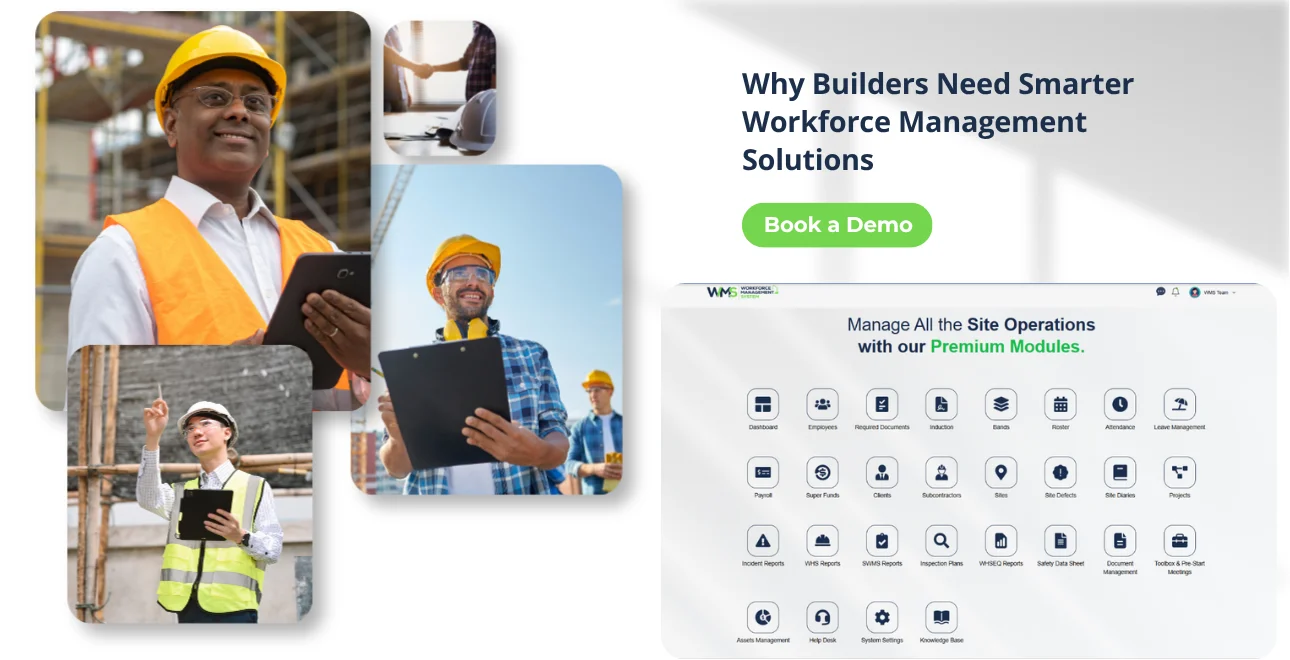
The construction industry is a very demanding industry. There is a time sensitivity with apps, and labour is not always available, and safety has to be kept to a high standard.
Fewer Manual Bottlenecks
Manual Workflow Bottlenecks are eliminated with Smarter Workforce Management. If rostering and compliance automatically occur, supervisors can concentrate on the job rather than paperwork.
This change also means that there is less back and forth to and from site and the office. Information is updated and approved as it happens, and doesn't sit waiting in someone's Inbox.
Better Accuracy
Paper timesheets and spreadsheets are prone to mistakes. Such errors could result in payroll disputes or compliance issues that can be time-consuming and costly to correct.
The consequences of these mistakes could be bigger issues if not identified early, even if it's something minor such as failing to renew a licence or paying the wrong rate. These issues are caught before they get out of hand using automated systems.
Predictable Costs
Smarter systems are likely to make builders' projects go more smoothly. The costs of labour become more predictable, and less time is spent on admin.
What this predictability can do is most important in the tendering and budgeting process. Labour cost forecasting is particularly important for builders who need to determine their realistic and competitive bids.
The Key Pillars of Successful Construction Workforce Management
There are some basic principles that are essential to any effective workforce management system. These combine to hold construction teams in check and productive.
Planning
Good planning is having the right man at the right place at the right time. A robust WMS will help with that by providing forward-looking rosters that take into consideration skills, availability and project schedules.
Compliance
There is strict regulation of construction work. Automatic tracking of builder's licences, inductions and safety certificates eliminate costly risks of breakages and prevents work being put on hold.
Communication
The exchange of information between office and site minimises confusion. With a centralised approach, all involved in the project including project managers and subcontractors at various locations are on the same page.
Visibility
Immediate visibility of costs, attendance and progress enables builders to detect minor problems at an early stage of the construction process, preventing the most costly setbacks.
Forecasting
Forecasting is important for builders as it enables them to plan adequately in preparation for the manpower required and in such a way as to avoid a shortage of manpower, which could cause delays in handing over the project.
Essential Solutions for Managing a Modern Workforce
The above pillars illustrate the needs of construction companies. The tools below are what enable them to be possible in the day-to-day operations.
HRMS
An HR or Human Resource Management System maintains employee records, employment contracts and performance data in a single repository. This helps ease tracking of career advancement, handling discipline and keeping up-to-date personnel records.
HRIS
An HR Information System maintains and arranges the information about employees in a way that allows them to be easily referenced and utilised. It also helps you make reporting requirements easier particularly during an audit or workplace investigation.
Payroll
Automated payroll minimises payroll mistakes and helps workers get paid the right way and on time. This includes dealing with rates, overtime and construction-specific allowances.
Rostering
Smart rostering can deliver a more in-balance staffing solution to meet project demands without overstaffing or unnecessary overtime blowouts. It can also help to easily make fast roster changes when the weather or site conditions change.
HR Services
HR support when needed helps to manage onboarding, disputes and conforming to policy. This is especially beneficial for any builders who don't have an HR team within their company.
Task Management
During busy project phases, or where several trades are going to be working at the same time, Task tools help site teams stay aligned on the day-to-day work so nothing falls through the cracks.
These pillars and solutions come together in the following way.
| Pillar | Supporting Solution | Outcome for Builders |
|---|---|---|
| Planning | Rostering | Right workers on the right site, every day |
| Compliance | HRIS | Licences and inductions tracked automatically |
| Communication | Task Management | Aligned teams, fewer delays |
| Visibility | HRMS | Real-time view of workforce data |
| Forecasting | Payroll | Reliable labour cost projections |
How Smarter Workforce Strategies Improve Productivity
Labour management is a critical factor affecting the productivity of labour on the spot. A well-managed and compliant schedule allows staff to spend more time on building and less time waiting for instructions and permits.
Less Duplicate Work
Smarter systems cut down duplicate admin. Managers do not have to update multiple spreadsheets, but instead, have one accurate source of truth that gets updated automatically throughout the business.
This also minimises the chances for information to be misaligned, with one team using an old team list and another team using the most up-to-date list.
Faster Reporting
Quickly access labour and cost reports to assist in making better bidding and budgeting decisions when building with an integrated WMS. Once takes hours to make reports can be generated in minutes.
Small Gains Add Up
As time passes, these efficiencies roll up. Projects complete earlier, labour costs are contained, and there is less friction between teams day-to-day throughout the business.
The result is a more relaxed and uniform staff, leading to improved customer relationships and rebooking.
Practical Examples for Builders
Imagine a mid-sized builder with three sites, operating simultaneously. If there is no central system, it's difficult and slow to monitor compliance of subcontractors at all three sites.
Compliance Made Simple
Once the builder has a WMS, it lets him monitor occupational health and safety licenses, induction status and attendance on a single dashboard. This reduces the chances of workers and employees who are not compliant being on site, safeguarding the business and its employees.
Automated Payroll in Action
One such example is payroll. A builder that employs both casual and full-time employees at different wages may be able to save time for payroll, reduce disputes and rework during pay time, by implementing automation to calculate their wages. This is particularly helpful in enterprise agreements or award classifications with multiple agreements.
The Bigger Picture
These examples illustrate the need for more builders to move away from manual processes and to embrace connected workforce systems to help the entire business, not just a single department.
The Future of Workforce Management in Australia
Australia's construction industry is continuing to experience a shortage of workers and an increasing amount of compliance requirements. The adoption of digital workforce management is no longer the exception, but firmly the norm, for projects of all sizes.
Smarter Forecasting
New tools are making predictive rostering and AI-assisted forecasting a lot more possible, so builders can prepare for shortages before they show up, and not get caught by them.
Mobile-First Tools
Expect rosters, timesheets and compliance paperwork to be viewed from a site team's phone more and more each day. This change is in recognition of the fact that the majority of construction activities occur off a desk.
Getting Ready for What's Next
Smart systems that are deployed today will provide a positive advantage for builders in the future as systems continue to evolve, especially as compliance mandates get more specific over time.
Common Challenges Workforce Management Solutions Help Solve
Construction companies are well aware of the issues that exist in the workforce. And, the majority of these come from manual or disconnected processes that are unable to keep up with ongoing projects.
Labour Shortages
It is difficult to hire staff for projects on a regular basis because of the lack of availability. A robust WMS can aid builders in identifying availability issues right away and will allow them to look for more manpower before they fall behind schedule.
Scheduling Conflicts
Seeking skilled workers at more than one site can cause conflicts. If these clashes are minimised through centralised rostering, planners will have a clear picture of what is available and where.
Payroll Errors
Human resource mistakes in manual payroll can create difficulties in the relationship between the company and the employees and cause disagreements that may be time-consuming. These errors are drastically reduced with automation, and record-keeping is kept accurate.
Compliance Gaps
Documented gaps in safety have real-world consequences, both monetary and in worker safety. Automated tracking ensures that certifications stay up to date with the entire workforce.
Here's a quick look at these challenges and how a WMS resolves each one:
| Challenge | Common Cause | How a WMS Helps |
|---|---|---|
| Labour Shortages | Limited visibility of worker availability | Early identification of staffing gaps |
| Scheduling Conflicts | Multiple sites needing the same workers | Centralised rostering across all projects |
| Payroll Errors | Manual calculations and mixed pay rates | Automated, accurate payroll processing |
| Compliance Gaps | Outdated licences and missed inductions | Automatic tracking of certifications |
Taking these issues on early really helps, because it prevents the kind of extra costs that pile up when teams react last minute and end up doing the same problem-solving again and again.
Finding A Solution That Grows With Your Business
You need a system that can handle your business as it gets bigger. Not every system is like that. You should look for a system that can grow with you from a few workers to hundreds of workers at many different sites.
Room To Adapt
A system should be able to work with different kinds of projects. It should work for small house builds and big commercial builds. You should not have to change the system when your business gets bigger.
Works With Existing Tools
The best systems work well with the tools you already use, like payroll and accounting. This means you do not have to enter the information twice, which is a big hassle.
Built For Construction
You should choose software that is made specifically for construction. This is better than using a human resources tool. Construction software has the features you need, like managing subcontractors and tracking compliance on site.
This is because it is made for construction, not any business. Construction businesses have needs, and the software should meet those needs.
Why More Australian Builders Are Adopting Smarter Solutions
Across Australia, builders are moving away from doing things by hand when it comes to administration. They are using systems to manage their workforce, and this is helping them save money and get better results on their projects, whether they are building homes or offices.
Rising Compliance Demands
The people in charge are expecting builders to show that they are meeting all the safety and licensing rules all the time, and having records makes it a lot easier to prove this when someone comes to check.
Staying Competitive
When businesses use systems that work well, they can usually finish their projects faster. Get things right more often, and this helps them get more work when they are competing with other companies to get a job.
More Than Big Builders
It is not just the building companies that are using these systems now. Smaller builders are also starting to use them because they can see that the good things about these systems work for them too and that they can get benefits from using them even if they are not as big as some companies.
Why WorkforceMS Is the Right Choice for the Construction Industry
WorkforceMS was made for construction businesses. It puts rostering, compliance, and payroll reporting all in one place.
Built Around Construction
Builders can use twelve main parts of WorkforceMS. These include managing people, looking after subcontractors, managing projects and keeping sites safe and compliant. Each part is made for how construction businesses work, not just taken from ordinary office software.
Safer More Compliant Sites
WorkforceMS helps builders keep track of rules and regulations. This means they can stay on top of licenses and inductions. It reduces paperwork. Helps make sites safer and more responsible. This happens on every project.
Grows With Your Business
WorkforceMS is made to help builders at every step. It does not matter if they have a team or many workers on many sites. As the business gets bigger, WorkforceMS gets bigger with it. The system does not need to be changed.
The features that work for a team will still work when the business gets larger and more complicated. This makes WorkforceMS a good choice for construction businesses of any size.
Conclusion
Workforce management in construction isn't only about spreadsheets or that manual tracking, you know the kind of stuff. Nowadays, builders actually need linked systems that support planning, compliance, and the everyday conversation across each site and each project, all at once.
Smarter workforce management gives Australian builders the visibility and control they need to manage labour well, reduce the admin clutter, and make sure everything stays compliant with the sector rules.
Platforms like WorkforceMS bring those components together into one purpose-built system, so construction businesses of any size can keep things moving smoothly, with operations that feel steadier, even well into the future.
Optimise your operations with WMS
Streamline scheduling, compliance, and workforce management in one platform.
Frequently Asked Questions
Workforce management solutions in construction are basically used to get everything in one place, you know… rostering, payroll, compliance and day-to-day communication, instead of juggling spreadsheet after spreadsheet and a stack of paper forms around the office.
Yeah, generally they are. Most platforms scale pretty easily so small builders can begin with the essentials, then add more modules as their team expands or as the sites start multiplying.
By working out wages accurately across different pay rates and roles. It also cuts down on the manual errors that typically spark disagreements, especially when schedules change late.
Because it's made for construction specifically, it blends rostering with compliance and project management into one connected workforce management system, so managers aren't switching between tools all day.
With workforce management solutions that flag staffing gaps early. That way, builders can line up workers in advance, instead of scrambling at the last minute when a crew walks in late or doesn't show.
Licences, inductions, and certifications can actually be monitored automatically. Then if anything starts drifting out of date, the system raises alerts so nothing important gets missed even when the work is moving fast, and people are rushing around.
Related Articles
Explore more insights on workforce management, compliance, and operations.

Top AI Solutions To Manage Construction Workforce
Explore the top AI solutions for managing a construction workforce, from onboarding to payroll and safety, with human review built in.
WorkforceMS Team
14 Sep 2026

Streamline Job Tracking with AI Construction Management Software
Discover how AI construction management software streamlines job tracking, project planning, risk alerts, defect reporting and safety compliance.
WorkforceMS Team
11 Sep 2026

Skills and Compliance Management for Construction Teams
Manage skills and compliance for construction teams with WorkforceMS. Track licences, SWMS, inductions and audits in one workforce management system.
WorkforceMS Team
10 Sep 2026
Ready to secure your operations?
