Workplace Roster for Construction Sites: How to Manage Workers, Shifts and Site Coverage
Learn how to build a workplace roster for construction sites, manage shifts and site coverage, and stay Fair Work compliant across every project.
Streamline your frontline operations
Every construction site is about timing. The roster is what makes the timing work. If you get the roster wrong, then the crews will show up at the site, their shifts will overlap, and there will be gaps in coverage that nobody notices until the work stops. But if you get the roster right, then the whole project will go as it should.
It will be on time; it will have all the staff it needs. There will not be a lot of confusion every day about who is where. This guide will tell you what you need to have in a workplace roster for a construction site and how to do it well when you have a lot of crews and projects to manage.
What Is a Workplace Roster for Construction Sites?
A workplace roster is just a schedule that details who is working, where and when. In a construction environment, that seems simple enough, but that's not always the case. One roster may have to cover more than one trade, different jobs, subcontractors employed alongside the main trade, and work that may vary due to different weather conditions, deliveries or various stages of the project.
A construction roster is different to a retail or office roster; it must show actual site conditions. It has to display names along with time slots and also include the site each person is assigned to, the role they're playing that day, and whether it's still a good fit for the site based on yesterday's work.
Sudden changes and updates that are not made on a regular basis soon become outdated. That's also why it's not feasible to use a construction roster as a "set and forget" document. Projects change weekly, and a job-specific list of projects compiled at the beginning of a job can be modified at the first delay or change order.
Why It Matters for Construction Site Management
A managed list of workers creates issues that affect the whole project. Employees might arrive at a place that isn't prepared for them, or a location might not have enough staff on a day when more people were needed. Both cases waste time and money. Both can be avoided with good planning.
Coordination Between Different Jobs and Teams
Construction projects don't usually depend on one kind of worker. Electricians, helpers, machine operators and people who work under contract often need to be on the job site at the time or in a certain order.
A good list helps prevent the problem of one group waiting because another hasn't finished or two teams being scheduled for the same space at the same time.
Staying on Track With the Timeline
Delays at a construction site cost money, and many of these delays could be avoided. They are usually due to staffing problems or issues with materials or the weather. When the list shows what the site needs each day, project managers can plan the work with confidence, without wondering if enough people will actually show up.
Helping With Safety and Responsibility
Knowing exactly who is on the job site at any time is not just helpful for organising. It's a safety rule. In an emergency, site leaders need to know who is present. A list that isn't up to date puts that safety duty in danger.
Saving on Extra Labour Costs
A list also helps with the budget. When hiring decisions are based on what the project needs instead of old habits, companies avoid paying for workers who aren't actually needed on a particular day while still making sure important tasks are covered properly.
Core Components Every Site Roster Needs
Worker and Role Details
All roster entries should indicate the name of the person working, the trade or role of that person, and any licences or certifications applicable to that trade/certification. This is particularly significant on sites where there are particular tasks that must be carried out by a qualified operator or by a certified tradesperson.
Site and Location Assignment
If the business is managing more than one project, it's important to indicate on the roster the project that the worker is working on that day. One of the most frequent reasons for workers arriving at the wrong site is due to lack of or vague site information.
Shift Times and Duration
All visits must be clearly structured with start time, finish time and break time in mind and easily visible at a glance. Construction rosters can also be started earlier than regular office hours, depending on the start time for the construction site.
Task or Work Area Assignment
A good roster not only includes who is on-site, but it will also segment jobs by area or task: who is working on the foundation, who is framing, who is cleaning up the site, etc. This amount of detail allows supervisors to attend to the day without having to follow up on individual people.
Subcontractor Information
Subcontractors should be added to the employee roster view, as well as having any compliance information, including insurance and site inductions. Leaving subcontractors off the shared roster introduces gaps in compliance monitoring and coverage.
Emergency Contact and Site Induction Status
It's also a good idea to add basic contact information and verification of each worker having undertaken the appropriate site induction. This is easily forgotten information on a day-to-day basis, but is essential when things go wrong at site.
How to Create a Workplace Roster for Construction Sites
Start With the Project Schedule
A roster should always be based on the project timeline and not the other way around. It is helpful to have a good idea, before the shifts are assigned, of what is to be done at the next stage of work in the next few days or weeks, as this will identify the actual staffing needs of the site rather than a guess.
Correlate Skills with Sites Requirements
After mapping out work, it involves matching the appropriate person to the appropriate job. This involves ensuring that the right certifications are in place, the right experience and availability of workers during the specified time.
Build In Buffer for Delays
Things seldom go according to plan in construction. A non-flexible schedule is shattered as soon as you have a late delivery or weather affects a day's productivity. Flexibility in the schedule, particularly for larger projects, will make it easier to adjust to changes without the need to re-start the project.
Provide a Clear Communication of the Roster
If the people on the list can't see it, then it's not a roster. Employees and subcontractors should have quick and simple access to their schedules, preferably from a phone, not a print-out that hangs on the wall of a site office that is often stale.
Review and Adjust Regularly
Once published, a roster should not be considered final. It is beneficial to monitor it regularly against what happens on site as soon as there is a mismatch, so as not to become a scheduling issue later in the project.
Managing Workers Across Multiple Sites and Shifts
The Challenge of Moving Crews Between Sites
A lot of construction businesses operate several projects concurrently, and the same labourers on different projects in the same week. This is hard to manage manually because you have to check out who has signed up elsewhere and make sure to confirm a shift when you have to.
Avoiding Double-Booking
One of the most frequently made rostering errors is double-booking workers between two workplaces, and one of the most disruptive. Typically, when rosters are kept at separate sites instead of through an integrated system, no one has a true view of who is working where.
Keeping a Single, Shared View
The best way to run workers across sites is by operating from a single, unified roster and not several disjointed ones. Having all staffing on one system makes it much easier to view at a glance and avoid scheduling conflicts in advance.
Travel Time Between Sites
If crews are transferring from one location to another within the same day/week, then travel time must be added to the roster as well. If this is not done, workers may show up late for work due to the sheer amount of time it requires to get from one site to the next.
Ensuring Site Coverage Without Overstaffing or Gaps
Reading Site Needs Accurately
One of the key aspects of getting coverage right is knowing just how many workers are needed on a specific day at a specific job location, not just filling in shifts for the sake of it or because it's convenient. Wasted manpower costs money and a lack of manpower means that the day's work is not completed.
Distribute the Coverage for the Week Evenly
There will be some days on a construction site when more people are needed than others; an example of this could be a concrete pour, a large delivery or a compliance inspection. Covering at these high and low times and not covering everyone the same way on a daily basis ensures that labour costs stay more in line with the demand.
Spotting Gaps Before They Become a Problem
A roster should be easy to read for anyone to see where coverage is light. The timing for finding a void is after a shift has begun; the objective would be to find a void when it can still be filled.
Managing Worker Availability and Last-Minute Shift Changes
Why Availability Changes Constantly
When you're working a construction job, you're going to find that you have to take more sick days, use more personal leave and are more likely to have changes to your work schedule, as it's a physically demanding job and the site is going to change all the time.
This is a reality that needs to be handled when developing a roster and cannot be taken for granted.
Handling Changes Without Disrupting the Site
When someone cannot make it to work, the company needs to find a replacement fast so that there is no gap in the work. This is a lot easier if we already know who is available and what skills they have, rather than having to make a lot of phone calls to figure it out. Construction crews need to be able to handle these changes.
Keeping Everyone Informed in Real Time
Last-minute changes only work if everyone knows about them. If we have a schedule that updates automatically and tells the workers about the changes, then we can avoid confusion, like when someone shows up to work and their shift has already been given to someone. This can be really frustrating for construction crews.
Building a Backup Pool
Some companies think it is a good idea to have a list of workers who can work at the last minute if needed. If we have this list already, then it is not so stressful when someone cannot make it to work. Construction crews can just call someone from the list. They can fill in. This makes things a lot easier for construction crews.
Roster Compliance and Fair Work Rules
Meeting Award and Agreement Requirements
Construction rosters need to have the pay rates and rules that are in the awards or agreements for the workers. If this is not done correctly, it is not a problem with the payroll; it can also cause problems with following the rules for the business.
Tracking Hours and Overtime Correctly
Construction work often has hours and overtime, especially when there are deadlines to meet. It is very important to track the hours that the workers actually work compared to the hours they are supposed to work so that the workers can be paid correctly and the business can follow the rules.
Keeping Records for Audits and Disputes
It is very important to have accurate records of the rosters in case there is a problem or an audit. If there is a problem, it is much better to have all the information about who was working when they were working and what the conditions were than trying to figure it out later.
Rest Breaks and Minimum Rest Periods
Construction rosters and rest breaks are also very important. Construction rosters need to ensure that workers have rest periods between shifts, especially when they work long hours or start early on many days in a row.
If this is not done, it can cause problems with following the rules. It can also be a safety risk because the workers may be too tired to work safely. Construction rosters need to be done to avoid these problems.
Work Roster Template vs Digital Rostering
| Aspect | Work Roster Template | Digital Rostering |
|---|---|---|
| Updates | Manual, easy to fall out of date | Live, updates instantly |
| Worker notifications | None. Relies on word of mouth | Automatic, sent straight to workers |
| Multi-site visibility | Separate sheets per site | One shared view across all sites |
| Conflict detection | Manual checking required | Flags double-bookings automatically |
| Best suited for | Very small, single-site teams | Growing teams, multiple sites |
How WorkforceMS Simplifies Roster Management
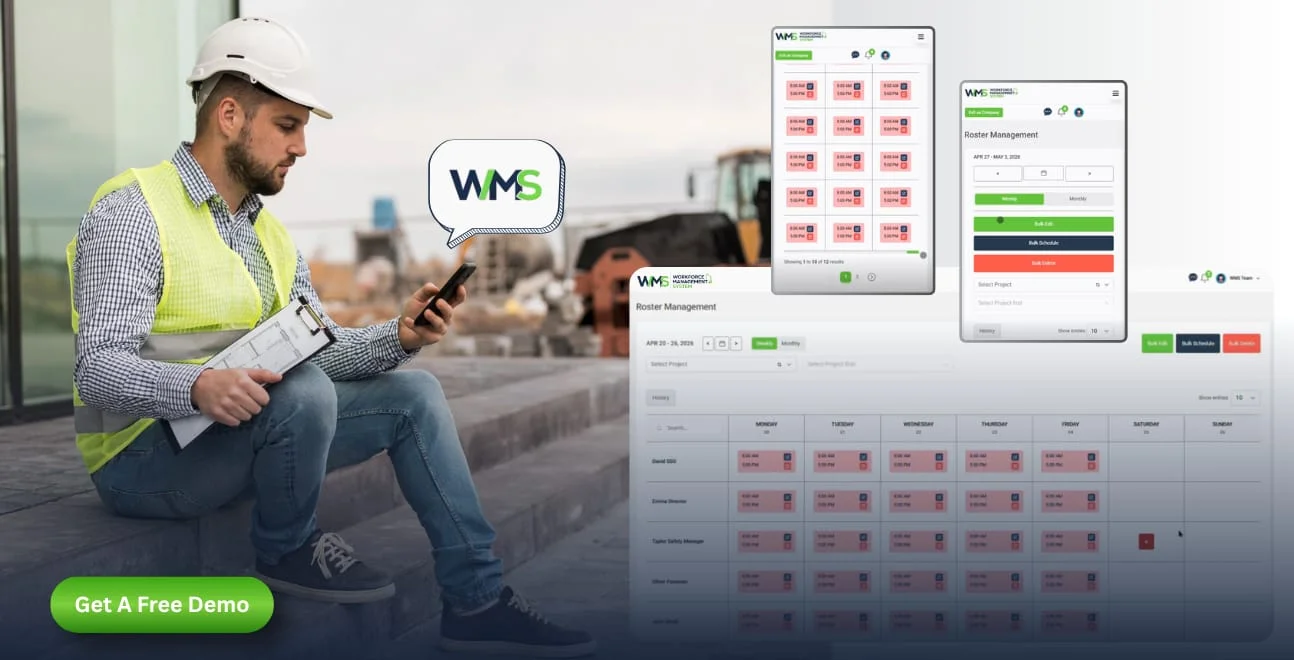
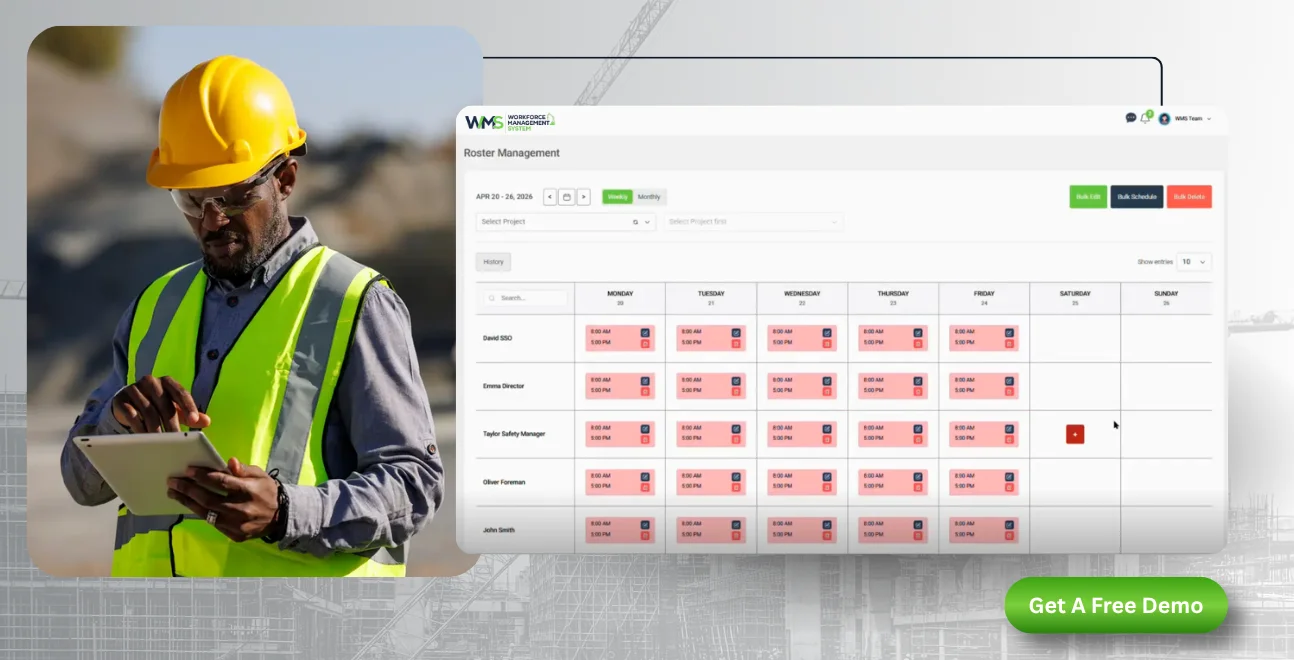
As a construction company expands, it will be difficult to maintain a manual roster system, and this is where an actual construction business rostering system can make a difference. WorkforceMS consolidates scheduling, site assignments, worker availability and compliance data into a single platform custom-designed for the construction industry.
Supervisors have instant visibility into coverage of all active sites, can identify coverage issues before they cause delays and can ensure that last-minute changes are not confusing. All worker availability, their certifications and where they are assigned are always up to date.
This keeps the list of workers accurate. Reflects what is really happening out in the field. Rostering can be a job for companies that have many places where work is done or for those that have staff rotating between locations.
Book a demoOptimise your operations with WMS
Streamline scheduling, compliance, and workforce management in one platform.
Frequently Asked Questions
Rosters should show the correct pay rates, rest breaks between shifts, and allowances and rules of the applicable award or agreement.
The minimum standards for rest periods, overtime and notice that Fair Work sets are essential to construction rosters being compliant.
This depends on the award/agreement, but the workers are normally required to have a reasonable lead time before any change/addition to a shift.
A simple schedule format that indicates who is working, where and when. It can be used for smaller teams, but it's not updated or alerting the workers.
At least worker details and site assignment, shift times, task allocation, and at least compliance with subcontractors.
Project conditions and stages change continually, and if a roster remains static, it will no longer accurately represent what is actually taking place onsite.
Related Articles
Explore more insights on workforce management, compliance, and operations.

Top AI Solutions To Manage Construction Workforce
Explore the top AI solutions for managing a construction workforce, from onboarding to payroll and safety, with human review built in.
WorkforceMS Team
14 Sep 2026

Streamline Job Tracking with AI Construction Management Software
Discover how AI construction management software streamlines job tracking, project planning, risk alerts, defect reporting and safety compliance.
WorkforceMS Team
11 Sep 2026

Skills and Compliance Management for Construction Teams
Manage skills and compliance for construction teams with WorkforceMS. Track licences, SWMS, inductions and audits in one workforce management system.
WorkforceMS Team
10 Sep 2026
Ready to secure your operations?
