Best HR Hiring Software Australia 2026: Top Platforms for Construction Teams
Compare the best HR hiring software Australia 2026 for construction teams. Award compliance, mobile site access, licence tracking and payroll integration compared.

Share this article
Streamline your frontline operations
See how WMS simplifies scheduling, compliance and workforce management in one powerful platform.
HR hiring software is basically a digital platform that automates recruiting workflows, onboarding, payroll links, and compliance management for employers. For Australian construction teams, the best HR hiring software should cover a bunch of construction specific stuff too, not only the usual "generic" candidate stuff. Things like award interpretation, EBA compliance, mobile site access, and trade licence tracking, because without that, it tends to fall apart on real projects.
Key features to prioritise:
- Australian award and EBA interpretation, like CFMEU, ETU, CEPU, AMWU
- Mobile first design, with offline clock in and GPS verification
- STP Phase 2 support, and Fair Work compliance built in
- Trade licence expiry tracking, including White Card and High Risk Work licences
- Payroll integration, with Xero, MYOB, KeyPay, or Employment Hero Payroll
Introduction
Australia's construction industry employs 1.3 million + people, about 9% of the national workforce. Still, projections point to a shortage of roughly 300,000 workers by 2027. For construction business owners, HR managers, and project supervisors, that gap basically turns into one message: every new hire matters more than it used to.
Also, hiring in construction does not really behave like hiring in a regular office. You're coordinating staff across multiple job sites, juggling different enterprise agreements, tracking trade licences that expire, renewing safety inductions, and dealing with payroll that shifts depending on the award, penalty rates, and shift loading. So, the typical HR software made for desk based companies tends to fall apart when the reality gets messy and multi site.
This guide is a bit different. Rather than just listing "best HR software" for generic small businesses, we look at the leading platforms built for Australian construction teams. You'll see which systems can manage CFMEU rates, which mobile apps still function offline on remote locations, and which platforms handle compliance workflows that keep you audit ready even when things move fast.
Whether you run a 20 person fit out team or a 500 person civil construction group, this comparison gives you the evidence you need and a more direct route to book a demo with a platform designed for the way your work actually runs.
What Is HR Hiring Software and Why Do Construction Teams Need It?

HR hiring software is basically a cloud based system that sort of does the whole hiring and employment journey from job ads to applicant tracking, then onboarding, payroll, and compliance stuff too.
For construction crews, it tends to be non negotiable because general HR tools just cannot really cope with how the work runs across multiple sites. Things like multi site rostering, working out award rules, tracking trade licence status, and keeping safety documents organised are not "nice to have" features; they're the core of the job.
When you get the right platform in place, admin time drops, sometimes up to 90%, and you're also better placed to stay compliant with Fair Work, STP Phase 2, and WHS expectations.
So what's actually different about generic HR versus construction focused platforms
Sure, generic platforms (think BambooHR or HiBob) can be fine for desk based teams with normal Monday to Friday patterns. But construction is a different world: people may be clocking on at 6 AM, spread across 3 sites, penalty rates move around depending on the relevant EBA clause, and if a White Card lapses for even a short window, it can stop a job.
That's why construction specific HR software, like WorkforceMS (and similar platforms) is built around site driven workflows from the start. It supports a geofenced mobile clock in, it can run automatic award interpretation for CFMEU and ETU arrangements, and it flags licence expiry in real time. Generic tools often handle these items like they're optional extras, construction platforms treat them more like essentials, you know.
Main compliance headaches in construction HR (and why software helps a lot)
In Australia, construction compliance is getting more intense heading into 2026. Since 1 January 2025, intentional wage underpayment is now a criminal offence. At the same time, WHS rules around psychosocial hazards now expect proper, documented risk management. Plus Fair Work is actively auditing award compliance across the industry, so it's not just "best practice", it's real oversight.
The right hiring HR software helps reduce those problems by automation: STP Phase 2 reporting makes sure each pay component is categorised correctly, award engines work out penalties and allowances without guesswork, and document storage keeps SWMS, inductions, and licences together with expiry alerts. Without that kind of built in automation, compliance can turn into a never ending admin task, and honestly it becomes a constant risk hanging around the business.
How to pick the best HR software for your construction business
You'll want construction HR software that actually "gets it" fast, not just another dashboard somewhere.
Start by weighing five things in a sort of line, but not too strictly (1) award and EBA interpretation accuracy, (2) mobile functionality for site workers, (3) integration with the payroll and accounting you already use, (4) tracking for trade licences and safety documents, and (5) implementation support that fits construction workflows.
Then request a demo where the vendor loads your real award or EBA. If they can't, or they act weird about it, you should treat that as a red flag. No platform that isn't built for your complexity should go near your payroll.
Award interpretation and EBA compliance: the non negotiable feature
This is the one thing you cannot compromise on for Australian construction. Your software has to interpret Modern Awards and EBAs correctly, calculating base rates, penalties, allowances, and shift loadings without you having to do manual work, spreadsheets, or weird workarounds at 6pm on a Friday.
Try asking vendors this kind of question: "Can your system handle CFMEU building rates, ETU electrical allowances, and CEPU plumbing penalties out of the box?"
If the response is "we need custom configuration" or "you'll need a consultant setup," then expect weeks of delay and ongoing risk. It's not only about time, it's about whether you'll still trust the numbers later. Some platforms like WorkforceMS and Humanforce tend to arrive pre configured for major construction awards, which helps avoid the slow start.
Mobile first design for site based workforces
Your team isn't sitting calmly in an office chair. They're out on scaffolding, in excavations, and across three job sites, maybe more. The mobile app needs to work offline (because reception can be problematic), use GPS verification to reduce buddy punching, and let workers and supervisors capture photos for incident reporting and for licence verification.
Before you buy, test it properly. Give a supervisor and two workers a trial login. Send them to a site where coverage is patchy, then watch if they can clock in, view the roster, and submit a timesheet. If the app stumbles, the whole platform stumbles.
Integration with existing payroll and accounting systems
Most construction businesses are already running something like Xero, MYOB, KeyPay, or Employment Hero Payroll, mostly because of STP compliance. The right HRIS should integrate with those systems, so it syncs employee data, leave balances, and timesheets, instead of forcing a rip and replace migration.
Be careful with "all in one" setups that want you to switch payroll at the same time you switch HR. Construction payroll is complex, and moving it while you're also changing HR is often how mistakes appear. Instead, choose an HRIS that connects to your existing payroll source of truth, calmly and consistently, without making you rewrite how you operate.
Top 7 Best HR Hiring Software Australia for Construction in 2026
The best HR hiring software for Australian construction in 2026 is WorkforceMS (best for multi site workforce management), followed by Employment Hero (small business all in one), ELMO (mid market groups), foundU (labour hire and shift teams), Worknice (multi entity groups), Humanforce (rostering and award compliance), and Connecteam (free option for small crews). Each is evaluated for construction specific features, not generic SMB suitability.
WorkforceMS: Best for Multi Site Construction Workforce Management
WorkforceMS is purpose built for Australian construction, labour hire, and industrial services. Unlike generic platforms, it handles multiple awards and EBAs out of the box (CFMEU, ETU, CEPU, SCHADS, AMWU, and TWU) with automated penalty calculations and real time labour cost visibility.
Key construction features:
- GPS + photo time tracking with iBeacon verification for site attendance
- Trade licence expiry tracking (White Card, High Risk Work Licences, EWP, forklift) with automated alerts 30/60/90 days before expiry
- Multi site rostering with fatigue management and penalty rate checks before shifts publish
- Payroll integration with Xero, MYOB, KeyPay, and Employment Hero Payroll
- Offline mobile app that syncs when connectivity returns
WorkforceMS is designed for construction groups with 50 to 5,000 employees managing complex awards across multiple sites. Pricing is custom quoted based on modules and headcount.
Employment Hero: Best All in One for Small Construction Businesses
Employment Hero serves roughly 350,000 businesses globally, with an average customer size of ~7 employees. For micro and small construction businesses (a few site supervisors and an admin team), it's a strong, affordable choice.
Strengths: All in one HR, payroll, and recruitment; Australian award compliance; mobile app; free plan for basic features.
Construction limitations: Not built for multi entity groups, complex EBA interpretation, or trade licence tracking. Best for businesses with straightforward Modern Award coverage and minimal site complexity.
Pricing: From $6 to $9 per employee/month. Free plan available for basic HR features.
ELMO Software: Best for Mid Market Construction Groups
ELMO is a major Australian player with over 3,000 organisations and 2 million end users. Its modular suite covers HR Core, recruitment, onboarding, rostering, time and attendance, learning, and payroll.
Strengths: Deep Australian compliance (Modern Awards, SuperStream, STP); strong learning management for site inductions; scalable to 5,000+ employees.
Construction limitations: Modular pricing escalates quickly; UX is functional rather than modern; configuration changes typically require professional services rather than self serve admin.
Pricing: Custom quotes; entry reportedly ~$35/user/month for a single module.
foundU: Best for Labour Hire and Shift Based Construction Teams
foundU is workforce management led with native Australian payroll. It's particularly strong for labour hire businesses and construction services with high proportions of shift based, wage paid workers.
Strengths: Automated award interpretation; flat per user pricing (~$13/user/month); mobile app with geo located clock ins; VEVO checks built in.
Construction limitations: HR Core depth is lighter than purpose built HRIS platforms; multi entity support is shaped around labour hire client models rather than corporate group structures.
Worknice: Best for Multi Entity Construction Groups
Worknice leads for Australian construction groups operating multiple ABNs (operating companies, project entities, labour hire vehicles) in a single account.
Strengths: True multi entity architecture; configurable onboarding bundles per worker type (site, office, wages, EBA); automated ticket and licence expiry tracking; modern UX.
Construction limitations: Not a workforce management tool. Rostering, geofenced clock ins, and award interpretation for shift based pay require integration with Deputy, Tanda, or Humanforce.
Pricing: ~$12 to $14 per employee/month depending on modules.
Humanforce: Best for Rostering and Award Compliance
Humanforce is a workforce management platform with deep adoption in shift based industries, including operational construction roles.
Strengths: Rostering engine with built in Modern Award and EBA interpretation; fatigue and penalty rate checks; biometric, mobile, and facial recognition clock ins; real time labour cost visibility.
Construction limitations: Best understood as workforce management with HR features, not a full HRIS. Pair with an HRIS for people data, org charts, and performance management.
Pricing: Custom quoting based on modules and headcount.
Connecteam: Best Free Option for Small Construction Crews
Connecteam offers a free for life plan for up to 10 users, making it ideal for small contractors and startup construction businesses.
Strengths: GPS time clock, drag and drop scheduling, digital forms and checklists, training and licence management with expiry alerts, and team chat.
Construction limitations: Limited payroll features (requires integration); not designed for complex award interpretation or multi entity structures.
Pricing: Free for up to 10 users. Paid plans from ~$44/month for 30 users.
WorkforceMS vs Competitors: Feature Comparison for Construction
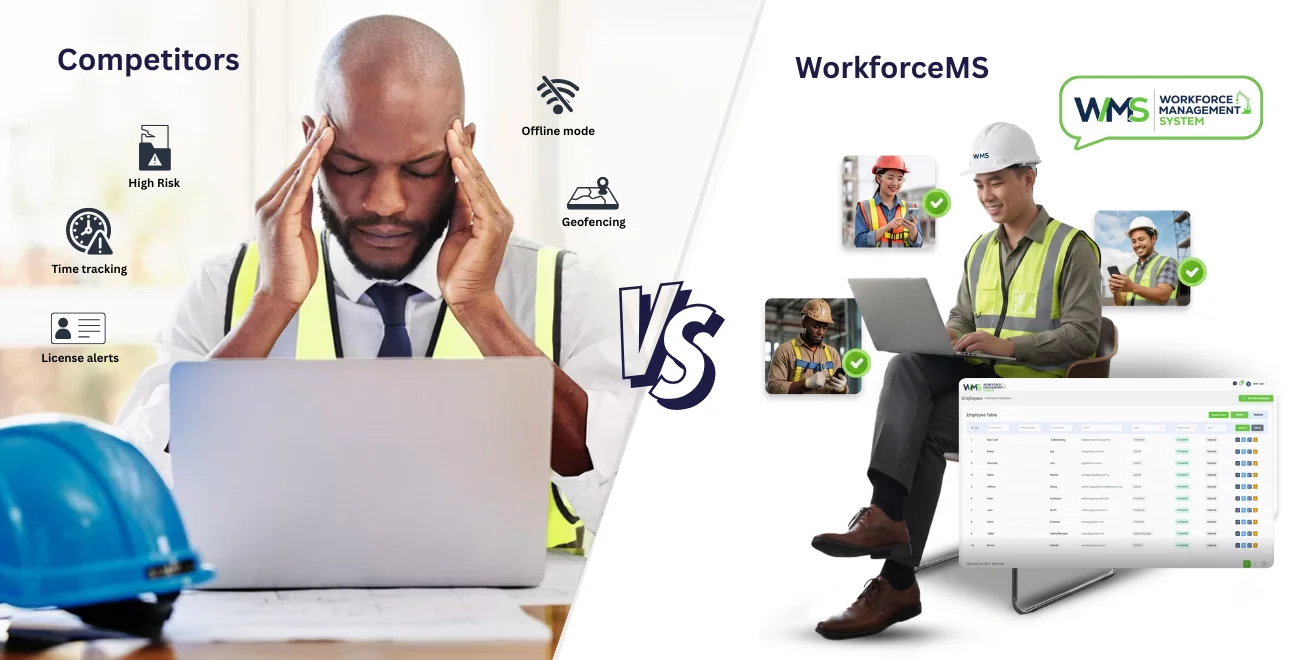
WorkforceMS outperforms competitors in construction specific compliance: pre built award interpretation for CFMEU/ETU/CEPU, trade licence expiry automation, and offline mobile access for remote sites.
While Employment Hero suits micro businesses and ELMO serves large enterprises, WorkforceMS is the only platform purpose built for mid market construction groups managing multi site, multi award workforces with complex EBAs.
Construction Compliance Features Compared
| Feature | WorkforceMS | Employment Hero | ELMO | foundU | Worknice |
|---|---|---|---|---|---|
| CFMEU/ETU/CEPU pre built | Yes | Limited | Configurable | Yes | Via integration |
| White Card tracking | Automated | No | Manual | Manual | Automated |
| High Risk Work Licence alerts | 30/60/90 day | No | Manual | Manual | Automated |
| SWMS document storage | Yes | Basic | Yes | No | Basic |
| STP Phase 2 compliant | Yes | Yes | Yes | Yes | Yes |
| Psychosocial hazard tracking | Yes | Basic | Yes | No | Basic |
Mobile and Field Functionality Compared
| Feature | WorkforceMS | Employment Hero | ELMO | foundU | Connecteam |
|---|---|---|---|---|---|
| Offline mode | Yes | Limited | No | Limited | Limited |
| GPS + photo clock in | Yes | Yes | Basic | Yes | Yes |
| iBeacon verification | Yes | No | No | No | No |
| Geofencing | Yes | Yes | Basic | Yes | Yes |
| Site based roster view | Yes | Basic | Basic | Yes | Yes |
Pricing and ROI for Construction Businesses
| Platform | Starting Price | Best For | Typical ROI Timeline |
|---|---|---|---|
| WorkforceMS | Custom quote | 50 to 5,000 employees, multi site | 6 to 12 months |
| Employment Hero | $6/employee/month | Micro/small construction | 3 to 6 months |
| ELMO | ~$35/employee/month | 200 to 5,000 employees | 12 to 18 months |
| foundU | ~$13/employee/month | Labour hire, shift based | 6 to 12 months |
| Worknice | ~$12 to $14/employee/month | Multi entity groups | 6 to 12 months |
| Humanforce | Custom quote | Shift based operations | 6 to 12 months |
| Connecteam | Free (up to 10 users) | Small crews, startups | Immediate |
5 Critical Mistakes to Avoid When Buying HR Software for Construction
The five costliest mistakes are: (1) choosing software that can't interpret your EBA, (2) ignoring mobile access for site workers, (3) underestimating implementation and crew adoption, (4) buying on price alone without compliance risk analysis, and (5) failing to verify STP Phase 2 and Fair Work compliance. Each mistake can cost tens of thousands in back pay claims, audit penalties, or failed software migrations.
1: Choosing a Platform That Can't Handle Australian Awards and EBAs
Since 1 January 2025, intentional wage underpayment is a criminal offence in Australia. A platform that miscalculates CFMEU Saturday penalties or ETU height allowances exposes you to prosecution, not just back pay.
The fix: Before signing, send the vendor your most complex EBA and ask them to demonstrate live calculation. If they need a "consultant engagement" to configure it, walk away.
2: Ignoring Mobile Accessibility for Site Workers
A beautiful desktop dashboard is useless if your site supervisor can't clock in workers from a muddy excavation with no mobile coverage. Test the app in real conditions, not on office WiFi.
3: Underestimating Implementation and Change Management
Software fails at the crew level, not the office. If your workers and supervisors don't adopt the mobile app, you're paying for a database no one uses. Plan for site level training, not just admin onboarding.
4: Buying on Price Alone Without Considering Compliance Risk
A $5/employee/month platform that miscalculates awards will cost you more in Fair Work penalties than a $15 platform that gets it right. Compliance is insurance, not overhead.
5: Failing to Verify STP Phase 2 and Fair Work Compliance
Any HR software you choose must be ATO compliant for STP Phase 2, reporting income types, allowances, and tax details correctly. Verify this independently. don't trust vendor claims alone.
Essential Tools and Integrations for Construction HR Software
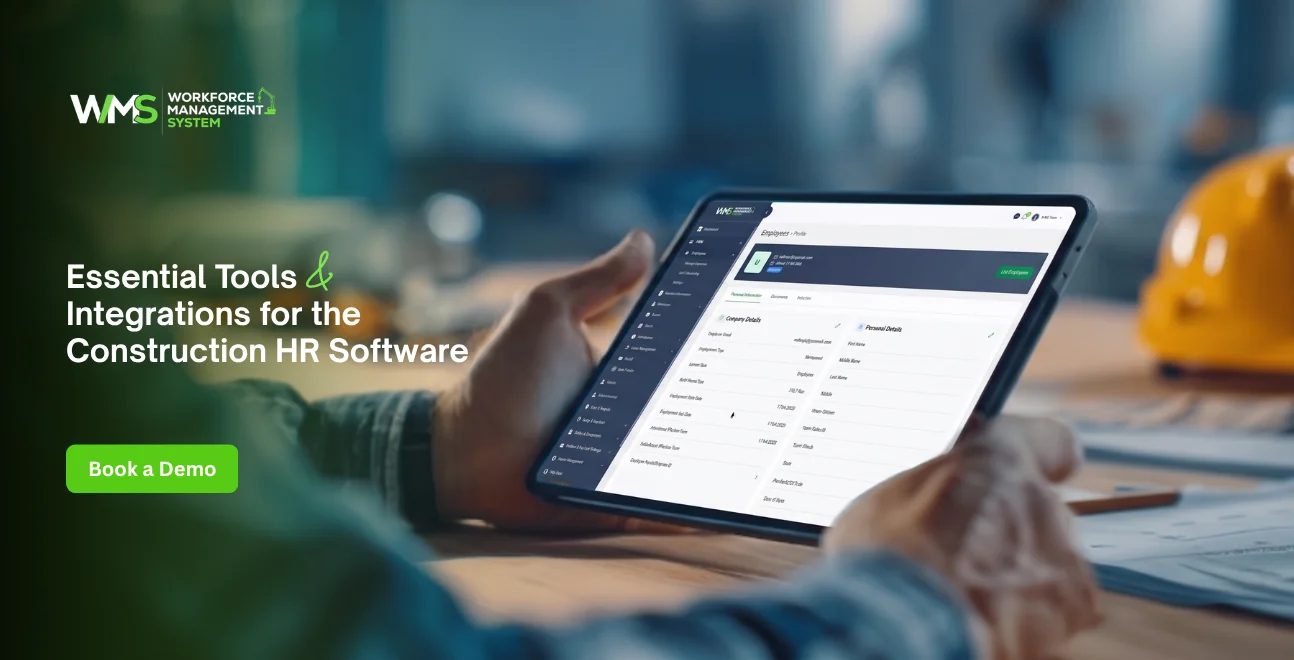
The most critical integrations for construction HR software are payroll systems (Xero, MYOB, KeyPay, Employment Hero Payroll), project management platforms (Procore, Buildlogic, Nexvia), and safety compliance tools (White Card registries, SWMS databases). These integrations eliminate double handling, ensure data flows from site to office without manual re entry, and keep compliance documentation centralised and audit ready.
Payroll Integrations: Xero, MYOB, KeyPay, and Employment Hero Payroll
Most Australian construction businesses already run proven payroll. The right HRIS syncs employee master data, leave balances, and approved timesheets into these systems, so maintaining payroll as the source of truth for STP lodgement while the HRIS handles people management.
Internal link opportunity: Link "Xero integration" to a WorkforceMS + Xero integration guide.
Project Management Integrations: Procore, Buildlogic, and Nexvia
When HR data connects to project management, labour costs become visible in real time. WorkforceMS integrations allow project managers to see actual hours against budgeted hours, flag cost overruns before they escalate, and link timesheet data directly to progress claims.
Safety and Compliance Tools: White Card Tracking and SWMS Management
Construction specific HR software should integrate with or replace standalone safety tools. White Card verification, High Risk Work Licence registries, and SWMS document libraries belong in the same system as onboarding and payroll, not scattered across spreadsheets and filing cabinets.
Real World Example: How a 200 Person Construction Group Streamlined HR
A 200 person civil construction group operating across Queensland and NSW replaced spreadsheets and a generic HR platform with WorkforceMS. The result: 90% reduction in payroll admin time, zero licence expiry lapses in 12 months, and full STP Phase 2 compliance. Site supervisors now roster from mobile apps, workers clock in with GPS verification, and the finance team exports timesheets directly to Xero.
The Challenge: Multi Site Payroll Errors and Licence Lapses
Before switching, the group used a generic HR platform plus Excel for rostering. Payroll errors were common: penalty rates miscalculated, shift loadings missed, and two High Risk Work Licence lapses caused project delays. Compliance was reactive, not preventive.
The Solution: Implementing Construction Specific HR Software
WorkforceMS was configured with their CFMEU and ETU EBAs pre loaded. Site supervisors received mobile training in 30 minutes. Within 60 days, all sites were running digital rosters, GPS clock ins, and automated licence alerts. The finance team eliminated manual timesheet entry.
Expert Insights: 2026 Trends Shaping Construction HR Technology
Three trends define 2026: AI powered award interpretation that predicts compliance risks before they occur, mobile first workforce management with offline functionality for remote sites, and HR BIM integration that connects people data to project digital twins. Construction businesses adopting these trends now will outpace competitors still running spreadsheets.
AI Powered Award Interpretation and Predictive Compliance
AI is moving beyond chatbots into core compliance. Advanced platforms now flag potential award breaches before payroll runs, identifying misclassified allowances, missed penalty rates, and incorrect super calculations in real time. This shifts compliance from reactive audit defence to proactive risk prevention.
The Rise of Mobile First Workforce Management for Remote Sites
With Australia's construction pipeline exceeding $450 billion and projects in remote locations from Pilbara to Western Sydney, mobile workforce management is no longer optional. 2026 platforms must work offline, sync via satellite, and operate on rugged devices, not just smartphones.
Integration of HR Data With Building Information Modelling (BIM)
The most forward thinking construction firms are connecting HR data to BIM workflows. When a project model shows 50 electricians needed in Week 12, the HR system should already have qualified, licenced, available workers rostered. This convergence of people data and project data is the next competitive frontier.
Key Takeaways: Choosing the Right HR Software for Your Construction Team
Start with compliance: verify award interpretation, STP Phase 2, and licence tracking. Prioritise mobile access for site based teams. Test integrations with your existing payroll and project tools. Request a demo with your actual EBA loaded. And remember: the cheapest platform that miscalculates penalties will cost more than the right platform that gets them right.
Start With Compliance, Then Evaluate Features
Award interpretation and EBA compliance are non negotiable. Every other feature is secondary if the platform can't pay your workers correctly.
Prioritise Mobile Access for Site Based Teams
If the app doesn't work on a remote site with poor coverage, your supervisors will revert to paper, defeating the purpose.
Request a Demo With Your Actual Award or EBA Loaded
Don't accept generic demos. Send your most complex EBA to the vendor and watch them calculate a penalty rate live. If they hesitate, so should you.
Ready to Transform Your Construction HR? Start Your Free WorkforceMS Demo
WorkforceMS is the only HR hiring software built specifically for Australian construction teams. See your CFMEU, ETU, or CEPU award running live in 60 seconds. Book a free demo today and discover how multi site rostering, automated compliance, and offline mobile access can reduce your administrative time by up to 90%.
Optimise your operations with WMS
Streamline scheduling, compliance, and workforce management in one platform.
Frequently Asked Questions About HR Software for Australian Construction
The best HR software for construction is WorkforceMS, purpose built for multi site, multi award construction teams with automated compliance, offline mobile access, and trade licence tracking. For smaller crews, Connecteam offers a free plan, while Employment Hero suits micro businesses with simple award coverage.
Prices range from free (Connecteam, up to 10 users) to $6 to $35 per employee per month for paid platforms. Enterprise custom quotes apply for large groups. Most construction businesses recover costs within 6 to 12 months through reduced payroll errors and admin time.
Yes. STP Phase 2 is mandatory for all employers. Any HR software you choose must be ATO compliant, correctly reporting income types, allowances, and tax details. Verify compliance before purchasing. non compliance risks ATO penalties.
Yes. Platforms like WorkforceMS and Worknice support multiple ABNs in a single account. Each employee is assigned to a specific entity for payroll routing, while group level reporting and compliance dashboards remain unified.
Construction HR software records each licence as a structured record: type, class, issuing state, expiry date, and scanned copy. The system runs scheduled checks and triggers alerts to the worker, manager, and compliance team 30 to 90 days before expiry.
An HRIS focuses on employee data, records, and compliance. Workforce Management System handles rostering, time tracking, and award interpretation. Construction businesses often need both, or a platform like WorkforceMS that combines both functions.
Most credible platforms integrate with existing payroll (Xero, MYOB, KeyPay) rather than replacing it. This avoids risky migration projects. Some all in one platforms bundle payroll natively, which is useful if you don't already have a system.
Implementation typically takes 2 to 8 weeks depending on complexity. Construction specific platforms like WorkforceMS are faster because awards and EBAs come pre configured. Generic platforms may require 3 to 6 months of custom configuration.
Related Articles
Explore more insights on workforce management, compliance, and operations.

Security Operations and Monitoring Workforce Planning
Plan guard rosters, track live attendance and cover every shift with WorkforceMS. Strengthen security operations and monitoring with smarter workforce planning.

Muhammad Asim
09 Oct 2026

Telehealth and Digital Healthcare Scheduling WMS
Simplify telehealth and digital healthcare scheduling with WorkforceMS. Manage rosters, remote clock-ins and compliance records in one easy-to-use platform.
Muhammad Asim
08 Oct 2026

Healthcare Workforce Management for Aged Care
Simplify rostering, credential tracking and payroll for aged care healthcare teams. Discover how WorkforceMS gives your carers more time with residents.
Muhammad Asim
05 Oct 2026
Ready to secure your operations?
