KeyPay Employment Hero for Construction Businesses
Discover how KeyPay Employment Hero supports construction payroll, HR, and site teams, and where a construction-focused WMS offers more.

Share this article
Streamline your frontline operations
See how WMS simplifies scheduling, compliance and workforce management in one powerful platform.
Introduction
Controlling construction employees is seldom simple. With ever-changing locations, contractors and compliance regulations, payroll and workforce management can become a burden. In this article, we will explore how KeyPay Employment Hero can be integrated into construction industry workflows and how a dedicated can provide more built for purpose support.
KeyPay Employment Hero for Construction Businesses
Many Australian businesses, including those in the construction sector, are using a combination of payroll and HR software called KeyPay Employment Hero. It integrates payroll processing, employee records, and some of the workforce tools into a single system.
A Platform Built for General Business Use
Employment Hero was not created for the construction industry, but for a wide variety of industries. Many of its features are good for office-dwelling teams but must be customised for site-dwelling teams, varying shifts, and interpretation of awards in the construction industry.
Why Construction Businesses Still Choose It
While Enterprise is not designed for construction, many construction companies choose it because of its ease of implementation, familiarity and robust compliance with payroll. It is a good place to begin, specifically if your company is looking to depart with manual payroll.
Where It Fits Into Construction Operations
To many construction companies, KeyPay Employment Hero is the main solution for payroll and basic HR tasks, and they are using other solutions or paper-based methods to manage their scheduling and work site tracking as well as the compliance documentation pertaining to their industry.
Common Pain Points Businesses Report
Construction users' feedback generally focuses on increasing the amount of manual effort required to bridge gaps between payroll data and construction site operations. Project cost tracking and visibility of crews in real time are often cited as workarounds that need to be improved.
Construction Businesses Can Manage With Employment Hero
While not everything applies to onsite construction environments, Employment Hero provides a reasonable suite of HR/payroll capabilities for construction businesses to use.
Core HR and Payroll Functions
The platform not only manages employee onboarding, leave requests, payslips, and superannuation reporting, but it also helps streamline the whole process. There's a set of essential tasks that should happen in every organisation to keep things running smoothly, whether the business is big or small, and regardless of how many workers are involved.
Document and Compliance Storage
Employment Hero also enables businesses to keep employee records like contracts, qualifications and certifications in one place. This allows for overall record-keeping but is not a guarantee of construction-specific qualifications such as white cards.
Limitations for Site-Specific Needs
It isn't particularly suited to job costing by site, to keeping an eye on the movements of crews in real time or to interfacing with compliance issues unique to the construction industry, such as white card verification and site inductions.
Managing Employees, Contractors and Site-Based Teams
Workforces in the construction industry are seldom composed of a single employment. Most sites employ permanent staff, casual labour and subcontractors who are paid differently and have various compliance requirements.
Handling Mixed Employment Arrangements
KeyPay Employment Hero can handle regular employee payroll and some contractor payments, but managing the difference between award-covered employees and independent contractors at various locations can be a manual process.
Site-Based Team Visibility
It can become more difficult to keep track of who is working where, and for how long, when multiple sites are in operation simultaneously and without being configured into a specific HR system.
Compliance Considerations for Contractors
Construction arrangements pose unique compliance risks, such as the sham contracting rules and insurance requirements. These risks are not likely to be highlighted automatically in general payroll software and are likely to be left to the business to detect.
Onboarding Workers Across Multiple Sites
One of the common challenges in construction is to enable a new worker to join a different site with minimal delay, but still complete their induction and compliance checks. Employment Hero can be used for digital induction, although site-specific induction steps would need to be handled separately.
KeyPay Employment Hero Handles Workforce Time Tracking
Owing to the pay rates, allowances and overtime that may be based on exactly when and where work was done, time tracking is a key issue in construction payroll accuracy.
Clock In and Clock Out Functionality
The Employment Hero app has the most basic time and attendance tracking features, which include the ability to clock in and out. This is fairly practical if the worker is stationed at a single job site but is not appropriate if the worker changes job sites within a week.
Award Interpretation Challenges
The Award makes special rules on travel time, site allowances and overtime limits. Employment Hero's award interpretation engine handles general cases well, but may require manual adjustments for the conditions of pay in the construction industry.
GPS and Location-Based Tracking Limits
GPS verification can be used for certain construction companies to ensure that employees were on location when they clocked in. The features of Employment Hero's location tracking are less extensive than those of specific construction WMS systems.
Gaps in Site-Level Reporting
This may be more difficult to access when businesses are looking for specific details on hours worked per site, per project, or cost code until they build custom reports or export to another tool.
Using KeyPay Employment Hero as Payroll Software for Construction Teams
KeyPay Employment Hero is a payroll software that does just what every construction firm requires to do, correctly, each pay cycle.
Accurate Pay Runs and Compliance
The platform streamlines superannuation calculations, PAYG withholding and Single Touch Payroll reporting, easing the administrative burden of ensuring compliance with Australian tax requirements.
Payslip and Reporting Features
The platform provides employees with digital payslips and basic reporting, promoting transparency and minimising payroll administrators' queries.
Handling Allowances and Site Rates
Construction pay may include site allowances, travel loadings and tool allowances. These can be set up in Employment Hero, but it will be important to set up each location's rate correctly.
Where Construction Businesses Still Need More
Even with strong payroll fundamentals, construction businesses with multiple cost centres, retention payments, or progress claims may require extra tools to tie payroll data to project financials.
Free Online Payroll System Support for Growing Construction Teams
While free online payroll can be attractive for small construction companies keeping a close eye on budgets, it can have its drawbacks as companies expand.
Suitable for Very Small Teams
If your business has a few employees, simple pay requirements, and one location, a free online payroll system can be sufficient.
Where Free Tools Fall Short
Free systems don't automatically scale to accommodate larger crews and more complicated awards, and they don't provide the same level of compliance protection and support that can be found in other systems as size and complexity increase.
Hidden Costs of Staying Free Too Long
Businesses that wait to upgrade from a free system may incur unseen expenses down the road that can involve lost time to manually correct data, as well as the potential for compliance fines from failure to meet reporting requirements.
Weighing Cost Against Risk
Payroll mistakes can pose serious financial and compliance problems for construction companies. It may be more expensive to make the corrections or deal with compliance problems down the road than to pay the upfront costs of a free system.
Using Auto Payroll to Simplify Construction Pay Administration
The goals of auto payroll systems are to lower the amount of manual data entry and to shorten payroll cycles, especially when your payroll team is spread out across multiple projects.
How Auto Payroll Reduces Manual Work
Auto payroll eliminates repetitive processes, including calculating standard hours, applying default pay rates and creating pay runs on a predetermined schedule, which leaves more time for exception handling.
Best Suited to Predictable Pay Structures
This automation is best suited for a situation where the terms of pay are uniform. Even when payroll is calculated on construction projects, with varying site allowances and overtime, the manual review of payroll can still be needed before the end of each pay run.
Reducing Errors Through Automation
With proper setup, auto payroll can help eliminate the repetitive manual work and human error in timekeeping, such as with standard hours and consistent allowances, especially with a consistent staff.
Balancing Automation With Oversight
Despite the auto payroll feature, construction companies can still save time with a final review process to ensure that any irregularities in payroll are only considered site-specific rather than the automated rules.
Employment Hero for Managing Multiple Construction Sites
Multiple construction job sites mean more headaches than general HR or payroll systems can cope with.
Centralised Record Keeping
Employee records are centralised with Employment Hero, allowing businesses to have a single source of truth for HR data everywhere they work and across all projects.
Site-Level Reporting Gaps
But for each site, it is usually hand-filtered or exported to Excel to further analyse labour costs, hours and compliance documents.
Coordinating Site Supervisors and Head Office
In many cases, multi-site construction firms require supervisors to make immediate decisions about their workforce, such as scheduling and hiring, at the site, and head office has responsibility for ensuring compliance with payroll and the applicable rules. This is a division of responsibilities that is more difficult to handle in a platform that doesn't have site-based permission systems.
Scaling Challenges as Sites Increase
The more active sites, the more administration is required to keep records, allowances and compliance documents in sync. Often, this scaling is more difficult without site-specific workforce tools within the business.
KeyPay Employment Hero vs a Construction-Focused WMS
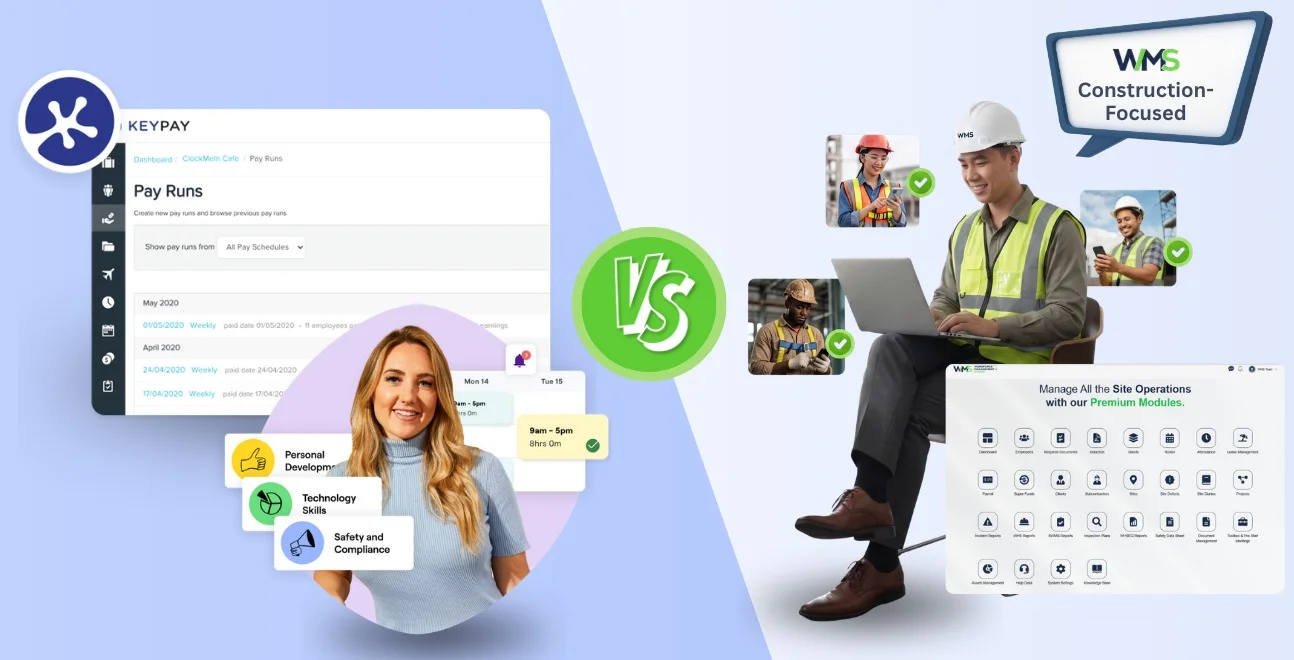
When it comes to HR and payroll, the general platform is best for most industries, while the construction-focused solution is best for construction.
| Feature | KeyPay Employment Hero | Construction-Focused WMS |
|---|---|---|
| Payroll and STP compliance | Strong | Strong (often integrated) |
| Site-based scheduling | Limited | Purpose-built |
| Job costing by site or project | Manual workaround | Native functionality |
| Contractor and compliance tracking | Basic | Construction-specific |
| Multi-site visibility | Limited | Designed for it |
Interpreting the Comparison
As you can see in the table, KeyPay Employment Hero is performing fine when it comes to payroll compliance, but when it comes to scheduling, job costing, and compliance on site, a construction-focused WMS will typically outperform.
Why the Difference Matters Long-Term
When companies opt for a platform designed with construction workflows from the ground up, it becomes less likely that an expensive construction system change or workaround tools will be necessary.
Choosing the Right Workforce Management Solution for Construction
The right system is what works for the business size, number of sites used and the functional requirements the construction truly requires on a day-to-day basis.
| Business Need | Better Suited Option |
|---|---|
| Simple payroll for a small, single-site team | KeyPay Employment Hero |
| Multiple active sites with job costing needs | Construction-Focused WMS |
| Heavy contractor and compliance management | Construction-Focused WMS |
| Straightforward HR administration only | KeyPay Employment Hero |
Matching the System to Business Complexity
Employment Hero could be adequate for smaller construction businesses that have a straightforward payroll system. For larger and multi-site companies, a construction workflow-centric platform is more beneficial.
Questions to Ask Before Deciding
Before using a platform, businesses need to think about the number of sites they operate, the rate at which they want to expand and the amount of time they are spending to work around software restrictions.
Long-Term Scalability Considerations
The expense of working around some of the limitations of the general-purpose platforms can end up being more than is worth the time and effort of implementing a platform designed specifically for the construction industry.
Optimise your operations with WMS
Streamline scheduling, compliance, and workforce management in one platform.
FAQ: KeyPay Employment Hero for Construction
Construction businesses will use KeyPay as the payroll engine, which will manage pay runs, STP reporting, and superannuation.
It does a good job of covering the fundamental payroll compliance aspects but is often not configured in a dedicated WMS for construction site allowances and job costing.
It handles onboarding, leave, document management and employee record management, but leaves compliance with construction-specific requirements for WMS tracking to another system.
Yes, construction workers can clock in, access payslips, and track leave in the app, but GPS site verification isn't as extensive as a WMS.
It is a way of consolidating the data between locations, but sometimes it will be necessary to report manually, as in a WMS, the costs and hours of construction labour by project.
A dedicated WMS is more likely to provide robust job costing and compliance capabilities for construction companies with multiple locations and contractors.
Related Articles
Explore more insights on workforce management, compliance, and operations.

Security Operations and Monitoring Workforce Planning
Plan guard rosters, track live attendance and cover every shift with WorkforceMS. Strengthen security operations and monitoring with smarter workforce planning.

Muhammad Asim
09 Oct 2026

Telehealth and Digital Healthcare Scheduling WMS
Simplify telehealth and digital healthcare scheduling with WorkforceMS. Manage rosters, remote clock-ins and compliance records in one easy-to-use platform.
Muhammad Asim
08 Oct 2026

Healthcare Workforce Management for Aged Care
Simplify rostering, credential tracking and payroll for aged care healthcare teams. Discover how WorkforceMS gives your carers more time with residents.
Muhammad Asim
05 Oct 2026
Ready to secure your operations?
